

Why Your Skin Suddenly Changed After 45 (And What Actually Helps)
One morning, you look in the mirror and something feels different.
Your skin seems drier than it did a few months ago. Fine lines that once appeared only when you smiled now linger throughout the day. The moisturizer you've loved for years now seems to disappear before you've even put the lid back on the jar. Products that never caused irritation now leave your skin feeling tight, sensitive, or unexpectedly reactive.
Something I heard clients say quite often was, "I swear my skin changed overnight."
If you've ever found yourself thinking the same thing, you're certainly not alone.
These changes typically begin during the forties or fifties. They arrive so gradually that it's difficult to recognize what's happening until your skincare routine no longer feels familiar. It's easy to assume your favorite moisturizer stopped working, a cleanser changed its formula, or your skin simply decided to become "difficult."
I smile when clients blame the cleanser that “suddenly makes their skin feel dry”. Most of the time, the cleanser formula hadn't changed. Their skin had and that realization came as a tremendous relief.
Menopause doesn't simply make skin "older." It changes the way your skin functions. Those changes happen beneath the surface long before many of them become visible in the mirror.
I've seen these changes countless times throughout my years as a licensed esthetician. Women would arrive convinced they had chosen the wrong products or forgotten how to care for their skin. In nearly every case, they weren't doing anything wrong. Their skin had entered a new chapter, and it was asking for something different.
Those conversations stayed with me. They reminded me how easy it is to believe you've somehow failed your skin when you're actually experiencing a completely normal transition.
I wrote this guide to explain what's happening and to make those changes feel a little less confusing. Inside, you'll find practical explanations, realistic expectations, and skincare recommendations designed to help your skin feel healthier, stronger, and more comfortable throughout this stage of life.
And if you've ever looked in the mirror and wondered how your skin could feel dry, sensitive, and somehow still break out at the same time, welcome to menopause. It rarely asks permission before changing the rules.
Once you understand those new rules, caring for your skin becomes much less frustrating. Before we talk about ingredients, routines, and treatments, let's begin with what's actually happening inside your skin. That foundation makes every recommendation that follows far easier to understand.
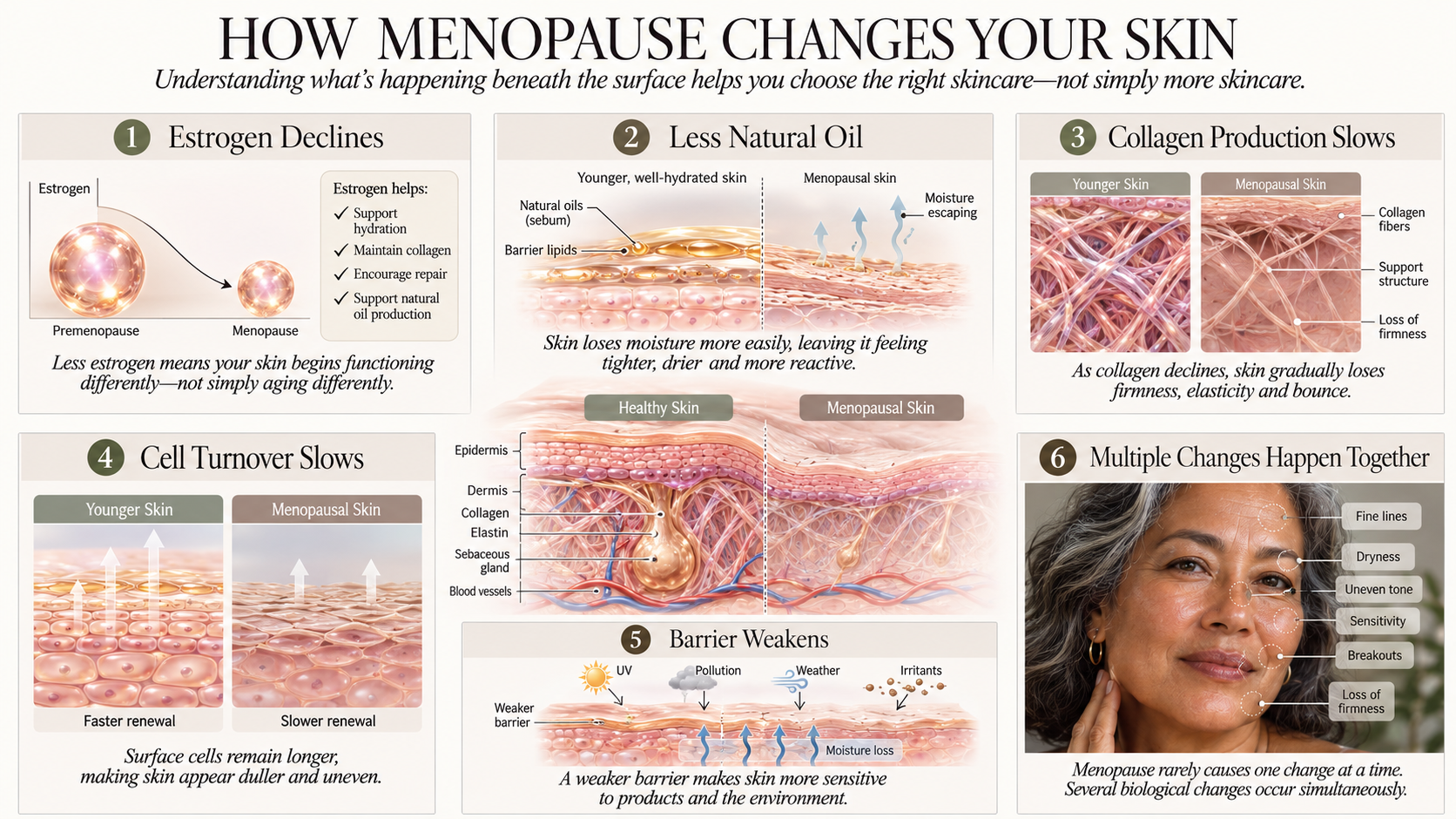
Healthy skin is constantly rebuilding itself. Millions of skin cells are replaced, collagen is rebuilt, natural oils help seal in moisture, and the skin barrier works continuously to protect you from the outside world. Most of us never think about those processes because they happen automatically.
A question I heard repeatedly in the treatment room was, "Why is this happening now?"
The answer was estrogen.
Most of us think of estrogen as a reproductive hormone, but it also plays an important role in the skin. Throughout much of adult life, it helps maintain hydration, supports collagen production, encourages natural oil production, and contributes to the skin's ability to repair everyday damage. Those ongoing processes help skin remain resilient, comfortable, and better equipped to protect itself.
As estrogen gradually declines during perimenopause and menopause, those systems begin adjusting to a new normal. The changes unfold over time. Then one day, you realize your skin no longer behaves the way it always has.
Skin becomes drier because it produces fewer of the natural oils that help prevent moisture from escaping. Collagen production slows, so skin loses some of the firmness and bounce it once had. Cell turnover becomes less efficient, leaving the complexion looking dull or uneven for longer between renewal cycles. Even small irritations can become more noticeable because the skin barrier is no longer as resilient as it once was.
Maybe you’ve noticed that these changes rarely arrive one at a time. Dryness may appear alongside increased sensitivity. Skin that feels tight after cleansing can still develop occasional breakouts and fine lines become more noticeable just as makeup begins settling differently than it used to.
I've had clients look at me with complete disbelief and say, "How can my skin be this dry and still break out?"
It's a fair question.
When the skin barrier becomes compromised, it struggles to hold onto moisture while becoming more reactive to ingredients, weather, stress, and everyday environmental changes. Several biological changes are unfolding at the same time, which is why menopausal skin feels unpredictable.
No two women experience menopause exactly the same way, but certain patterns appear repeatedly. Some changes develop over several years, while others seem to arrive all at once. You may recognize every one of these changes, or only a handful.
One thing I always encourage women to remember is that none of these changes means your skin is "failing." It's responding to a completely different hormonal environment than it had ten or twenty years ago.
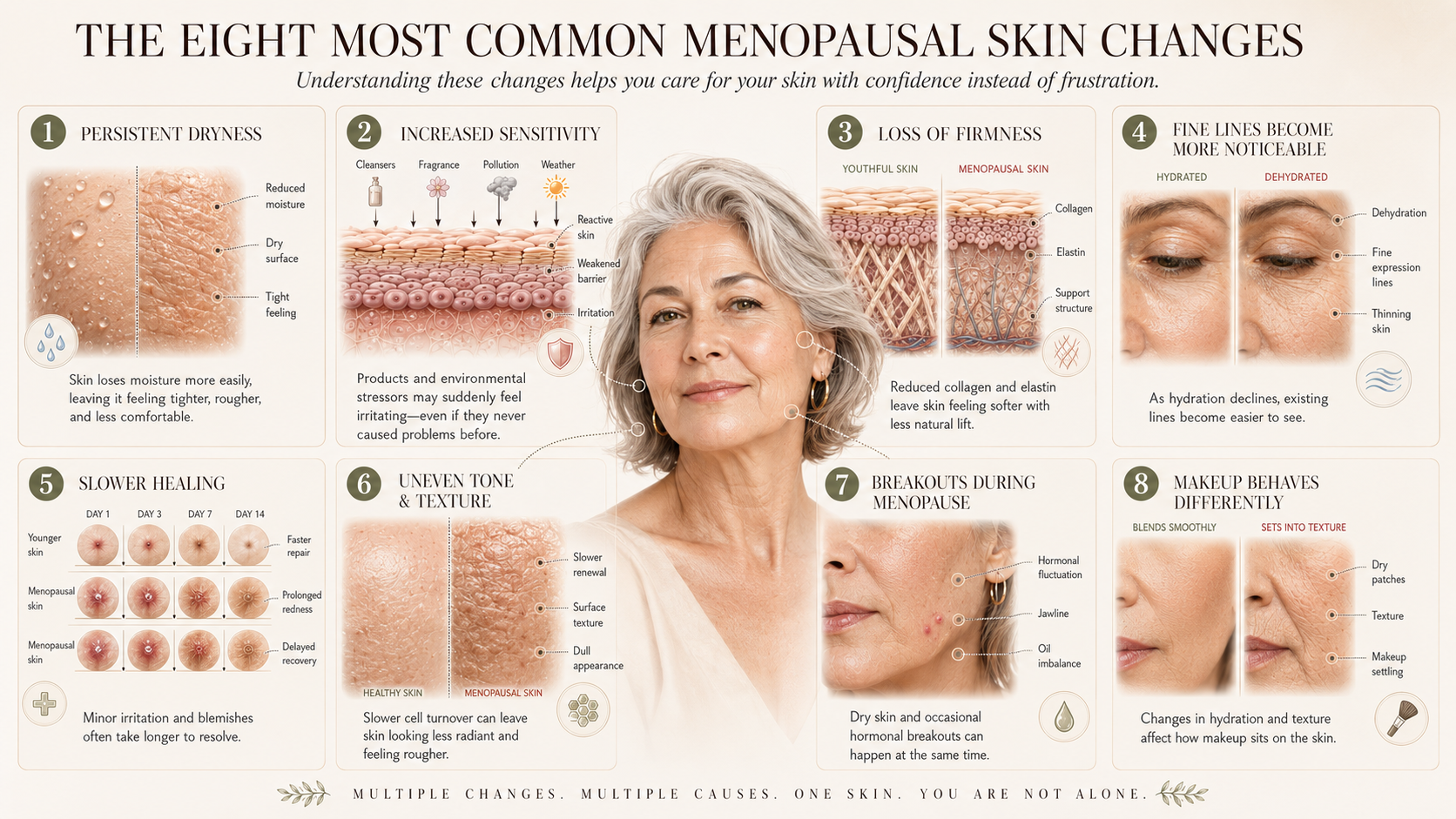
1. Persistent Dryness
For many women, dryness is the first noticeable change.
Skin may begin feeling tight after cleansing, rough around the cheeks, or uncomfortable by the end of the day even though you've applied moisturizer. You may find yourself reaching for richer, more emollient creams during seasons when you never needed them before.
Clients would tell me, "I feel like my skin drinks moisturizer and immediately wants more."
That description is surprisingly accurate. As natural oil production slows and the skin barrier becomes less efficient, moisture escapes more easily. It's usually the first time women begin reapplying moisturizer during the day instead of only morning and evening.
2. Increased Sensitivity
Products you've used happily for years may start to sting, burn, or leave behind unexpected redness.
When the skin barrier becomes more fragile, it reacts more easily to everyday products and environmental stressors that it once tolerated without complaint.
One week your routine feels perfectly comfortable. The next, your favorite vitamin C serum seems determined to start an argument.
3. Loss of Firmness and Elasticity
One of the most common questions I hear is, "When did everything start feeling... softer?"
It's a wonderfully honest way to describe what many women notice.
As collagen and elastin production decline, skin doesn't spring back with quite the same resilience. The jawline may appear less defined, cheeks can lose some of their natural fullness, and fine lines become easier to see because the skin isn't as well supported from within.
These changes happen over time, which is why many women don't notice them until they compare a recent photograph with one taken several years earlier.
4. Fine Lines That Suddenly Seem More Noticeable
It can feel as though new wrinkles appeared overnight.
Quite often, those lines were already beginning to form. What changed was the skin surrounding them.
As hydration decreases, the surface of the skin reflects light differently. Lines that once appeared only during facial expression begin remaining visible for longer because the surrounding skin has become thinner and less plump.
5. Slower Healing
A small blemish that once disappeared within a few days may now seem determined to linger for weeks.
Minor irritation, post-inflammatory discoloration, and even small scratches take longer to resolve because the skin's natural repair processes have slowed.
Patience becomes a surprisingly valuable skincare ingredient during menopause.
6. Uneven Tone and Texture
A complexion that once looked bright and rested may begin looking tired.
Slower cell turnover allows dull surface cells to remain longer before being naturally shed. Skin may lose some of its brightness, feel rougher to the touch, or develop patches that reflect light unevenly.
Fortunately, this is one of the changes that respond beautifully to thoughtful skincare.
7. Breakouts That Make Absolutely No Sense
Few things are more confusing than developing acne at the same stage of life when your skin also feels dry.
I've seen the puzzled expressions more times than I can count.
Hormonal fluctuations don't disappear simply because oil production decreases. Skin can become drier overall while still experiencing occasional hormonal breakouts, particularly around the chin and jawline.
Yes, menopause can be confusing (and annoying) enough to give you both problems at the same time.
8. Makeup Doesn't Wear the Way It Used To
Sometimes women tell me they think they've lost their ability to apply makeup correctly.
When skin becomes drier and texture changes, foundation, concealer, and powder behave differently. Products that once blended effortlessly may settle into fine lines or cling to patches of dry skin that weren't there before.
The solution isn't buying different makeup first. It's giving the skin underneath the support it now needs.
As you read through these changes, you may have recognized several that sound remarkably familiar. That's because menopause rarely affects just one aspect of your skin. You may experience a combination of changes that influence one another over time.
The good news is that each of these concerns points toward a practical solution. Each of these concerns has a practical solution, and we'll work through them one by one.
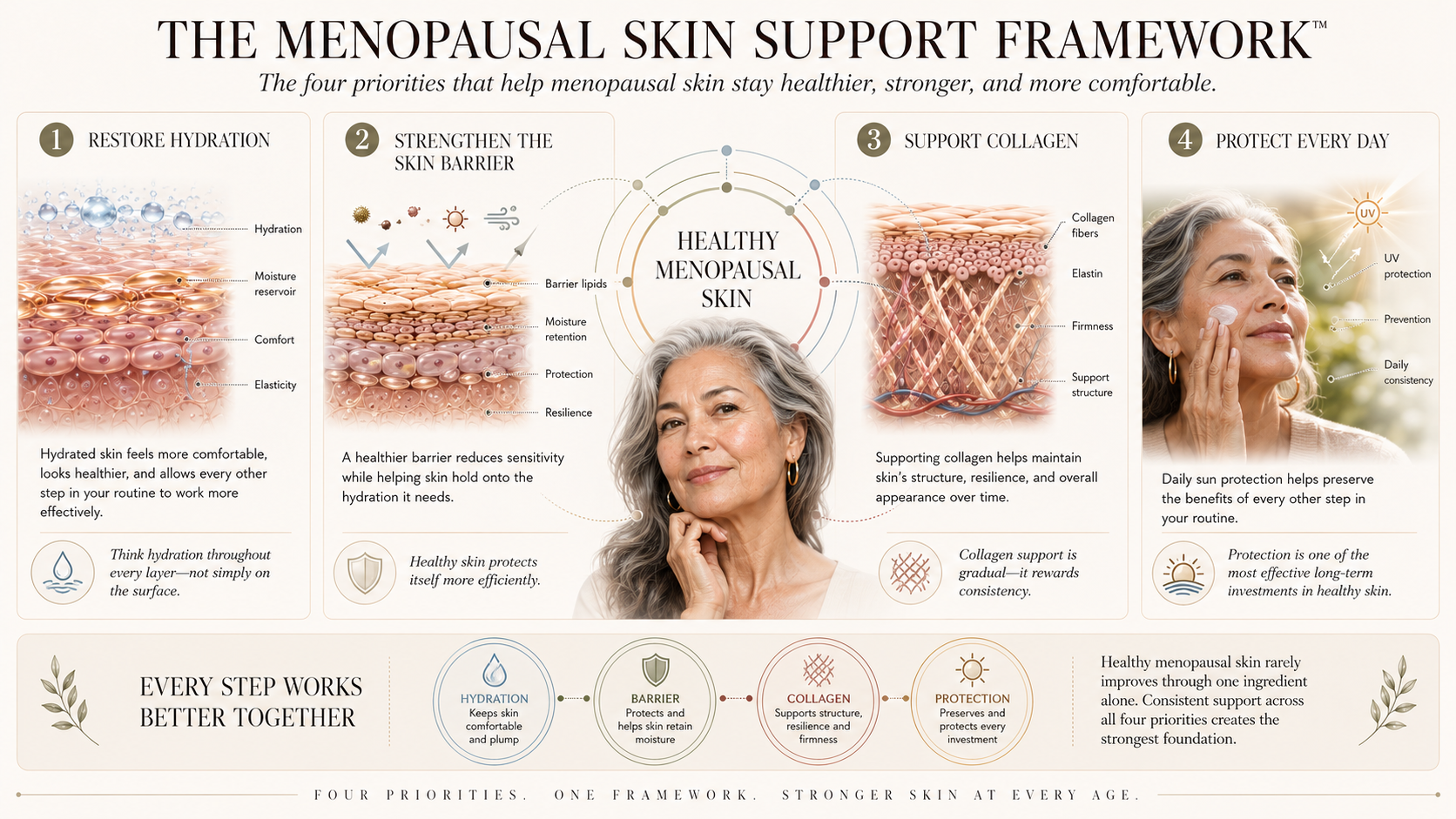
As your skin changes during menopause, your skincare routine has a different job than it did ten or twenty years ago. Cleansing, moisturizing, and protecting your skin are still the foundation, but the goal shifts toward supporting processes that have naturally slowed over time.
Every recommendation in this guide comes back to four priorities.
Restore Moisture
Dryness is typically the first noticeable sign that your skin's needs are changing. Hydration becomes increasingly important because skin loses moisture more easily than it once did. A well-formulated moisturizer helps replenish water, soften roughness, and improve comfort throughout the day. Richer emollients that once felt unnecessary become welcome companions, especially during colder months or in dry climates.
Comfort is more than a cosmetic benefit. Well-hydrated skin looks smoother, feels calmer, and provides a healthier surface for makeup application.
Protect the Skin Barrier
Think of the skin barrier as your body's first line of defense. It helps keep moisture inside while reducing the effects of everyday stressors, including UV exposure, weather, allergies, medications, hormonal changes, and other environmental factors. As the barrier becomes less efficient, skin reacts more easily to products that never caused concern before.
Supporting the barrier doesn't require an elaborate routine. Gentle cleansing, the right serum, a calming moisturizer, daily sunscreen, and avoiding unnecessary irritation accomplish far more than adding multiple new products all at once.
Encourage Collagen Production
Collagen declines naturally with age, and menopause accelerates that process.
No skincare product can replace the collagen your body once produced in earlier years, but certain ingredients can encourage healthier collagen production while helping protect the collagen you already have. Daily sunscreen, vitamin C, retinoids, and peptide-based products all contribute in different ways, which we'll discuss later in this guide.
Improvements usually appear over months of consistent care, making patience one of the most valuable parts of any effective routine.
Treat Skin Gently
Dry, reactive skin makes us want to do more. Extra exfoliation, stronger acids, frequent product changes, and aggressive cleansing usually create additional irritation instead of improving the situation. Skin responds much better to consistency than constant experimentation.
A calm, well-supported complexion provides a stronger foundation for every other step in your routine.
These four priorities provide a simple way to evaluate every skincare product you use. Every cleanser, serum, moisturizer, and treatment has a purpose. The key is choosing products that support what your skin needs today.
Understanding those priorities also makes ingredient lists far less intimidating. Instead of trying to memorize dozens of skincare ingredients, you can begin asking a much simpler question:
What is this product helping my skin do?
That perspective makes building a routine feel far less overwhelming and provides a practical way to decide which products deserve a place on your bathroom counter.
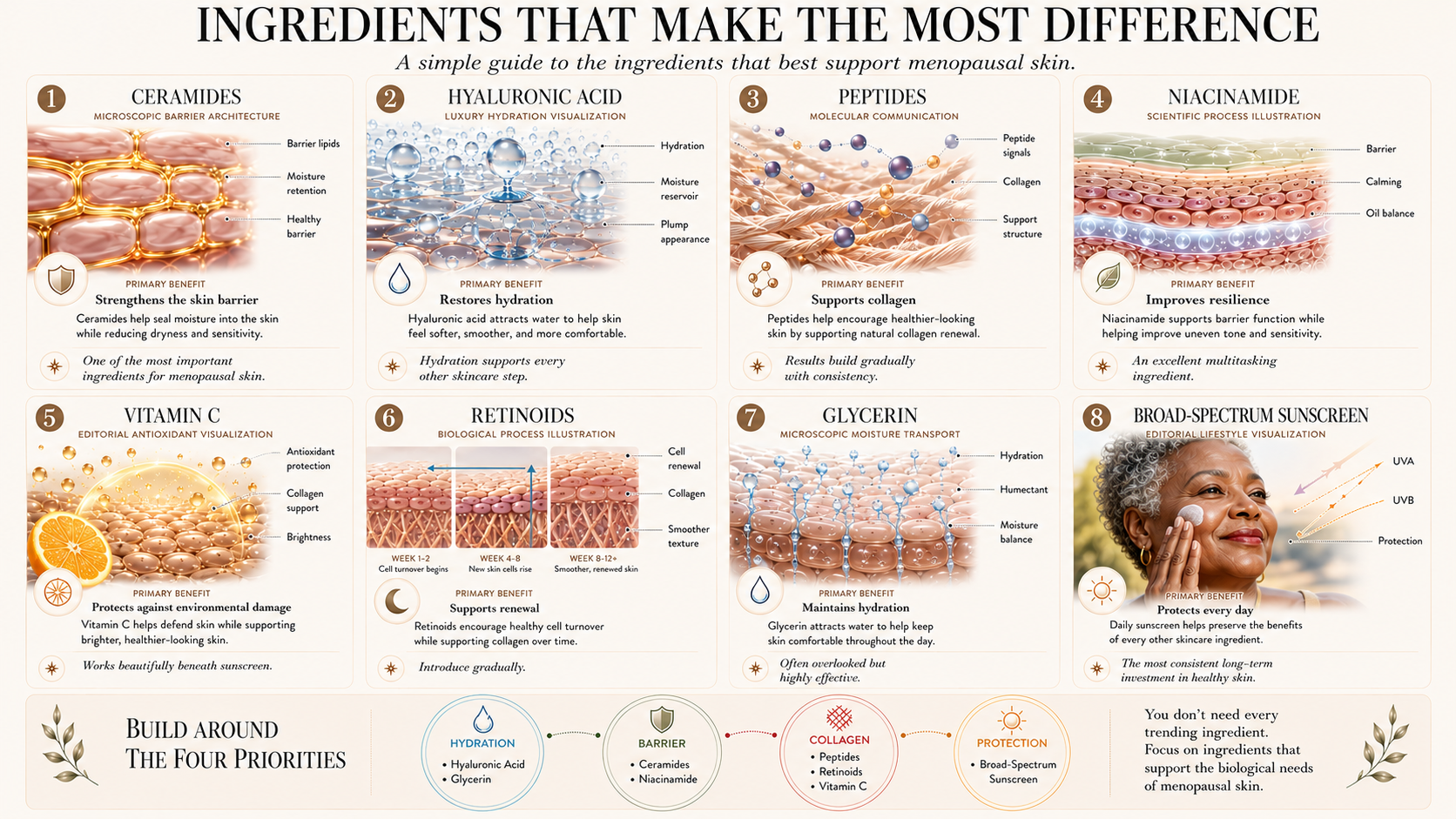
Walk into any skincare aisle and you'll find hundreds of products promising firmer skin, fewer wrinkles, or a youthful glow. It's easy to feel as though every bottle contains the next miracle ingredient.
Fortunately, caring for menopausal skin doesn't require dozens of products or an overflowing bathroom cabinet. A small group of well-studied ingredients addresses most of the changes we've already discussed. Once you understand what each ingredient does, choosing products becomes much simpler.
Hyaluronic Acid: Helps Restore Hydration
If your skin feels tight before lunchtime or seems to absorb moisturizer almost immediately, hyaluronic acid is an excellent place to begin.
This ingredient acts like a moisture-binding sponge, helping attract and hold water within the outer layers of the skin. As hydration improves, skin feels softer, appears smoother, and fine lines caused by dehydration become less noticeable.
Think of hyaluronic acid as adding water and your moisturizer as helping keep it there. Used together, they make an excellent team.
Ceramides: Strengthen the Skin Barrier
Ceramides are naturally present in healthy skin. Think of them as part of the mortar that holds the skin barrier together.
As menopause progresses, supporting those protective lipids becomes increasingly important. Products containing ceramides help reinforce the barrier, improve moisture retention, and reduce the tight, easily irritated feeling that accompanies dry skin.
For anyone experiencing persistent dryness or increased sensitivity, ceramides are among the ingredients I recommend looking for first.
Retinoids: Support Cell Turnover and Collagen
Retinoids remain one of the most extensively researched ingredients in skincare, and for good reason.
They encourage healthier cell turnover while supporting collagen production over time. With consistent use, they can soften the appearance of fine lines, improve texture, and contribute to a smoother, more even-looking complexion.
Retinoids reward consistency more than speed. Improvements develop with continued use, and introducing them slowly allows the skin time to adjust comfortably.
Vitamin C: Protect and Brighten
Vitamin C is one of my favorite daytime ingredients because it works on several concerns at once.
As an antioxidant, it helps defend skin from environmental damage caused by daily UV exposure and pollution. It also supports collagen production while helping brighten uneven skin tone and reduce the appearance of discoloration.
Morning is the ideal time to apply vitamin C because it complements your daily sunscreen as part of your daytime routine.
Peptides: Encourage Firmer-Looking Skin
Peptides are small chains of amino acids that help support the proteins responsible for skin's structure.
Peptides work progressively, making them a valuable addition to a long-term routine focused on maintaining firmness and supporting the skin's structure.
Their gentle nature also makes them an appealing option for skin that has become more sensitive during menopause.
Sunscreen: The Product That Protects Everything Else
If I could encourage every client to develop one daily habit, wearing sunscreen would be at the top of the list.
Ultraviolet light accelerates collagen breakdown, contributes to uneven pigmentation, and weakens many of the improvements your skincare routine is working to achieve.
A broad-spectrum SPF 30 or higher, applied every morning and reapplied when appropriate, protects the progress your other products are helping you build. When clients ask what I use most often, I usually recommend non-nano zinc oxide formulas because they tend to be gentle on mature, sensitive skin and are widely recognized as a reef-safe choice.
Not every ingredient belongs in every routine, and there's no prize for using the greatest number of products. Skin usually responds best to thoughtful consistency rather than constant experimentation.
Choose ingredients that help your skin stay hydrated, resilient, comfortable, and well protected throughout this stage of life. A thoughtful routine built around those goals will almost always serve your skin better than a shelf full of products you rarely use.
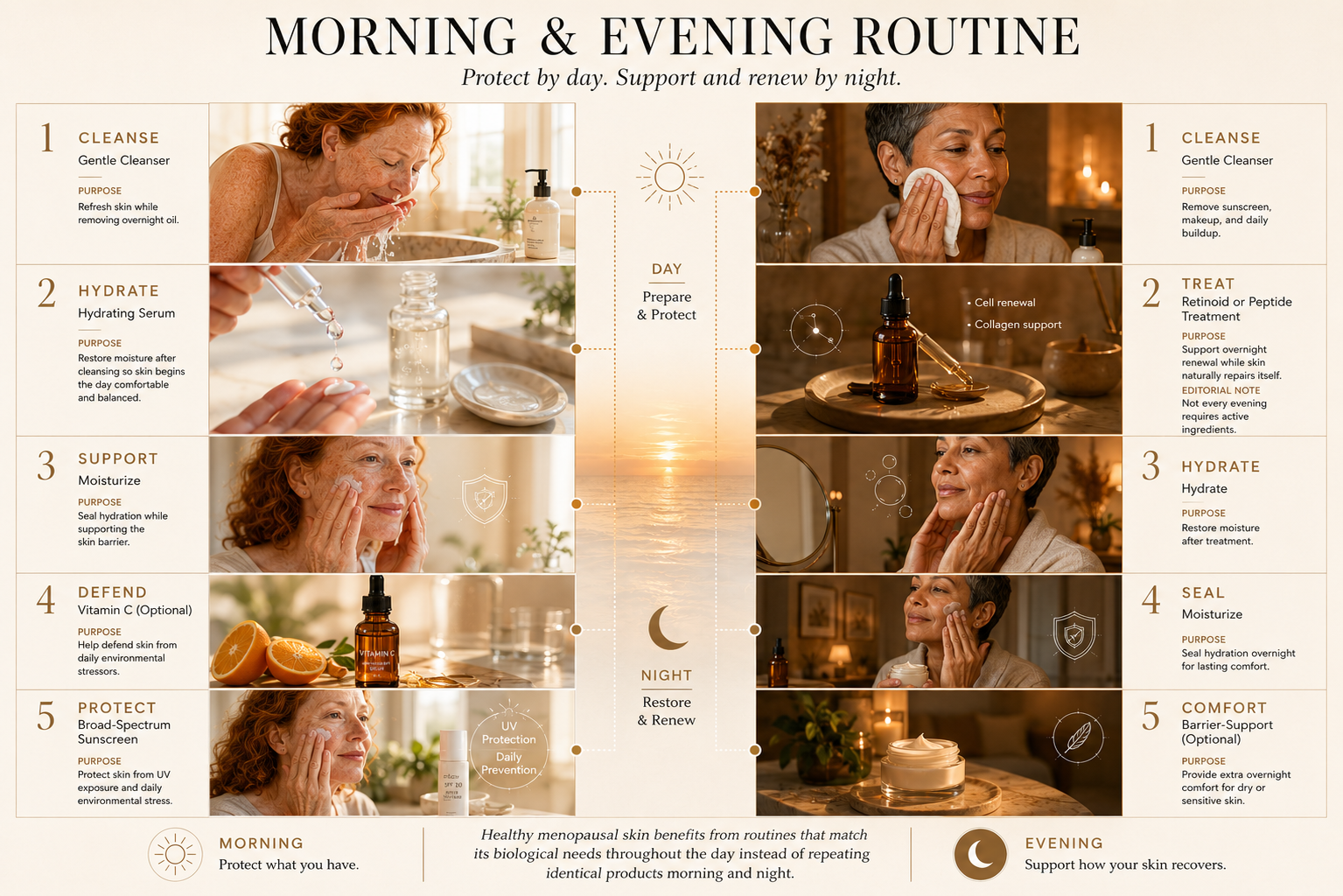
One of the biggest misconceptions about skincare is that more products automatically produce better results. After years of working with clients, I've found that healthy skin usually comes from choosing the right products and using them consistently—not from following a complicated ten-step routine.
A simple routine built around your skin's changing needs is easier to maintain and far more effective over the long term.
Morning Routine
Step 1: Cleanse Gently
Cleanse your skin with lukewarm water and a gentle, non‑stripping cleanser that lifts away overnight oil without leaving your skin tight or dry. After cleansing, your face should feel fresh and comfortable, not squeaky.
Step 2: Apply a Treatment Serum
This is the ideal time to apply products that address your primary skin concerns.
A hydrating serum containing hyaluronic acid helps replenish moisture, while vitamin C provides antioxidant protection and supports a brighter, more even-looking complexion. If sensitivity is your primary concern, look for calming ingredients that support the skin barrier.
There's no need to layer multiple serums unless each one serves a specific purpose.
Step 3: Moisturize
Choose a moisturizer that leaves your skin feeling comfortable throughout the day.
Richer, more emollient creams become more comfortable during menopause because they help reduce moisture loss throughout the day. Ingredients such as ceramides, squalane, and nourishing lipids provide additional support for a compromised skin barrier.
Step 4: Finish with Sunscreen
Sunscreen is the final step of your morning routine and the product that protects everything underneath it.
Apply a broad-spectrum SPF 30 or higher every morning, even on cloudy days. If you'll be outdoors for extended periods, reapply according to the product directions.
Evening Routine
Step 1: Remove Makeup and Cleanse
At the end of the day, remove sunscreen, makeup, and environmental debris with a gentle cleanser.
If you wear heavier makeup or water-resistant sunscreen, a cleansing balm or oil followed by a mild cleanser can thoroughly cleanse the skin without excessive rubbing.
Step 2: Apply Treatment Products
Evening is an excellent time for ingredients that focus on renewal and repair.
Retinoids, peptides, and other targeted treatments are commonly used at night because they support skin while you sleep. If you're introducing a retinoid for the first time, begin gradually (perhaps two evenings a week) and increase frequency as your skin becomes comfortable.
Resist the urge to start several new active ingredients at the same time. Introduce one product at a time so you can see how your skin responds.
Step 3: Moisturize
Finish with a nourishing moisturizer or night cream to replenish moisture overnight and support the skin barrier.
Keep It Consistent – The 80/20 Rule
Healthy skin is usually the result of small, repeated choices made over time. About 80% of your results come from what you do at home, and the other 20% comes from professional treatments.
I always tell my clients that your home routine does the heavy lifting. My treatments amplify your results, but what you do every day is what truly transforms your skin.
Skincare trends will continue to come and go, but healthy skin responds remarkably well to consistency. Pay attention to how your skin feels, make thoughtful adjustments when needed, and let your routine evolve with your skin instead of every new trend.
Lifestyle Habits That Support Healthy Menopausal Skin

Healthy skin depends on more than the products you apply each morning and evening. Your skin reflects what's happening throughout your body, and daily habits influence how well it hydrates, repairs, and protects itself.
You don't need to overhaul your lifestyle overnight. Small improvements practiced consistently can support the work your skincare routine is already doing.
Prioritize Quality Sleep
While you sleep, your skin is hard at work repairing itself. During the night, it replenishes moisture, supports collagen production, and recovers from everyday exposure to sunlight, pollution, and environmental stress.
Menopause can make restful sleep more difficult because of hot flashes, night sweats, and hormonal changes. While those challenges aren't always easy to control, establishing healthy sleep habits can benefit both your overall well-being and your skin.
Aim for a consistent sleep schedule whenever possible, keep your bedroom cool, and create an evening routine that helps your body recognize it's time to wind down.
Stay Well Hydrated
Hydrated skin begins from within.
Drinking enough water won't replace a good moisturizer, but healthy hydration supports countless processes throughout the body, including those that help keep skin functioning at its best.
If plain water isn't your favorite choice, herbal tea, sparkling water without added sugar, and water-rich fruits and vegetables all contribute to your daily fluid intake.
Nourish Your Skin Through Nutrition
Your skin depends on a steady supply of nutrients to repair itself and maintain its structure.
A balanced diet that includes colorful fruits and vegetables, lean proteins, healthy fats, whole grains, and omega-3-rich foods provides many of the building blocks your skin uses every day.
Protein deserves special attention because collagen is a protein. While eating more protein won't directly create new collagen in your skin, consuming adequate protein gives your body the amino acids it needs to maintain healthy tissues throughout the body.
Rather than searching for a single "miracle food," focus on eating a wide variety of nutrient-dense foods most of the time.
Manage Stress
Many women also notice that periods of high stress make hot flashes, sleep disturbances, and skin sensitivity feel even more difficult to manage.
Periods of prolonged stress can leave skin feeling more reactive, contribute to breakouts, slow recovery, and make inflammatory skin conditions more difficult to manage.
No one eliminates stress completely, but finding healthy ways to manage it benefits both your skin and your overall health. A daily walk, gardening, reading, spending time with friends, practicing yoga, or simply enjoying a quiet cup of tea can all become meaningful parts of your self-care routine.
Keep Moving
Regular physical activity supports circulation, cardiovascular health, muscle strength, and overall wellness.
Exercise isn't a substitute for skincare, but maintaining an active lifestyle contributes to healthy aging throughout the body, including the skin. Whether you enjoy walking, swimming, strength training, cycling, dancing, or gardening, choosing activities you genuinely enjoy makes consistency much easier.
Strength training also becomes increasingly important during menopause because it supports muscle mass, bone health, balance, and overall healthy aging.
Protect Your Skin from the Sun Every Day
Sun exposure remains one of the biggest contributors to premature skin aging.
Ultraviolet light accelerates collagen breakdown, contributes to uneven pigmentation, and can undo much of the progress you're working to achieve with your skincare routine.
Daily sunscreen, protective clothing, sunglasses, and seeking shade during the strongest afternoon sun all help preserve your skin's health over the years.
Avoid Smoking and Drink Alcohol in Moderation
Smoking reduces blood flow to the skin and accelerates collagen breakdown, making fine lines and loss of firmness more noticeable over time.
Excessive alcohol can contribute to dehydration and leave skin looking dull or feeling less comfortable. Enjoying alcohol in moderation, staying hydrated, and avoiding tobacco products all support healthier skin as you age.
Healthy Skin Is Built from the Inside and the Outside
Healthy skin is shaped by the choices you make both in front of the bathroom mirror and throughout the rest of your day.
A gentle skincare routine, nourishing foods, restorative sleep, regular movement, stress management, and daily sun protection work together in ways that no single product ever could. When those habits become part of everyday life, they create an environment where your skin has the best opportunity to remain healthy, resilient, and comfortable throughout menopause.
The Most Common Skincare Mistakes During Menopause

When skin begins changing, it's natural to assume you need to do more. Many of the clients I see aren't neglecting their skin; they're simply using routines that worked beautifully ten or fifteen years ago but no longer match what their skin needs today.
Small adjustments make a bigger impact overall.
Over-Cleansing
When skin feels dry or rough, cleansing more often can seem like the logical solution. In reality, washing too frequently or using a harsh cleanser strips away protective oils your skin is already struggling to replace.
Cleanse morning and evening with a gentle, non-stripping cleanser, then allow your moisturizer to do its job. Healthy skin should feel comfortable after cleansing, never tight or squeaky.
Over-Exfoliating
Exfoliation has its place, but more isn't better.
As cell turnover naturally slows during menopause, it's tempting to exfoliate more aggressively. Strong acids, frequent scrubs, or combining multiple exfoliating products can leave the skin barrier irritated and inflamed.
Gentle, consistent exfoliation almost always produces better long-term results than trying to force faster renewal.
Using Too Many Active Ingredients
Retinoids, vitamin C, exfoliating acids, peptides, niacinamide—each has benefits, but using several powerful ingredients together can overwhelm skin that has become more sensitive.
Whenever you introduce a new treatment product, give your skin time to adjust before adding another. This also makes it much easier to identify what's helping and what isn't.
Skipping Moisturizer Because Your Skin Still Breaks Out
This surprises many clients.
Adult breakouts and dry skin can appear together during menopause. Choosing a lightweight, barrier-supporting moisturizer helps maintain hydration without automatically making acne worse.
Healthy moisture levels support the skin's natural barrier, which benefits nearly every skin type.
Forgetting Your Neck and Décolletage
Your skincare routine shouldn't stop at your jawline.
The neck and chest experience many of the same hormonal changes as facial skin, yet they're typically left out of daily skincare routines. Cleansers, serums, moisturizers, and sunscreen should be applied to these areas as well.
Treating your face differently from your neck creates a noticeable contrast over time.
Expecting Overnight Results
You wouldn’t expect dramatic results from a single workout, no matter how much we wish it worked that way. Skin is similar. Most ingredients need weeks, sometimes months, of steady use before meaningful changes appear. Changing products every few weeks makes it almost impossible to know what's actually helping your skin.
In skincare, consistency nearly always outperforms chasing every new launch or viral recommendation.
Progress Comes from Patience
Healthy skin develops through consistent care, and menopause doesn't erase years of good skincare habits. Your routine simply needs to evolve alongside your skin.
Focus on gentle cleansing, consistent hydration, barrier support, daily sun protection, and ingredients with proven benefits. Those habits, practiced day after day, create results that no single product can deliver on its own.
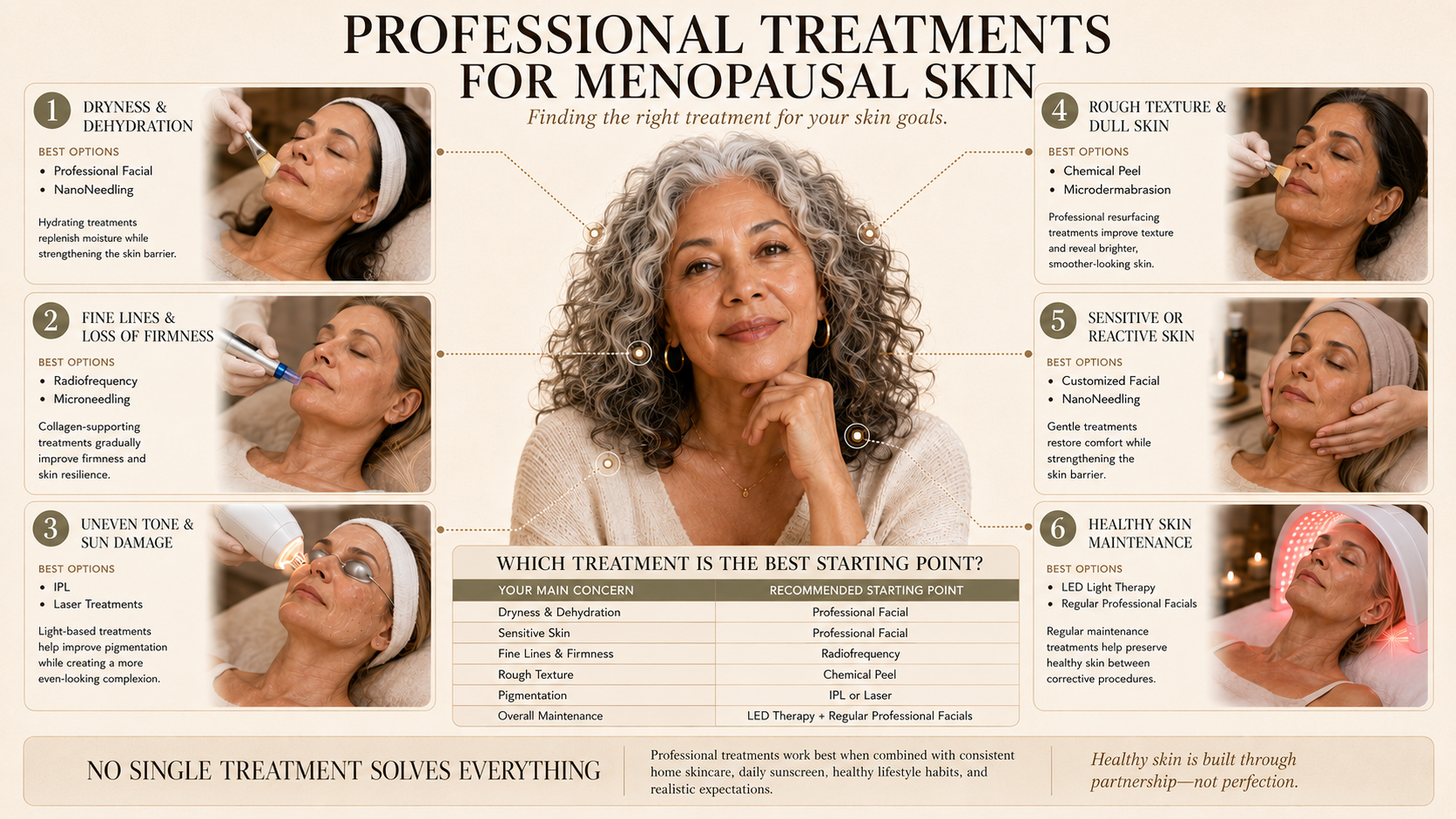
A consistent home routine provides the foundation for healthy skin, but professional treatments can help address concerns that skincare products alone cannot fully improve. The goal isn’t to replace your daily routine; it’s to complement it.
No professional treatment can stop the natural hormonal changes of menopause, but several can complement a thoughtful home routine by improving hydration, supporting collagen, refining texture, or calming inflammation.
Not every treatment is appropriate for every skin type or medical history. Always discuss your health history, medications, and skincare goals with a qualified provider before beginning a new treatment plan.
Professional Facials
A customized facial remains one of the most effective ways to support menopausal skin and to give yourself some much‑needed, deeply restorative self‑care.
Unlike a one-size-fits-all treatment, a professional facial can be adjusted as your skin changes throughout the year. Gentle exfoliation, deep hydration, barrier repair, and calming ingredients help restore comfort while improving the skin's overall appearance.
Many clients also appreciate having their routine evaluated. Small adjustments produce better results than replacing every product they own.
Microdermabrasion
Microdermabrasion gently removes the outermost layer of dead skin cells, leaving the skin feeling smoother and looking brighter. It can improve texture, soften the appearance of superficial discoloration, and help skincare products absorb more effectively.
Because menopausal skin is drier and more delicate, treatment intensity should always be customized. A gentle approach generally delivers better results than aggressive resurfacing.
Chemical Peels
Chemical peels range from very gentle to more intensive treatments.
Superficial peels performed at appropriate intervals can improve texture, brighten uneven pigmentation, and encourage smoother-looking skin with relatively little downtime. The strength and type of peel should always be matched to your skin's condition and tolerance.
Healthy skin responds better to a series of appropriate treatments than a single overly aggressive one.
NanoNeedling
NanoNeedling is a non-invasive treatment designed to enhance the absorption of professional skincare products while gently stimulating the skin's natural renewal process. Unlike traditional microneedling, NanoNeedling doesn't create controlled injury in the skin. Instead, it uses microscopic silicone tips to temporarily improve product penetration into the uppermost layers of the epidermis.
I recommend NanoNeedling for clients whose skin has become drier, more sensitive, or less tolerant of aggressive treatments. It can improve hydration, smooth the skin's surface, and leave the complexion looking healthier and more refreshed without the downtime associated with deeper procedures.
One of the professional systems I frequently use in my treatment room is ReZenerate®, which combines NanoNeedling technology with targeted professional serums. It's a wonderful option for clients who want to support healthy, radiant skin while taking a gentler approach during menopause.
Radiofrequency (RF)
Radiofrequency treatments use controlled heat to warm the deeper layers of the skin, encouraging collagen remodeling over time. As collagen rebuilds, skin appears firmer, smoother, and more lifted.
Results develop gradually through a series of treatments and continued collagen production. Radiofrequency is frequently chosen by clients who want subtle, natural-looking improvements without surgery.
Ultrasound Skin Tightening
Ultrasound treatments deliver focused sound energy into deeper layers of tissue to stimulate collagen production below the skin's surface. This technology is commonly used to improve mild skin laxity around the jawline, neck, and lower face.
Like radiofrequency, improvements appear over time as new collagen develops, making realistic expectations and patience important parts of the treatment process.
Laser Treatments
Laser treatments use concentrated light energy to target specific concerns within the skin. Different lasers are designed for different purposes, so the right treatment depends on what you're hoping to improve.
It's worth knowing that laser treatments and Intense Pulsed Light (IPL) are not the same technology, even though they're often discussed together. Your provider can recommend the option that's best suited to your specific concerns.
Some lasers focus on reducing sun damage, age spots, and uneven pigmentation. Others stimulate collagen production to soften fine lines, improve skin texture, and address mild skin laxity. Fractional lasers can also improve acne scarring and other textural concerns by encouraging the skin to rebuild itself over time.
Because menopausal skin is
thinner, drier, and more sensitive than it was in earlier years, treatment settings and recovery plans should always be individualized. An experienced provider will evaluate your skin type, medical history, and goals before recommending the most appropriate laser.
Like many professional treatments, the best results develop progressively. A series of treatments, combined with consistent home care and daily sun protection, typically produces more natural-looking improvements than expecting dramatic changes after a single session.
Microneedling
Microneedling works by creating controlled micro-injuries that stimulate the skin's natural repair process.
Over time, it can help soften the appearance of fine lines, improve skin texture, and support collagen production. Results develop over time as new collagen forms, making consistency and proper aftercare just as important as the treatment itself.
Because menopausal skin is more sensitive, an experienced provider should evaluate whether microneedling is appropriate for your skin.
LED Light Therapy
LED light therapy is a gentle, non-invasive treatment that can complement many skincare routines.
Different wavelengths of light support different concerns. Red light is commonly used to encourage collagen production and calm inflammation. Blue light helps reduce acne-causing bacteria. Green light is used to improve redness and uneven pigmentation, while amber light supports healing and skin rejuvenation.
Many people appreciate LED therapy because it involves little to no downtime and pairs well with other professional treatments.
When to See a Dermatologist
Some skin changes deserve medical evaluation rather than cosmetic treatment.
If you notice a new or changing mole, persistent sores that don't heal or any spot that changes in size, shape, or color, rapidly changing pigmentation, unexplained rashes, or severe breakouts that don't improve with appropriate skincare, schedule an appointment with a board-certified dermatologist.
Menopause changes many aspects of the skin, but not every skin concern should automatically be attributed to hormones.
Think of Professional Treatments as a Partnership
Healthy skin is rarely transformed by a single facial, peel, or device. It is built through the combination of consistent home care, appropriate professional treatments, and realistic expectations. When those pieces work together, improvements tend to look gradual, natural, and lasting rather than dramatic or artificial.
Professional treatments should never feel intimidating. They're simply tools that can support the work you're already doing at home. The best treatment plan is the one that's appropriate for your skin, fits comfortably within your budget, and leaves your skin healthier, not just temporarily smoother.
Frequently Asked Questions About Menopausal Skin

Does every woman experience skin changes during menopause?
Not necessarily. Genetics, lifestyle, sun exposure, overall health, and skincare habits all influence how skin ages. Some women notice only subtle changes, while others experience significant dryness, increased sensitivity, breakouts, or loss of firmness over a relatively short period.
Even if your skin changes are mild, adapting your routine as your skin evolves can help keep it healthy and comfortable for years to come.
Can skincare reverse menopausal skin aging?
Skincare can't stop the natural aging process or replace hormones that have declined, but it can significantly improve your skin's hydration, texture, resilience, and overall appearance.
Consistent home care, daily sun protection, healthy lifestyle habits, and appropriate professional treatments produce meaningful improvements over time.
Why did my skin become oily and dry at the same time?
This is one of the most common questions I am asked in the treatment room.
As hormone levels fluctuate, oil production becomes less predictable while the skin barrier loses moisture more easily. The result is skin that may feel dry and tight while still producing oil in certain areas or experiencing occasional breakouts.
Supporting the skin barrier with gentle cleansing and appropriate hydration usually produces better results than trying to dry the skin out further.
Can I still use retinol if my skin has become sensitive?
In many cases, yes.
The key is adjusting how often you use it and choosing a strength that's appropriate for your skin. Beginning with fewer applications each week, applying moisturizer to support the skin barrier, and increasing frequency allows sensitive skin to tolerate retinoids comfortably.
If irritation persists, consult your skincare professional or dermatologist for individualized guidance.
Do I really need moisturizer if my skin is still breaking out?
Yes.
Breakouts don't automatically mean your skin has enough moisture. Menopausal skin frequently experiences dehydration and barrier disruption at the same time that hormonal fluctuations contribute to blemishes.
Choosing a lightweight, non-comedogenic moisturizer helps support the skin barrier without unnecessarily clogging pores.
Which professional treatment should I start with?
There's no single answer because every woman's skin is different.
If you're new to professional skincare, a customized facial is an excellent starting point. It allows an experienced esthetician to evaluate your skin, discuss your concerns, and recommend treatments that fit your goals, budget, and comfort level.
Building a treatment plan intentionally produces better long-term results than trying several advanced procedures all at once.
How long does it take to see improvement?
Healthy skin changes over time.
Hydration typically improves within days or weeks, while improvements in pigmentation, firmness, and collagen production typically require several months of consistent care. Professional treatments may accelerate those improvements, but they still work best when supported by a thoughtful home routine.
Patience is one of the most valuable ingredients in any skincare routine.
Is it too late to start taking better care of my skin?
Absolutely not.
I've worked with clients who began caring for their skin in their fifties, sixties, and beyond and were amazed by how much healthier, more comfortable, and more radiant their skin became with consistent care.
Your skin is always responding to how you care for it. While no routine can turn back the clock, it's never too late to improve your skin's health, strengthen its barrier, and help it look its very best.
Closing Reflection

Menopause changes your skin, but it doesn't diminish your beauty.
Your skin has spent decades protecting you through busy careers, family milestones, celebrations, challenges, laughter, tears, and countless ordinary days that quietly shaped your life. The changes you see in the mirror today aren't flaws to erase but evidence of a life fully lived.
That doesn't mean you have to stop caring for your skin. Quite the opposite.
Healthy, radiant skin isn't reserved for your twenties or thirties. With thoughtful care, consistent habits, and realistic expectations, your skin can continue to look vibrant, comfortable, and beautifully cared for many years to come.
After more than a decade as a licensed esthetician, one lesson has remained constant: the women who achieve the healthiest-looking skin are the ones who understand their skin, care for it consistently, and allow their routine to evolve as life changes.
I hope this guide has helped you understand not only what is happening to your skin, but why it's happening, and more importantly, given you the confidence to know what to do next.
Your skincare routine doesn't need to be complicated. It simply needs to support the skin you have today.
Be patient with yourself. Celebrate progress, not perfection. Small choices made consistently have a remarkable way of adding up over time.
Because caring for your skin has never been about looking younger.
It's about feeling comfortable, confident, and beautifully at home in the skin that's carried you through every chapter of your life.
Shop the Beauty Edit
Over the past 10 years, I've worked with countless skincare products in both my treatment room and my own daily routine. As a licensed esthetician with a special focus on sensitive skin, I'm careful about the products I recommend. In my treatment room, I use Hale & Hush Skincare because of its exceptional commitment to supporting sensitive, compromised skin.
Because Hale & Hush isn't currently available through Amazon or sold to the general public, the products I've selected here are brands that reflect a similar philosophy. I looked for formulas that prioritize skin-friendly ingredients, thoughtful formulation, responsibly sourced ingredients whenever possible, cruelty-free practices, and a gentle approach to supporting healthy skin—qualities I believe are especially important during menopause.
If you're interested in purchasing Hale & Hush products, I'd be happy to help. As an authorized skincare professional, I can have products drop-shipped anywhere within the United States. Feel free to contact me through B'Inspired Studio for personalized recommendations or assistance selecting the right products for your skin.
While no single product is right for everyone, each recommendation was chosen because it supports the principles we've explored throughout this guide: protecting the skin barrier, maintaining hydration, encouraging healthy collagen production, and building a routine around ingredients that have earned their place through consistent performance rather than marketing promises.
Remember, healthy skin isn't created by owning more products. A thoughtfully curated routine designed around your skin's unique needs will almost always outperform a cabinet full of impulse purchases.
Whether you're replacing a favorite moisturizer, searching for a gentle cleanser, or choosing your first vitamin C serum, I hope these recommendations help make shopping feel a little less overwhelming—and a lot more intentional.
My Recommended Essentials
Beauty and wellness articles are intended for educational purposes only and reflects my experience as a salon owner and licensed esthetician. I am not a physician, dermatologist, or other licensed medical provider. Skincare recommendations should never replace personalized medical advice. If you experience persistent skin changes, severe irritation, unexplained rashes, or have concerns about your health, please consult your healthcare provider or a board-certified dermatologist before beginning any new skincare routine or treatment.
Disclosure: This article may contain affiliate links. If you make a purchase through these links, I may earn a commission at no additional cost to you.
