

How to Choose the Right Hair Color With Seasonal Color Analysis
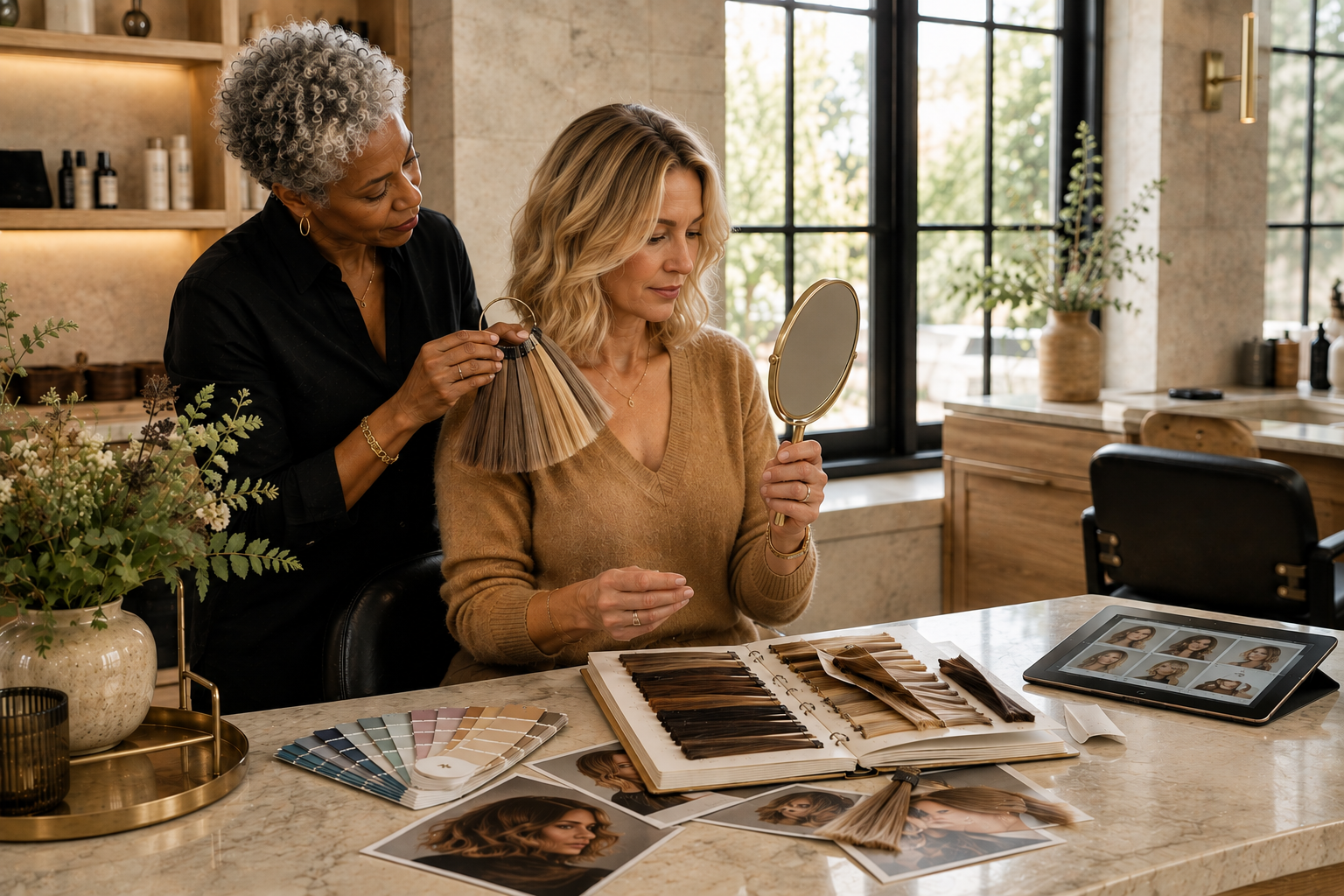
Hair Color Is Part of Your Personal Color Palette
Hair color is easy to treat like just another beauty choice, somewhere between picking a new lipstick and trying a different haircut. In reality, it influences far more than your hair.
It sits in one of the largest color areas around your face. It frames your eyes, rests beside your skin, and becomes part of how your features are read. When that frame changes, everything around it shifts a little. A lipstick you have worn for years suddenly feels too warm. A sweater you have always loved starts getting more compliments. Even your complexion can look brighter, softer, or a little more tired without anything else changing.
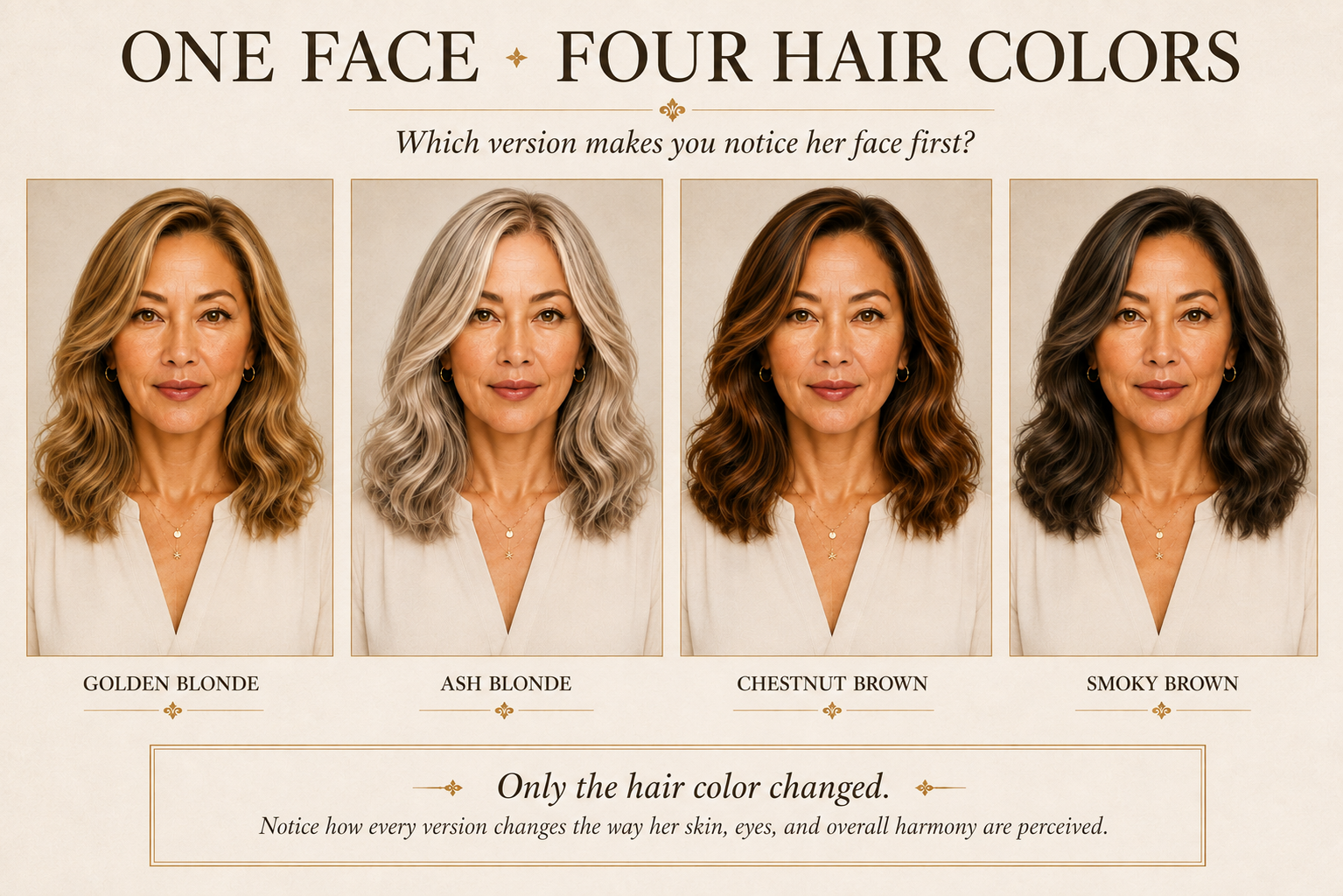
I have had this conversation with clients so many times. A woman would adjust only her hair color and then wonder why her makeup no longer felt right or why a favorite blouse seemed less flattering.
Fresh highlights look exactly the way you hoped when you leave the salon, then gradually warm up between appointments. The inspiration photo you save on Pinterest does not always translate to your own hair, even when the color is recreated faithfully by a professional stylist.
Years later, silver begins to appear and the colors in your wardrobe seem different again. Nothing about your personal style has changed, yet familiar shades no longer create the same effect.
It all comes back to one simple truth. Hair color never exists on its own. It is always interacting with your skin, your eyes, your makeup, and every color you wear.
Seasonal Color Analysis brings all of those pieces together. Instead of judging hair color by itself, it looks at your coloring as a whole. Your hair, skin, eyes, and wardrobe become parts of the same palette. When they work together, people notice you before they notice your hair.
Two blondes can look almost identical on a salon swatch, yet one brightens your complexion while the other quietly drains it. Sometimes the difference is nothing more than a small shift in warmth, depth, or softness.
You do not need to understand salon chemistry or memorize professional formulas to recognize those differences. Once you know what to look for, inspiration photos become easier to evaluate, conversations with your stylist feel more productive, and the choices you make about your hair begin to feel much more intentional.
Seasonal Color Analysis Changes the Way You Choose Hair Color
Hair color advice often starts with a simple question: "Do you have warm or cool undertones?"
Temperature matters however, it’s not the whole conversation.
Two women can both have cool undertones and still need completely different hair colors. One feels her best in softly blended ash tones that sit gently beside her complexion while another looks most alive in deeper, clearer color that creates noticeable contrast around her face. Both benefit from cool shades, yet the same formula would never create the same result.
Temperature
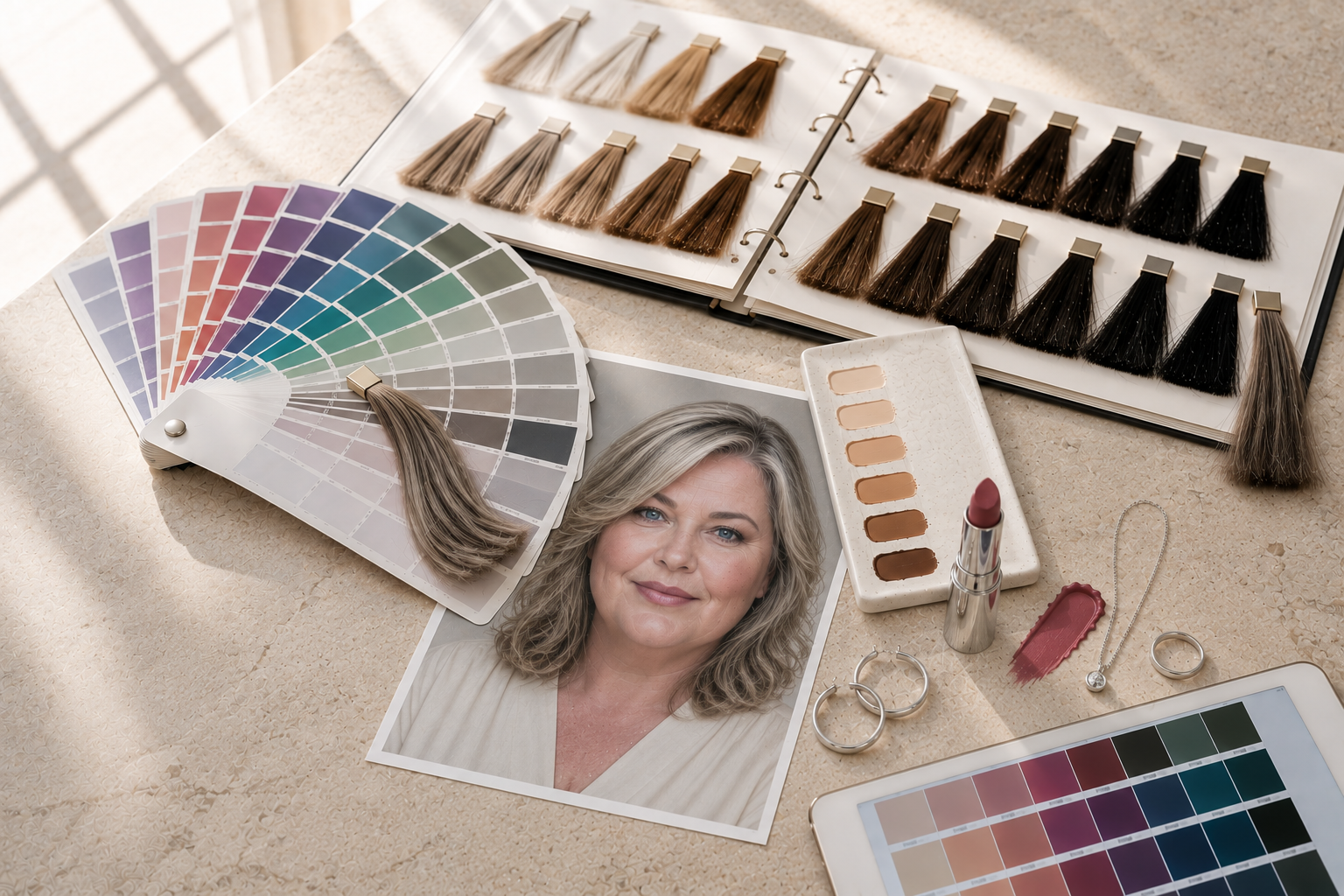
Temperature is the easiest characteristic to recognize because warmth and coolness are the first things we naturally notice. Golden blonde, honey brown, and copper all carry visible warmth. Ash blonde, smoky brunette, and blue‑black sit on the cooler side. People often respond to this instinctively, even if they cannot explain why one color feels more natural than another.
Depth
Two hair colors can be equally cool and still create very different impressions. That is where depth becomes important. During a consultation, a client would ask for a cooler brunette when what she was really responding to was depth. A light ash blonde and a deep ash brown can share the same coolness, yet they look nothing alike because one is much lighter than the other.
Softness
Some hair colors immediately catch your eye while others blend quietly into a person’s features. Seasonal Color Analysis describes this as chroma, although you do not need to remember the term to recognize the effect. A softly smoky brunette and a bright copper create completely different impressions long before you notice the haircut or makeup.
Contrast
Contrast is something you notice without even realizing it. Sometimes a new hair color makes someone’s eyes look brighter the moment they walk into the room. While working alongside stylists, I saw how a shift in hair color changed much more than the hair itself. Eyes looked clearer, complexions softened while sometimes the opposite happened.
Hair color can change that relationship in surprising ways. Going lighter or darker alters how your entire face is perceived, which is why the same shade can look completely different from one person to the next.
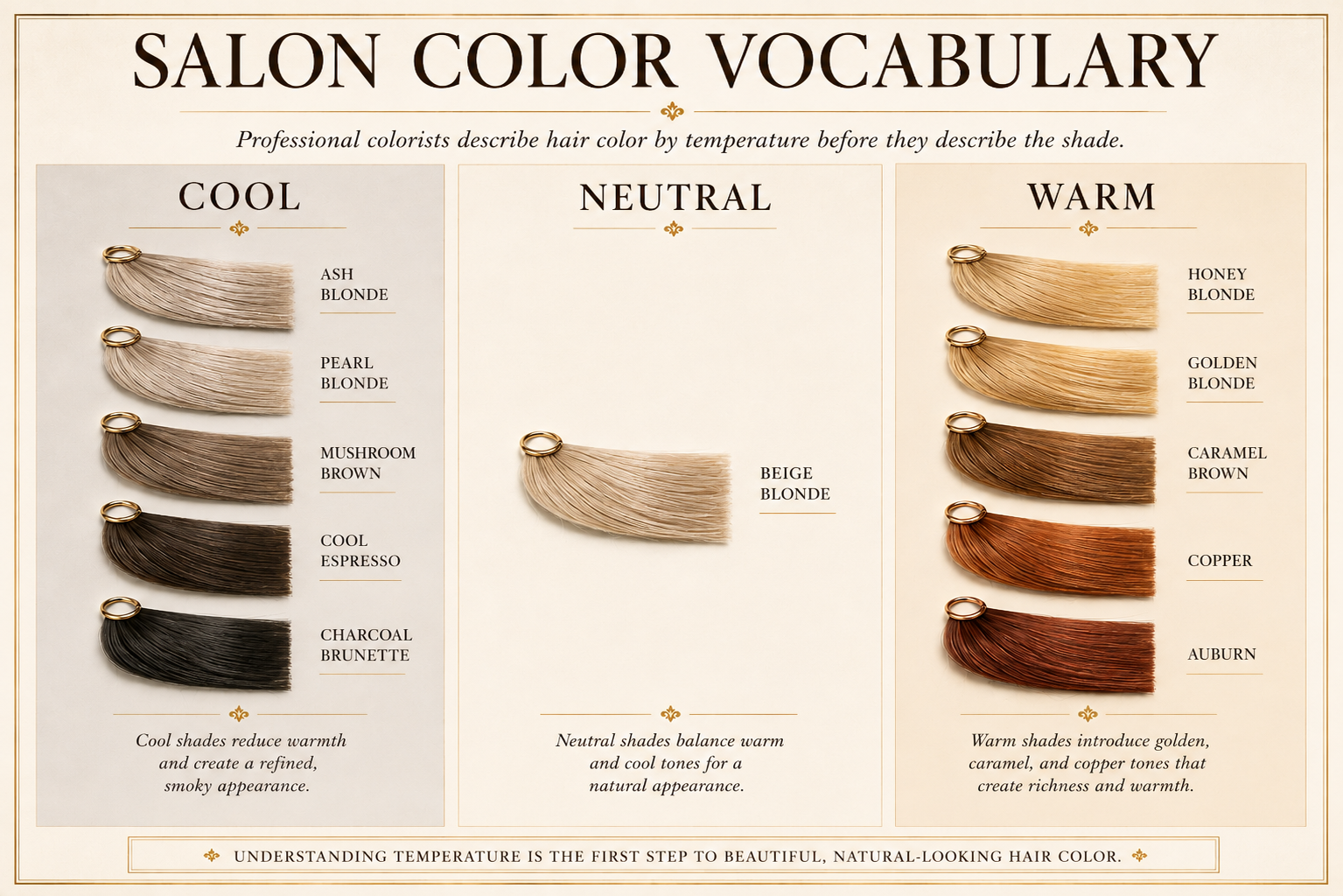
Walk into almost any salon consultation and you will hear words like ash, beige, pearl, caramel, or mushroom. They sound very specific, yet they are often the point where the conversation becomes confusing. Most people recognize the names without really knowing what they mean. They are describing the direction of the color you are asking for.
When Your Stylist Wants to Reduce Warmth
If you have ever said, “I do not want my blonde to look yellow,” you were requesting cool tones, even if you did not use those words.
Ash is the term you will hear most often when your blonde keeps turning yellow or your brunette starts looking warmer than you prefer. It simply means your stylist is trying to reduce that warmth.
Pearl is another cool description that surprises people. It adds a soft, delicate coolness that keeps blonde hair looking refined rather than obviously warm.
Mushroom blends cool brown, soft taupe, and smoky undertones. It feels subtle, sophisticated, and naturally muted.
Cool Espresso is a deep rich brunette shade that relies entirely on neutral-to-ash base and mimics the dark intensity of freshly brewed coffee.
Charcoal Brunette is a cool deep brown shade infused with smokey, ashen, and slate undertones.
When Warmth Is the Desired Outcome
Gold and honey both add warmth, but they do not look identical. Gold feels brighter and more sunlit, while honey has a richer, softer warmth.
Caramel is one of those names that has become so familiar we almost forget it is warm. Caramel highlights still bring noticeable golden warmth to the hair. They can be beautiful on the right person and unexpectedly overpowering on someone whose coloring naturally suits cooler shades.
Copper and auburn are often grouped together, although they create very different results. Copper is lighter, brighter, and full of energy while auburn has more depth and a red‑brown richness that feels quieter and more understated.
The Color That Does Not Strongly Lean Either Way
Then there is beige, one of the most versatile words you will hear in a salon.
Beige enters the conversation when someone wants a result that feels soft and natural without looking obviously warm or noticeably cool. Depending on the formula, it can lean gently in either direction while still keeping a beautifully understated appearance.
Color names are helpful, but they are not guarantees. Ask three different stylists for “beige blonde,” and each client could leave the salon with a slightly different result. Natural hair color, previous color history, texture, and the stylist’s formulation all influence the final look.
Understanding these words makes salon conversations much easier. Instead of guessing what your stylist means, you will recognize the direction they are describing and feel more confident talking about the result you want.
How the Four Seasonal Families Approach Hair Color
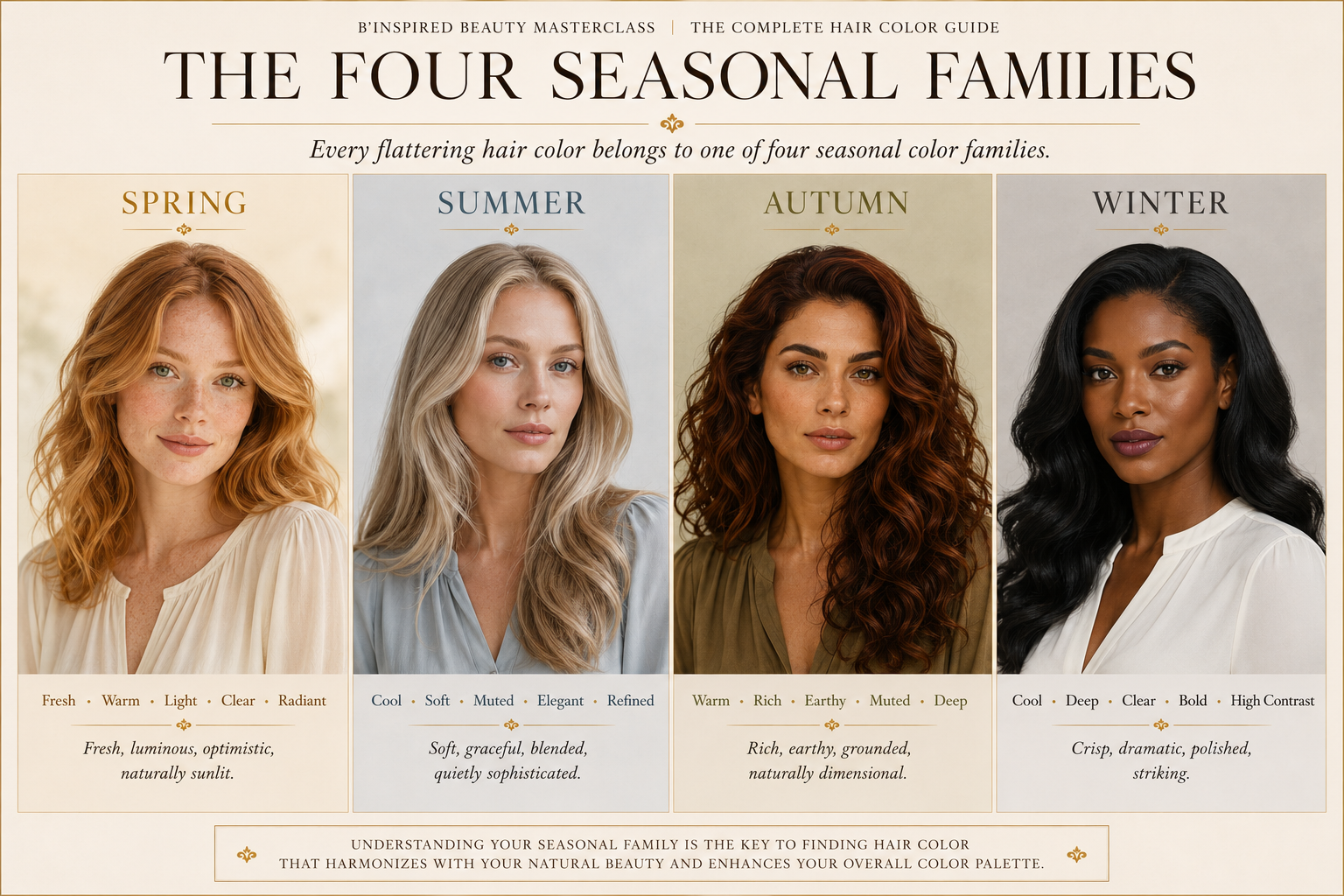
Two women can both be Summers and still have completely different natural hair colors. The same is true for every season, and it is one of the reasons Seasonal Color Analysis is often misunderstood. The seasons do not prescribe a single hair color but rather reveal the qualities that help a shade feel naturally at home beside your complexion.
Spring
Spring hair is easy to recognize because it rarely feels heavy. Even deeper Spring shades carry a sense of lightness and energy. Golden or strawberry blondes, honey tones, and warm light browns all share that quality. When too much ash is added, the color loses the lively feeling that makes Spring so distinctive.
Summer
Summer is the season where the smallest shifts make the biggest difference. A blonde that is only slightly warmer than intended can change the entire feeling of the hair. Ash blondes, cool beiges, and smoky brunettes stay much closer to Summer’s naturally soft, understated coloring.
Autumn
Chestnut, cinnamon, copper, rich auburn, and warm browns feel completely at home because they echo the warmth already present in Autumn coloring. Dimension plays an important role here too. Gentle variation between lighter and darker pieces looks more believable than a perfectly even color from roots to ends.
Winter
Winter is one of the few seasons that carries a much stronger contrast. Deep brunettes, blue‑black, cool espresso, and icy blondes all have a crisp, defined quality that reflects Winter’s coloring without overpowering it.
These four families provide the broad direction. The individual seasons refine it even further, which is why a True Summer and a Soft Summer, or a Dark Autumn and a True Autumn, will not necessarily choose the same hair color even though they belong to the same family.
Does Coloring Your Hair Change Your Season?
It is a frequent question, and an understandable one.
"If I have been coloring my hair blonde for years, does that make me a Spring?" "If I decide to go silver, will I become a Summer?"
It is an easy assumption to make because hair is one of the first things we notice about ourselves. Change the color, and your reflection immediately feels different.
Your season, however, is not built on hair color alone. It is the relationship between your skin, your eyes, your brows, and your natural coloring that creates your seasonal palette. Coloring your hair changes one part of that relationship, but it does not create a different season.
A True Summer might brighten her hair with cool beige highlights, while another may prefer a deeper ash brunette or choose to embrace her natural silver. The shades are different, yet they all share the same underlying cool tones that support a True Summer palette.
The same idea applies across every season. Seasonal Color Analysis does not assign one “correct” hair color. It offers a range of directions that work with your natural coloring, leaving plenty of room for personal style.
This is also why inspiration photos become incredibly useful once you know your season. Instead of asking your stylist to recreate someone else’s exact color, you begin noticing the qualities you want to draw from. Those qualities can often be adapted to your own season without copying the photograph exactly.
What If You Love a Hair Color That Isn’t in Your Season?
We’ve all saved a hair inspiration photo thinking, "I wish I could wear that color." Mine is a beautiful copper red. I’d love to try being a redhead and have it look as stunning on me as it does on a woman with Autumn coloring.
Even if the shade you love is not the best fit for your coloring, the photograph can still contribute something meaningful. Instead of focusing on the exact shade, look at what caught your attention in the first place. Was it the brightness around the face? The soft transition from darker roots to lighter ends? The shine? The dimension? The overall feeling? Those qualities do not belong to a single season. They can be interpreted in countless ways.
A colorist does not need to recreate the exact formula to recreate the impression it made on you. The warmth can be adjusted. The depth can be softened or brightened. Highlights can be placed differently.
This is why inspiration photos are most helpful when presented during your initial consultation rather than after your first color appointment. What you loved about the photograph can still become part of your own hair color without asking your features to compete with it.
Should You Stay Close to Your Natural Hair Color?
"If my natural hair is medium brown, does Seasonal Color Analysis mean I should stay a medium brown forever?"
Fortunately, the answer is no.
Your natural hair color offers helpful clues about your seasonal palette, but it is not the only beautiful option available to you.
Someone with naturally cool brunette hair may choose to wear a lighter blonde for years while may another might deepen her color or gradually transition to gray. None of those choices automatically move her outside her season.
The qualities of the color matter far more than recreating the exact shade you were born with. This is why Seasonal Color Analysis gives you direction rather than a single destination. It narrows thousands of possible hair colors into a range that works comfortably with your complexion, your eyes, and your natural contrast. Within that range, there is still plenty of room to decide what feels most like you.
That freedom is one of the reasons so many appreciate Seasonal Color Analysis. It helps you understand yourself well enough to make confident choices.
Why Hair Color Changes Between Salon Appointments
Hair color is one of the few beauty services that keeps changing long after you leave the salon. The appointment may only last a couple of hours, but your hair continues to shift afterward. Sunshine, heat styling, hard water, and swimming in chlorine all influence how your color looks over time.
Blonde noticeably shows those changes first. As cool tones fade, yellow and gold become easier to see. That is why people describe blonde hair as becoming “brassy,” even though it looked perfect just a few weeks earlier.
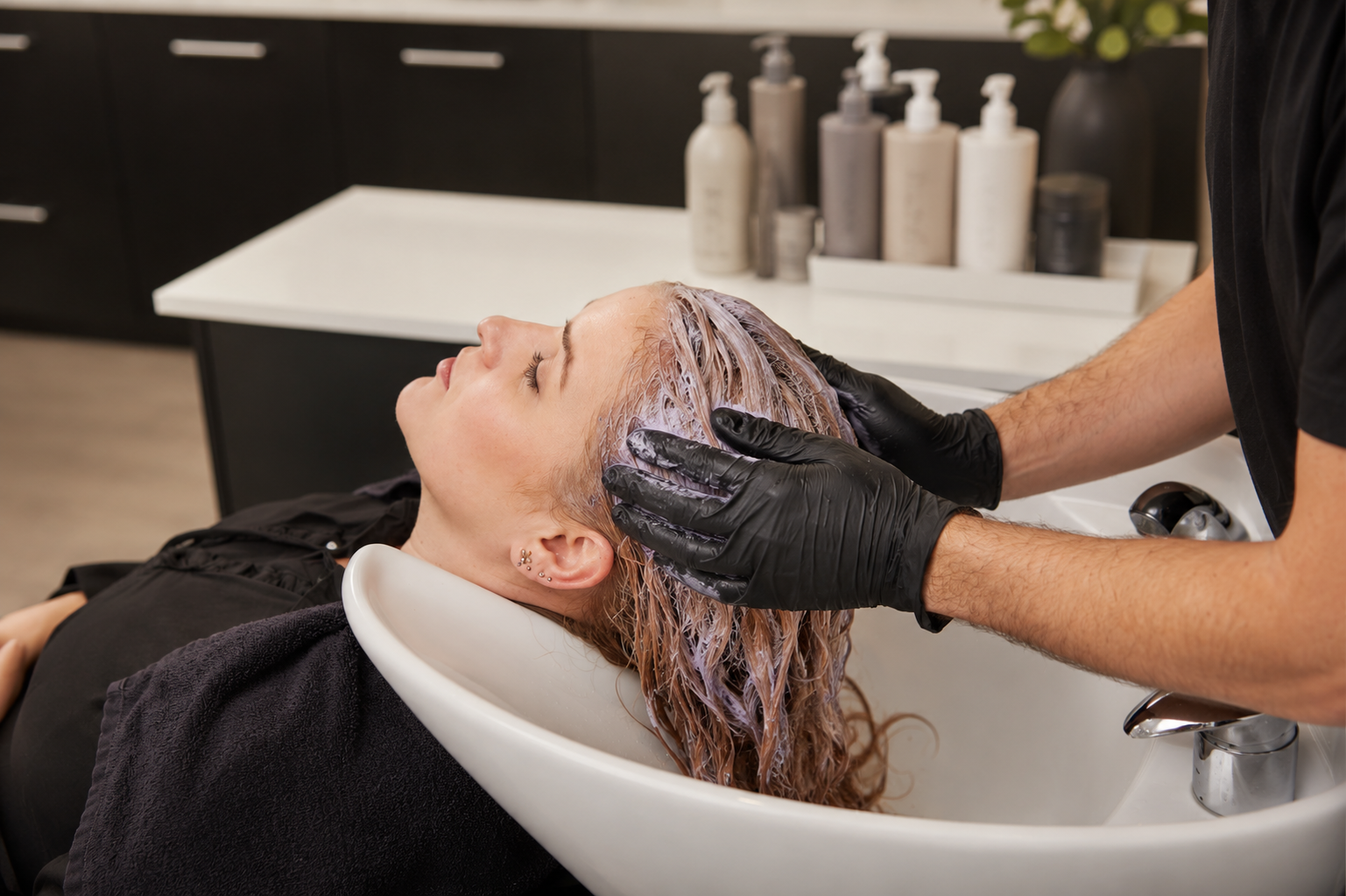
Brunettes change too, although the shift is more subtle. Browns start to look warmer, reds lose some of their depth, and highlights gradually stand out more as the surrounding color softens.
Sometimes the color does not need a major adjustment at all. A simple refresh is enough to bring it back to life.
A gloss is one way to restore tone and shine without starting over.
Purple shampoo gets talked about often, especially for blondes. Used thoughtfully, it helps reduce unwanted yellow tones. Used too frequently, especially on porous blonde or silver hair, it can leave the hair looking dull or even slightly violet.
Before deciding you need a completely different formula, take a closer look at what has actually changed. Sometimes a small color refresh is all that is needed.
How to Have a Better Conversation With Your Stylist
A good conversation during your initial color consultation. Sitting down with an experienced stylist gives you the chance to talk through your natural coloring, your hair history, and the kind of result you want to see. A thoughtful consultation sets the tone for everything that follows. It helps your stylist understand your goals before any color is mixed, and it gives you space to ask questions, share concerns, and make sure you are both imagining the same outcome.
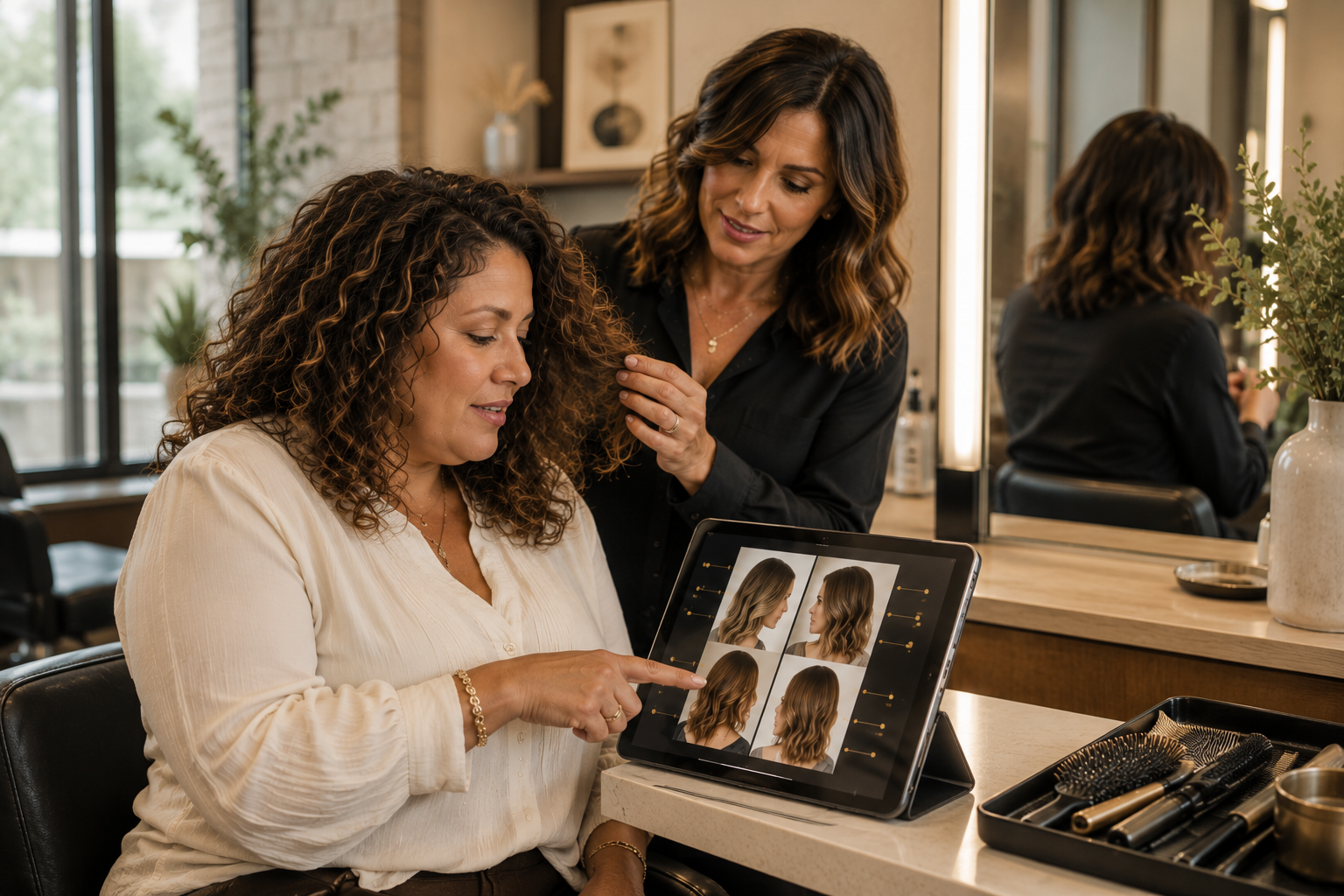
Bringing inspiration photos to your consultation is always a good idea. The surprising part is that your stylist may not be looking at the same thing you are. You might be drawn to the brightness around the face, while your stylist is studying the root color, the placement of the highlights, or the overall depth. You are both looking at the same photograph, but your attention has landed on different details. That is why it helps to explain exactly what caught your eye. Your observations tell your stylist far more than handing over a photo and hoping you both see the same thing.
The same approach works when you are talking about your own hair.
"My blonde always seems warmer after a few weeks." "I miss the depth my brunette had right after my appointment." "I like my highlights. I just do not want them to stand out so much."
Comments like these give your stylist a much clearer picture of what you are experiencing than simply saying you do not like your color anymore.
If you have had a Seasonal Color Analysis, bring your color fan or swatches with you. They help communicate the overall direction you want to achieve.
It is also worth mentioning your lifestyle and how much maintenance you prefer. Time in the sun, frequent swimming, daily washing, and the level of upkeep you are comfortable with all influence the recommendations your stylist will make.
Clear conversations lead to better results. The more specific you are about what you are seeing, the easier it becomes for your stylist to understand what you hope to achieve.
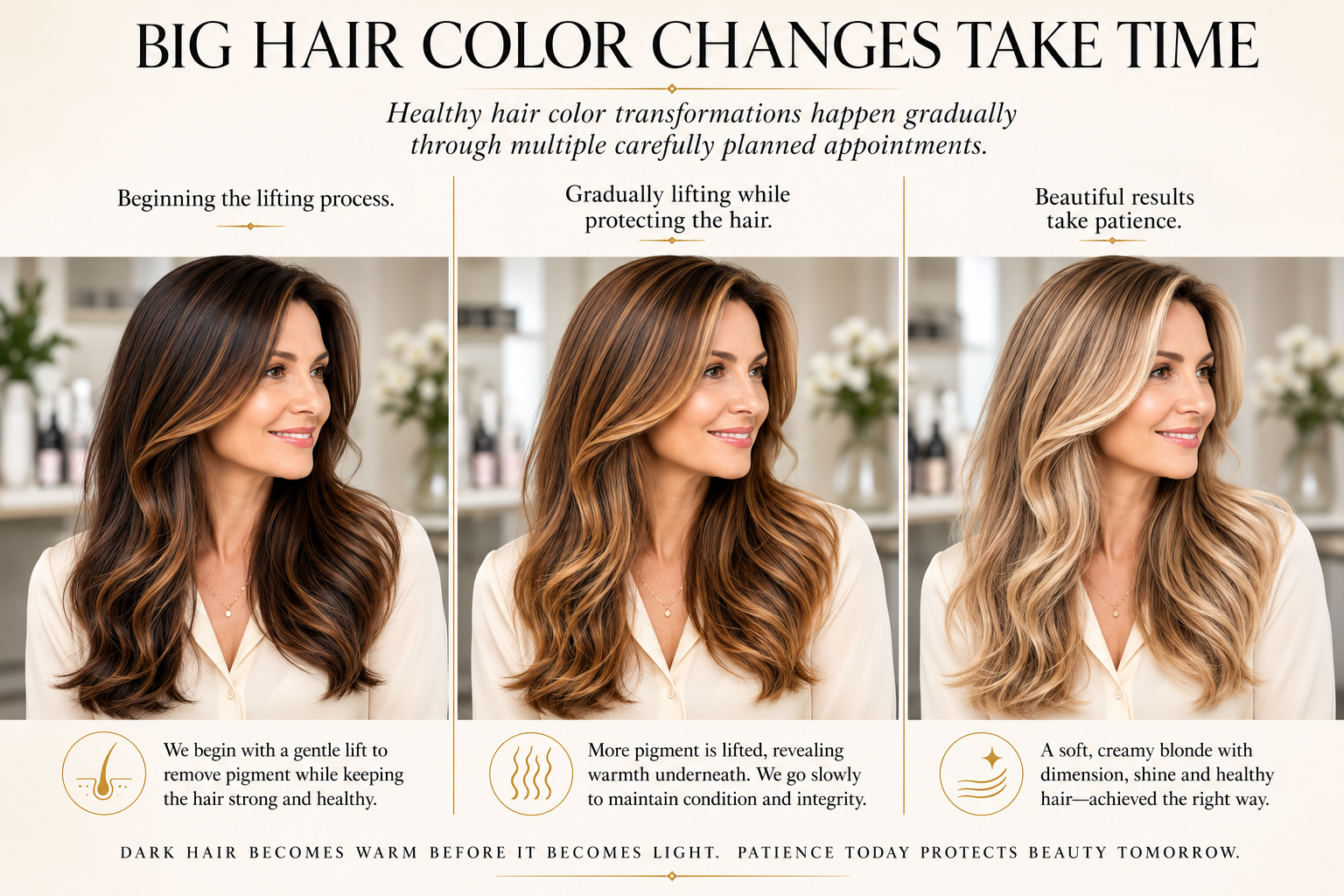
Social media has made dramatic hair transformations look surprisingly simple. A short video can make it seem as though someone walked into the salon with nearly black hair and walked out a few hours later as a bright platinum blonde. What those videos never show are the initial consultation, the conditioning treatments between visits, and the months it often takes to reach that final result.
This conversation happens in salons every day. A client arrives with a photo of icy blonde hair after years of dying their hair a dark brunette. The excitement makes perfect sense. So does the disappointment when they learn it probably will not happen in one appointment, or even two, or three.
My husband, a Master Colorist and John Paul Mitchell National Educator, explains this to clients constantly. A dark brunette does not safely become a light platinum blonde in a single afternoon. Each appointment removes a little more pigment while giving the hair time to stay healthy enough for the next step.
Going darker is much simpler than going lighter. As hair is lifted, more warmth appears before the lighter shades you are hoping for begin to show. Trying to rush that process leaves the hair dry, fragile, or uneven.
A good colorist is thinking about the condition of your hair at every stage, not just the final shade. Sometimes the best decision is stopping for the day, letting the hair recover, and continuing at the next appointment.
Waiting is not always exciting, but keeping your hair healthy is absolutely worth the time it takes.
Why Hair Texture Changes the Way Hair Color Looks
The same hair color can look completely different from one person to the next, even when the color formula is identical. Highlights make this easy to see. On straight hair, each ribbon of color stands out clearly. Add waves or curls, and those same highlights begin to blend together, creating a softer, more layered effect. The very same brunette can suddenly look far more dimensional without changing the formula at all.
Texture changes the way light moves across the hair, so it also changes the way color is perceived. That is why two people can choose the same shade and the same highlight placement, then leave the salon with results that look vastly different.
How Hair Color Decisions Change After 45
You can ask for the same hair color year after year, and then one day it just doesn’t feel like it fits anymore. The rich chestnut you used to love starts feeling a little heavier or the honey blonde that always brightened your face doesn’t lift your complexion the way it used to.
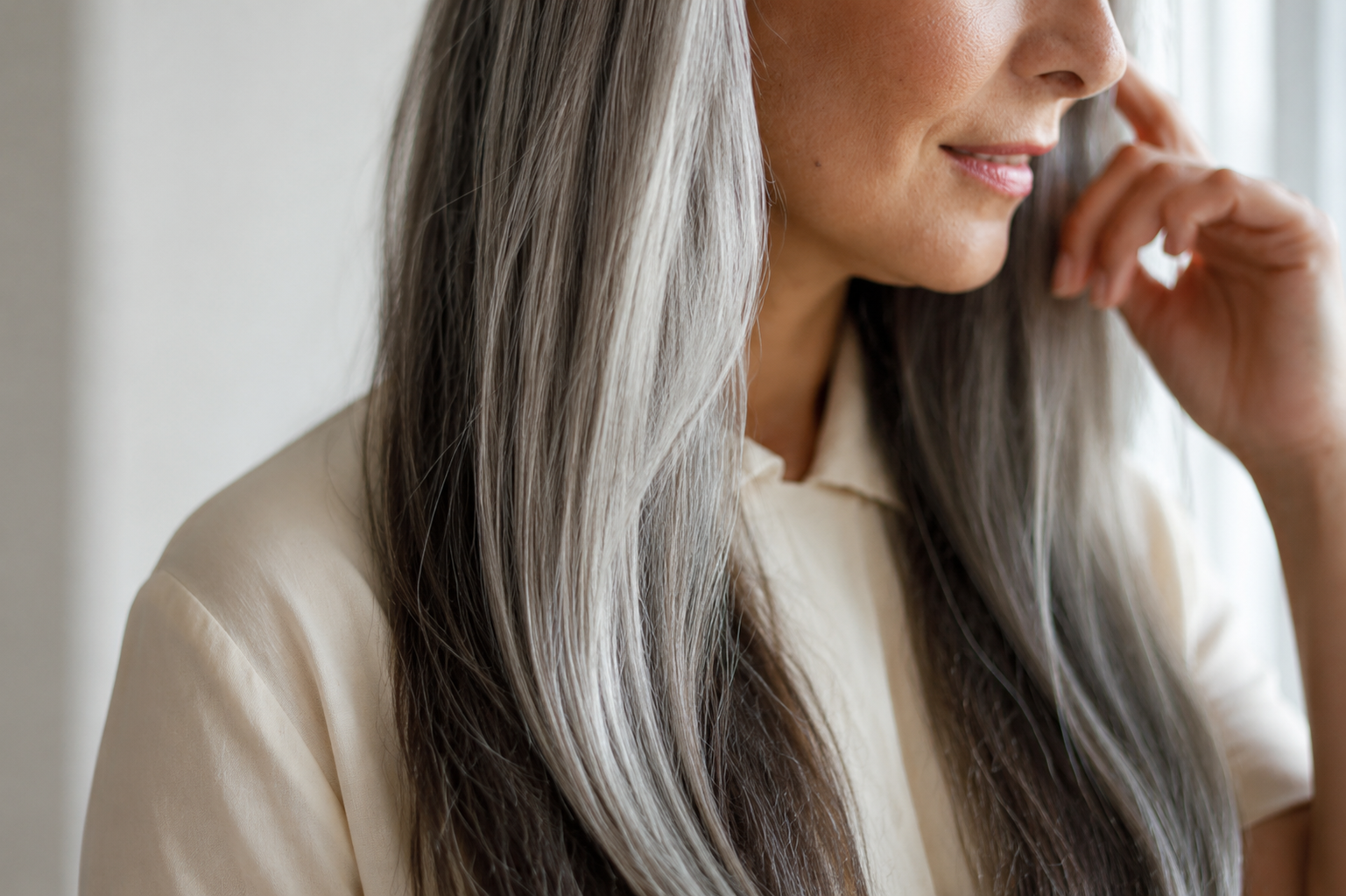
Most of us eventually experience that moment when a familiar shade suddenly feels “off,” even though the formula hasn’t changed. You catch yourself wondering why a color you’ve worn forever doesn’t feel like you anymore, and you can’t quite put your finger on what shifted.
Then the little changes start making sense. A few silver strands appear around your hairline. Your brows soften and lighten. Your skin reflects color differently than it did ten years ago. Each change is subtle on its own, but together they reshape how your hair color reads.
For some, that means adding a bit more dimension around the face. Others feel better with a softer highlight pattern or by letting their natural silver blend in. A few thoughtful adjustments can make a familiar color feel like your own again.
Frequently Asked Questions
How do I choose between permanent, demi-permanent, and gloss?
That decision has more to do with your hair goals than your season.
A gloss refreshes tone and shine. Demi-permanent color blends and enhances with less commitment. Permanent color creates the longest-lasting change. Your stylist can recommend the best approach based on your hair's condition and what you're hoping to achieve.
How much maintenance does my hair color require?
The answer depends less on on the color you've chosen. A cool blonde may need regular toning, while a dimensional brunette can often go much longer between appointments. Your stylist can help you choose a direction that fits both your coloring and the amount of maintenance you're comfortable with.
Is it safe to color your hair during pregnancy?
This is an important conversation to have with both your obstetric provider and your stylist.
Many healthcare providers consider certain hair coloring services to be low risk during pregnancy, particularly after the first trimester, because only a small amount of color is absorbed through the scalp. Even so, recommendations vary depending on your stage of pregnancy, your medical history, and the type of color service you're considering. Your healthcare provider is the best person to guide that decision.
How does menopause affect your hair and hair color?
Many women notice their hair shifting during menopause. It may become finer, drier, coarser, or less dense. Gray hair often becomes more visible, and the texture itself can change. All of these shifts influence the way hair reflects light, holds color, and responds to highlighting or coloring services.
Your seasonal palette does not change, but the way you express it does. A color you have loved for years may benefit from a different highlight placement, a little more dimension, or subtle adjustments in depth as your hair and skin continue to evolve. Regular conversations with your stylist become even more valuable during and after menopause because your hair keeps changing.
Can I still have highlights if I'm embracing my gray hair?
Absolutely.
Embracing gray doesn't mean giving up highlights forever. Many women choose to blend their silver with highlights or lowlights to create more dimension, soften the transition, or reduce the contrast between new growth and previously colored hair.
The approach depends on your natural gray pattern, your maintenance preferences, and the overall look you're hoping to achieve. Some women enjoy a bright, silver-forward appearance. Others prefer to weave gray into a softer blend that still includes touches of blonde or brunette.
Seasonal Color Analysis can help guide those decisions by keeping the temperature, depth, and overall character of the color aligned with your natural coloring.
Should I choose hair color before updating my makeup and wardrobe?
Hair frames your face every day, so it is a sensible place to begin. Once your hair color feels settled, it becomes much easier to evaluate clothing and makeup because the frame around your face has already been established.
Can I still wear trend colors like rose gold, lavender, or teal?
Yes, but they're rarely one-size-fits-all.
Fashion colors still have temperature, depth, and softness. A rose gold that flatters a Spring won't necessarily be the same rose gold that feels at home on a Summer. It's about choosing a version that complements your own coloring.
Final Thoughts
The next time you sit down in your stylist’s chair, the conversation may feel a little different. You might still bring inspiration photos. You might still want a brighter blonde, a deeper brunette, or decide it is finally time to embrace your silver. The difference is that you will understand what you are responding to. It will not be just the color itself. You will notice the depth, the temperature, the softness, the contrast, and the way those qualities interact with your own features.
Instead of searching for the exact formula someone else is wearing, you will have a clearer picture of what you want to create for yourself. Your stylist can then translate those ideas into a color that fits your hair, your maintenance preferences, and your personal coloring.
Seasonal Color Analysis gives you a way to understand why certain colors continue to feel like you, even as your hair and your life change.
Thank you for spending part of your day with me.
I appreciate you being here, and I hope this guide helps you feel a little more confident the next time you're talking with your stylist.
— Heather
Continue Exploring
If you're ready to explore Seasonal Color Analysis more deeply, these guides are a wonderful next step.
The Complete True Summer Color Guide
Explore the wardrobe colors, makeup, accessories, and hair color directions that bring the True Summer palette to life.The Complete Soft Summer Color Guide
Discover the gentle, muted colors that create Soft Summer's signature elegance.The Complete Light Summer Color Guide
Learn how lightness, freshness, and delicate contrast shape the Light Summer palette.
Shop the Guide
The products in this collection support many of the ideas we've explored throughout this guide. You'll find color-protecting hair care, glosses, toning shampoos, heat protection, scalp care, and a few everyday tools that help maintain healthy, beautiful hair between salon visits.
Choose what fits your own hair, lifestyle, and maintenance routine. These specially curated products can help preserve the work you and your stylist have created.
Disclosure: This article may contain affiliate links. If you make a purchase through these links, I may earn a commission at no additional cost to you.
