

The Complete True Summer Color Guide

You can usually tell when a color is working for you. Your complexion looks fresher, your eyes stand out, and the clothing seems to belong on you. Sometimes the difference comes down to a surprisingly small shift in undertone. One blue looks wonderful; another, only a shade away, doesn't have quite the same effect.
If you've always been drawn to cool blues, raspberry and cranberry, blue-green, violet, silver-gray, and softened navy, you may be a True Summer.
True Summer is the coolest expression of the Summer family, with more depth and color than many people expect from a Summer season. Cornflower and denim blue sit comfortably beside cool teal, rose, plum, lavender, and deeper berry shades.
A garden after summer rain captures its character beautifully. Hydrangeas deepen into blue and violet, wet stone turns blue-gray, and green leaves take on a cooler cast beneath an overcast sky. As the light begins to fade, those colors become richer without becoming heavy.
In this guide, we'll explore the complete True Summer palette and how to use it across your wardrobe, makeup, hair, jewelry, and nails. We'll also look at how True Summer relates to the other Summer seasons and what may shift as your coloring changes with age.
Whether you're new to seasonal color analysis or trying to make sense of colors you've instinctively loved for years, I hope this guide makes True Summer easier to recognize and use. You walk into a shop, spot a sweater halfway across the room, and think, there's my blue.
What Is True Summer?
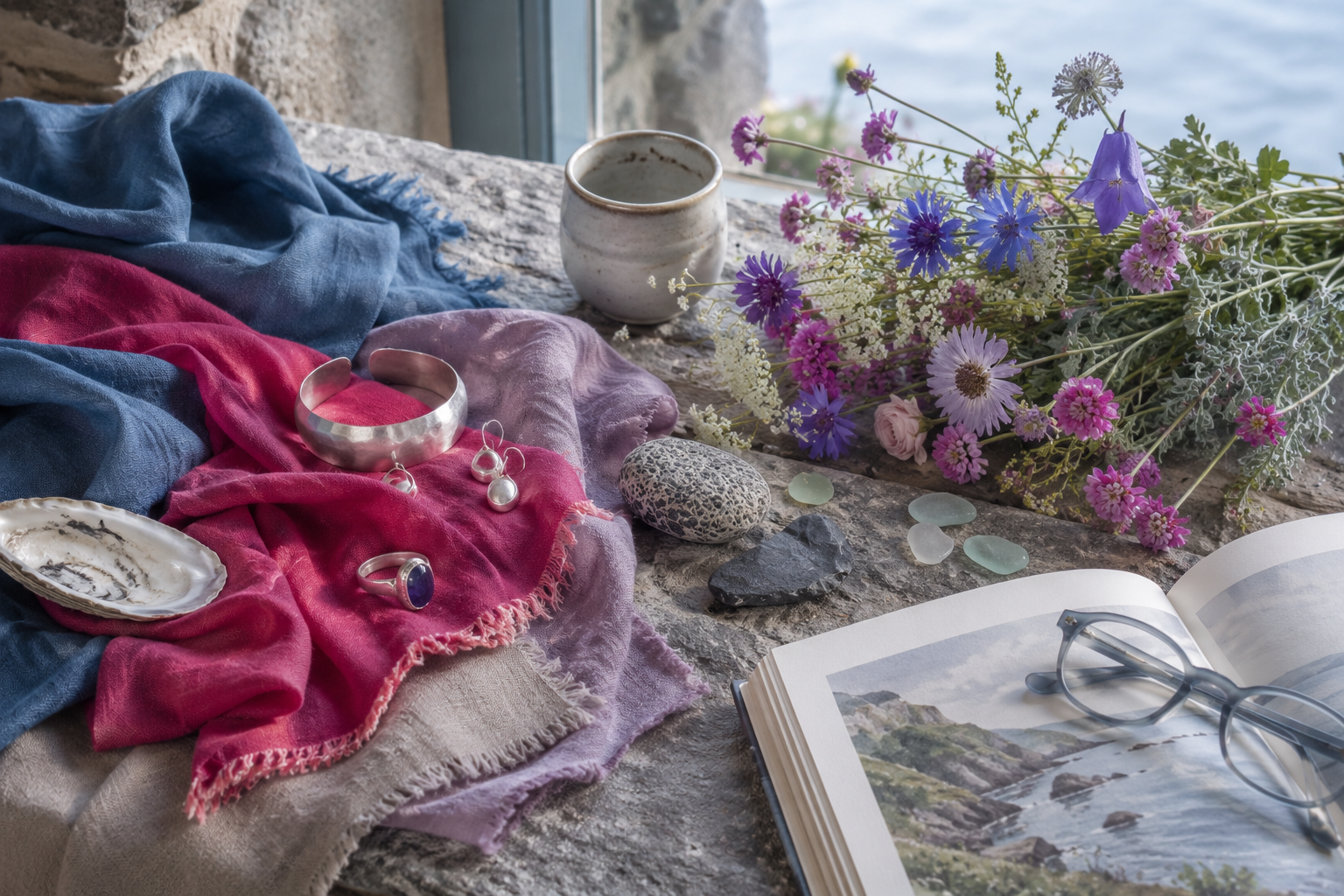
True Summer is the coolest of the three Summer seasons. In the twelve-season color system, it sits between Light Summer and Soft Summer. The palette is blue-based, moderately softened, and generally light to medium in value, with enough depth for shades such as Plum, Blue Charcoal, Cranberry, and Deep Teal.
Coolness is its defining characteristic. A color can have the right depth and still feel wrong when too much yellow or warmth is present. Peachy pink shifts away from the palette while a blue-based rose settles naturally into it. Camel carries a golden cast that Cool Taupe and Pewter do not.
True Summer is softened, but I wouldn't describe the entire palette as dusty. Raspberry should still look like raspberry, Violet should still look purple, and Blue Jade should retain its blue-green character. When gray begins to dominate and colors become smokier or more earthy, you're moving toward Soft Summer.
Light Summer moves in the other direction. Its slight Spring influence creates a lighter, more luminous palette with less room for the deeper colors True Summer handles so well.
Learning to recognize these differences is more useful than memorizing color names. Two garments labeled “rose,” “navy,” or “sage” can have completely different undertones. The name gets you into the general neighborhood; the color in front of you tells you whether you've arrived at the right address.
Characteristics of a True Summer
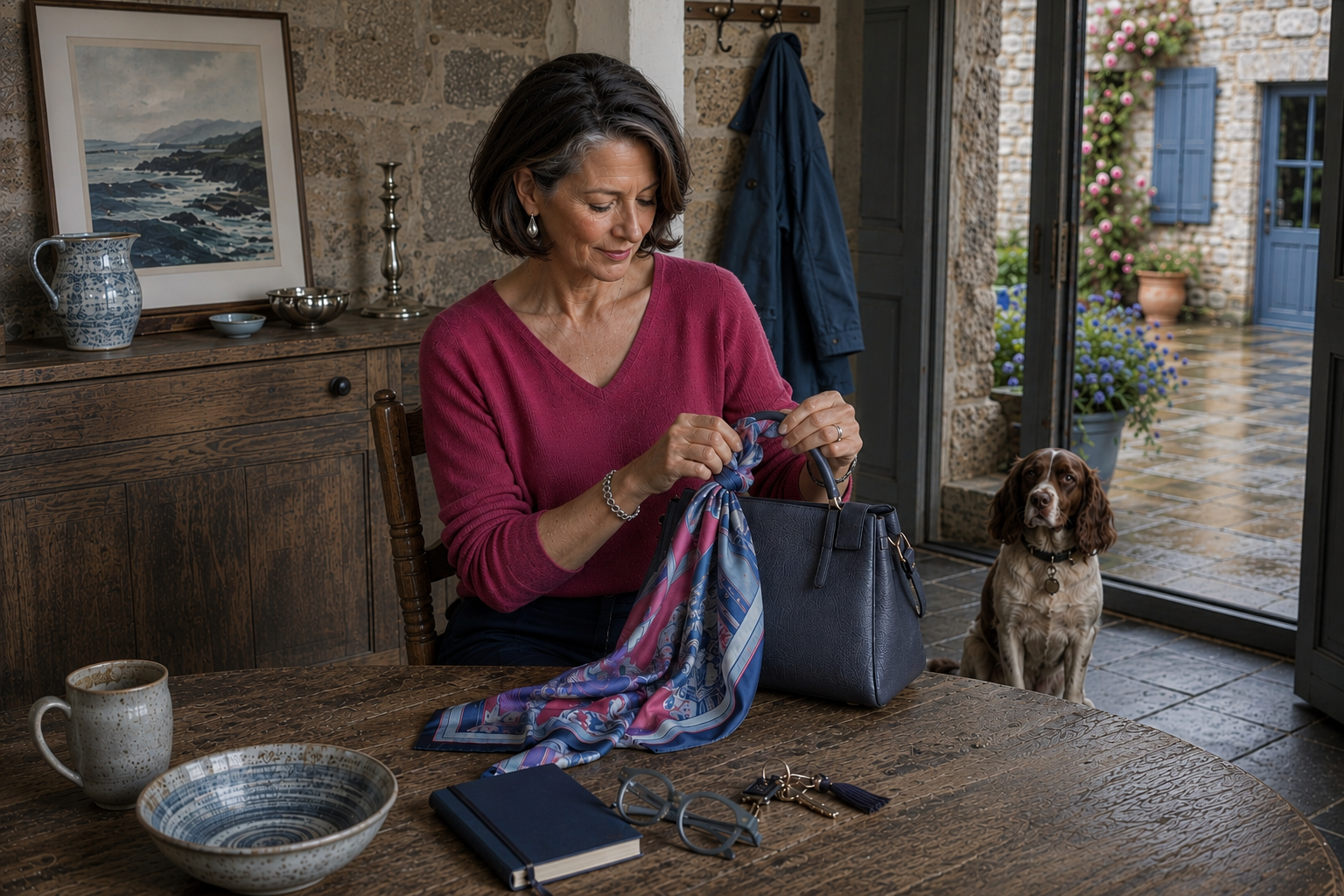
True Summers share a color relationship rather than one particular combination of hair, skin, and eyes. Two women may look quite different and still belong to the same season.
No single feature determines it. The way your coloring responds when different shades are placed near the face tells us far more.
Skin
True Summer skin occurs across a wide range of complexions, with cool or cool-neutral undertones. Cool skin doesn't necessarily appear visibly pink; on some women, the undertone is much easier to recognize through comparison.
Surface redness, pigmentation, freckles, and sun exposure can affect what we see without changing the underlying temperature of the skin.
Eyes
Blue, gray, blue-green, hazel, and brown eyes are all possible.
Denim Blue, Violet, Teal, and other cool shades may bring out details in the iris that aren't immediately obvious, from a gray-blue outer ring to cooler green or violet-brown flecks.
Brown eyes don't automatically indicate Autumn any more than blue eyes automatically indicate Summer.
Hair
Natural hair ranges from blonde through deeper brunette, with ash, neutral-cool, or smoky qualities appearing frequently. Strong gold, copper, and red warmth are less characteristic.
Temperature is sometimes easier to recognize through comparison. A brunette that seems neutral on its own may appear distinctly cooler beside chestnut or golden brown.
Gray, silver, and salt-and-pepper hair can also be part of True Summer coloring.
Contrast
True Summer typically has moderate natural contrast. There is enough definition among the features to support richer shades such as Cranberry, Plum, Deep Teal, and Marine Blue, without requiring Winter's sharp light-dark extremes.
The exact balance varies from woman to woman. A fair blonde and a deep brunette may both be True Summers while carrying very different amounts of natural depth.
The Overall Impression
Step back from the individual features and look at the woman as a whole. In the right colors, the complexion appears clearer, the eyes become more noticeable, and the clothing doesn't compete with the face.
A True Summer may be blonde or brunette, fair or deep-skinned, blue-eyed or brown-eyed. Draping and repeated color response are much more revealing than trying to match yourself to a prescribed set of features.
What Happens When True Summers Age?
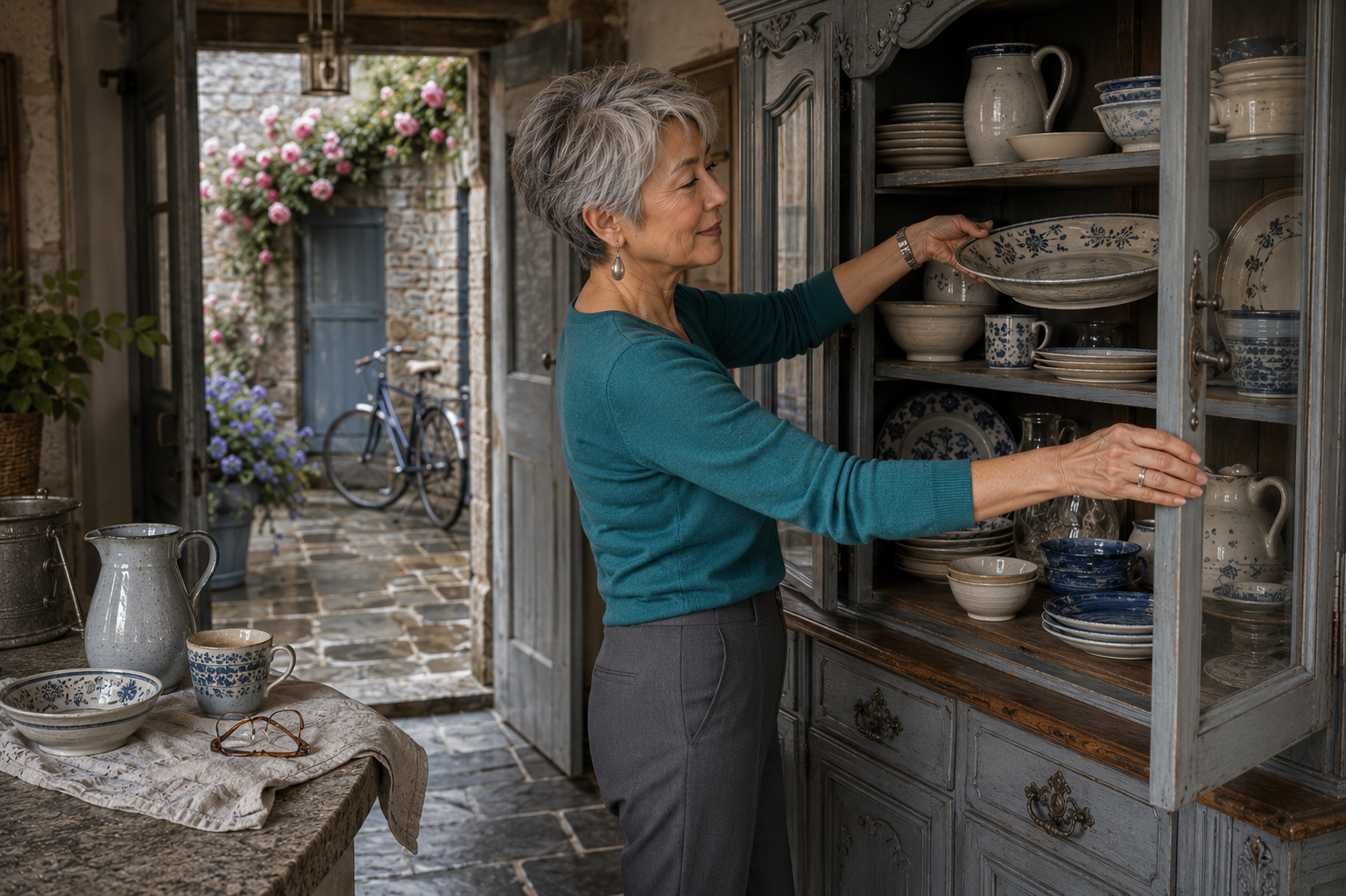
As we age, our natural coloring continues to evolve. Hair moves toward silver, pewter, or cool gray. Brows may become lighter, while menopause and years of sun exposure can influence pigmentation, texture, and the way light reflects from the skin. The face we're dressing at 55 or 65 isn't quite the same face we were dressing at 35.
Some women respond by adding more contrast through darker hair, stronger makeup, or deeper clothing. Before making those changes, it's worth looking at how your existing True Summer colors behave against your coloring now.
Silver hair can be especially beautiful with this palette. Blues, berries, violets, and blue-greens take on a different character beside it. You may find yourself wearing Summer Blue and Periwinkle more frequently, or discover that Cranberry, Plum, and Deep Teal are even more striking than they were before.
The same reassessment applies to makeup. A lipstick you once wore at full opacity may look better as a softer stain. Plum eyeshadow might move closer to the lashes, while Rose blush needs a little more pigment to remain visible. These are small adjustments to the face you have today.
I would resist the familiar idea that getting older means gradually disappearing into pale neutrals. True Summer still gives you Raspberry, Teal, Violet, Cranberry, and beautiful blues. Which of those colors you favor may change over the years.
Why True Summer Colors Feel So Refined

True Summer has a richness that is easy to underestimate. Raspberry, Marine Blue, Violet, Cranberry, Cool Teal, Rose, and Pewter have real presence, yet they sit comfortably beside one another.
The blues retain depth, berries stay distinctly colorful, and violet and blue-green remain recognizable rather than becoming heavily grayed. Even the deeper shades have a certain lightness to them.
You can see the effect particularly well in clothing. Deep Teal has enough presence for a full-length dress or tailored suit. Cranberry brings color to winter knitwear and outer layers, while Pewter, Soft Navy, and Cool Taupe make beautiful foundations for leather, wool, cashmere, denim, and silk.
The palette also leaves plenty of room for personal style. The same colors can move through a romantic wardrobe, clean tailoring, relaxed denim, artistic prints, minimalist pieces, or something far more eclectic. Seasonal color analysis tells you which colors relate well to your coloring; the clothes you choose to wear in them are entirely your own.
Your Complete True Summer Color Palette
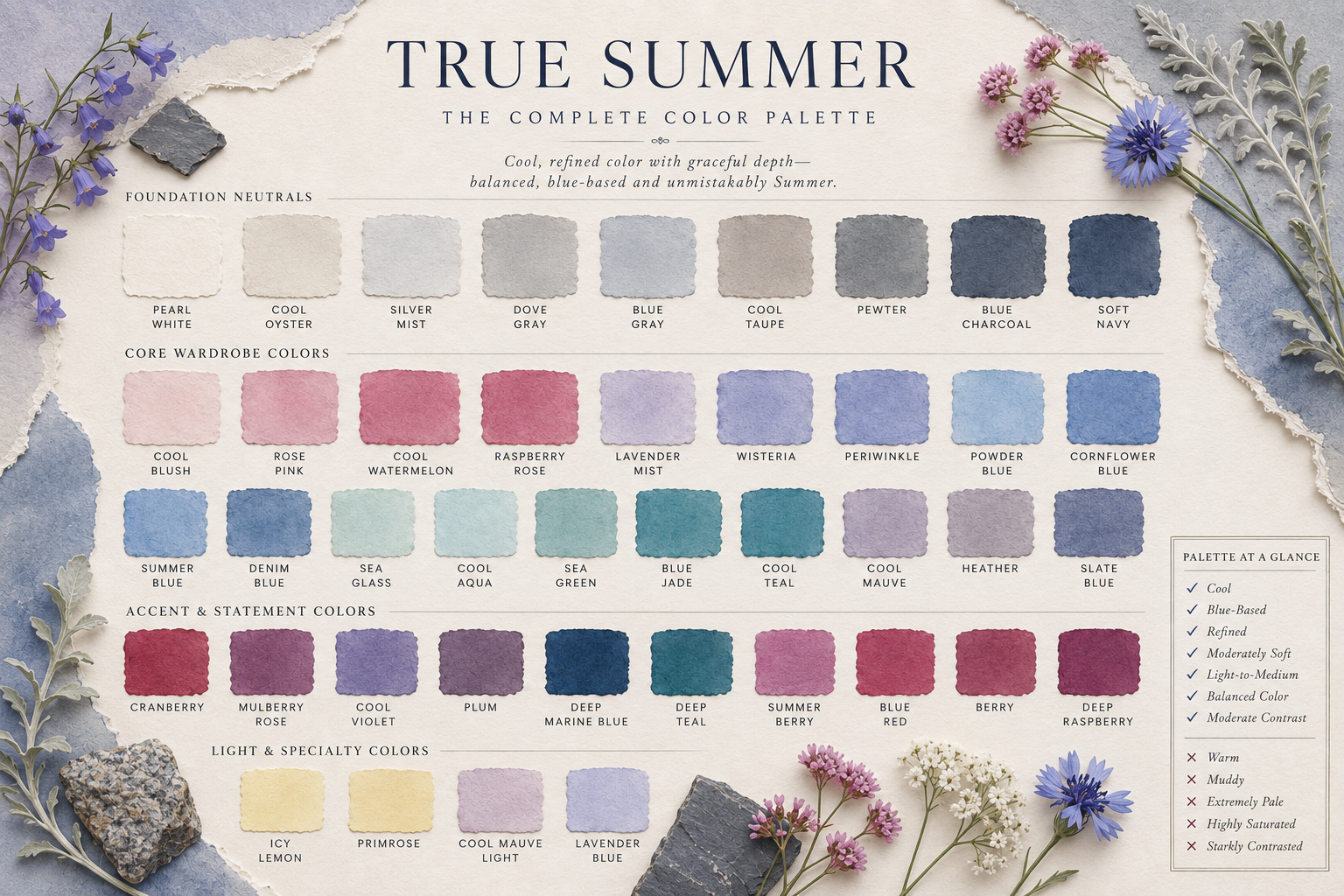
The forty-color True Summer palette moves from pale, light-reflective shades through substantial midtones and a smaller group of deeper colors. Blues are especially well represented, joined by roses, berries, violets, blue-greens, and silvery neutrals.
Foundation Neutrals
These are the shades that give a True Summer wardrobe its foundation:
Pearl White
Cool Oyster
Silver Mist
Dove Gray
Blue Gray
Cool Taupe
Pewter
Blue Charcoal
Soft Navy
Instead of golden beige, camel, warm cream, or chocolate brown, True Summer neutrals move through oyster, taupe, gray, charcoal, and navy.
Soft Navy and Blue Charcoal provide useful depth, while Pearl White and Cool Oyster cover the lighter end. Cool Taupe is particularly helpful if you like the versatility of beige but find that many versions turn golden against your skin.
Core Wardrobe Colors
This is the largest part of the palette:
Cool Blush
Rose Pink
Cool Watermelon
Raspberry Rose
Lavender Mist
Wisteria
Periwinkle
Powder Blue
Cornflower Blue
Summer Blue
Denim Blue
Sea Glass
Cool Aqua
Sea Green
Blue Jade
Cool Teal
Cool Mauve
Heather
Slate Blue
Blues occupy a generous part of this group, alongside rose, mauve, violet, and blue-green. These are the colors you're likely to see working across everyday clothing, from denim and knitwear to dresses, swimwear, jackets, skirts, and casual separates.
Accent & Statement Colors
The deeper end of the palette includes:
Cranberry
Mulberry Rose
Cool Violet
Plum
Deep Marine Blue
Deep Teal
Summer Cherry
Blue Red
Berry
Deep Raspberry
Cranberry and Deep Raspberry are useful alternatives when burgundy turns too brown. Deep Teal gives you a richer green without moving toward olive, while Deep Marine Blue can take the place of much darker navy or black.
Summer Cherry and Blue Red cover the classic red territory, both firmly on the blue-based side.
Light & Specialty Colors
A smaller group expands the lighter end:
Icy Lemon
Primrose
Cool Mauve Light
Lavender Blue
Icy Lemon and Primrose are cooler than butter, mustard, or golden yellow and work well in smaller doses, prints, lightweight knits, and warm-weather pieces. Cool Mauve Light and Lavender Blue add two more pale options beyond the familiar blues and pinks.
Metallics
The easiest metals to incorporate are:
Silver
Sterling Silver
White Gold
Platinum
Pewter
Soft or antiqued silver finishes
Highly polished silver reflects more light, while brushed, satin, and antiqued finishes have a more subdued character. We'll look more closely at metals and gemstones later in the guide.
Colors to Consider Carefully
True Summer usually has a more difficult relationship with shades dominated by yellow, orange, or earthy brown:
Black
Optic White
Camel
Golden Beige
Chocolate Brown
Rust
Terracotta
Mustard
Olive
Warm Coral
Peach
Tomato Red
Bright Orange
Yellow Gold
Very dusty colors can also become too muted, while extremely pale shades may lack enough substance. At the other end, highly saturated jewel tones and stark light-dark combinations can overpower the more moderate contrast of True Summer.
If one of these colors already has a happy place in your wardrobe, there's no need to evict it. This list is most useful when you're comparing new purchases.
The True Summer Palette at a Glance
✓ Cool
✓ Blue-based
✓ Light-to-medium overall
✓ Meaningful medium depth
✓ Moderately softened
✓ Moderate contrast
✓ Colorful and refined
✗ Warm
✗ Golden
✗ Earthy or muddy
✗ Extremely pale overall
✗ Heavily muted
✗ Highly saturated
✗ Starkly contrasted
You may discover that you live in Soft Navy, Denim Blue, Raspberry Rose, and Pewter, while another True Summer gravitates toward Violet, Teal, and Berry. You don't need all forty colors represented equally. The pleasure comes from discovering your own favorites within a palette that already knows how to work together.
The True Summer Style Philosophy
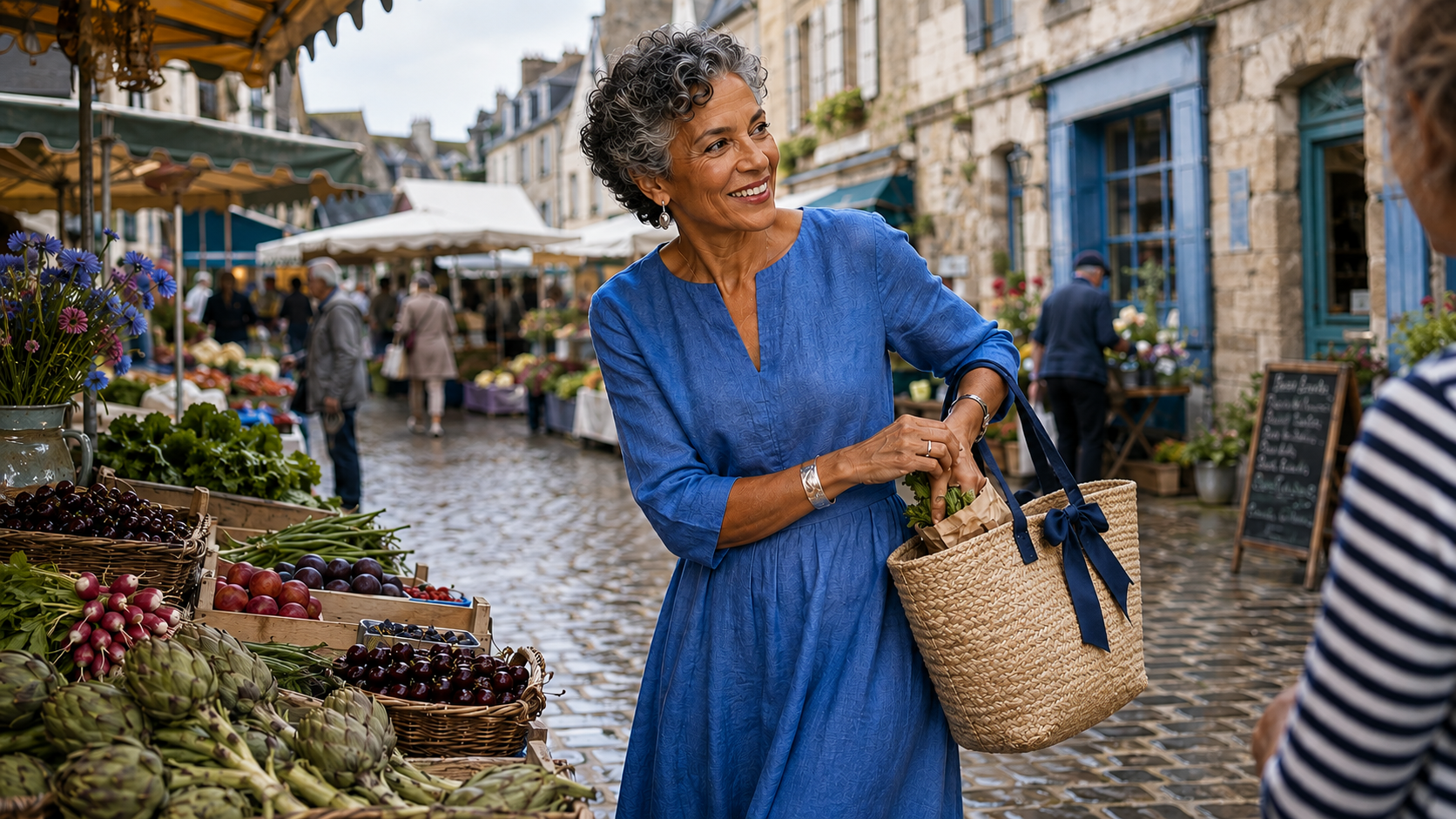
Seasonal color and personal style are two different things. The same True Summer palette can belong in a tailored wardrobe, relaxed denim, romantic dresses, minimalist separates, or something far more eclectic.
Let your lifestyle determine where the palette matters most. Start with the clothes you wear repeatedly and the pieces you keep for years. If most of your week is casual, getting the undertone right in denim, everyday knitwear, jackets, and shoes will matter more than building a collection of dressier colors you rarely wear. For a professional wardrobe, tailoring, leather goods, and outerwear deserve more attention. These are also sensible places to invest because they need to coordinate with so much of your closet.
Use less expensive or easily changed pieces to explore colors you're less certain about. A tee, summer skirt, inexpensive pair of earrings, or nail polish is a much easier experiment than a wool coat or leather handbag. You may discover that a shade you initially considered an accent becomes one of the most useful colors you own.
Prints require a slightly different eye. Stand back and judge the overall impression rather than checking every flower or stripe against your color fan. A small amount of warmth rarely ruins a print when the dominant effect remains cool. Background color deserves more attention because it may occupy most of the garment, particularly in a dress or blouse worn near the face.
Fabric matters too. Color behaves differently in washed linen, faded denim, brushed wool, velvet, silk, and cashmere. Texture and finish can make a familiar shade feel casual, polished, dramatic, or understated, which is especially useful if you prefer a relatively small wardrobe or tend to repeat favorite colors.
The real payoff appears when new purchases begin connecting naturally with what you already own. Before buying something, picture three ways you could wear it using pieces already in your closet. That quick test tells you far more about its usefulness than whether the color happens to appear on your seasonal fan.
Makeup for True Summers
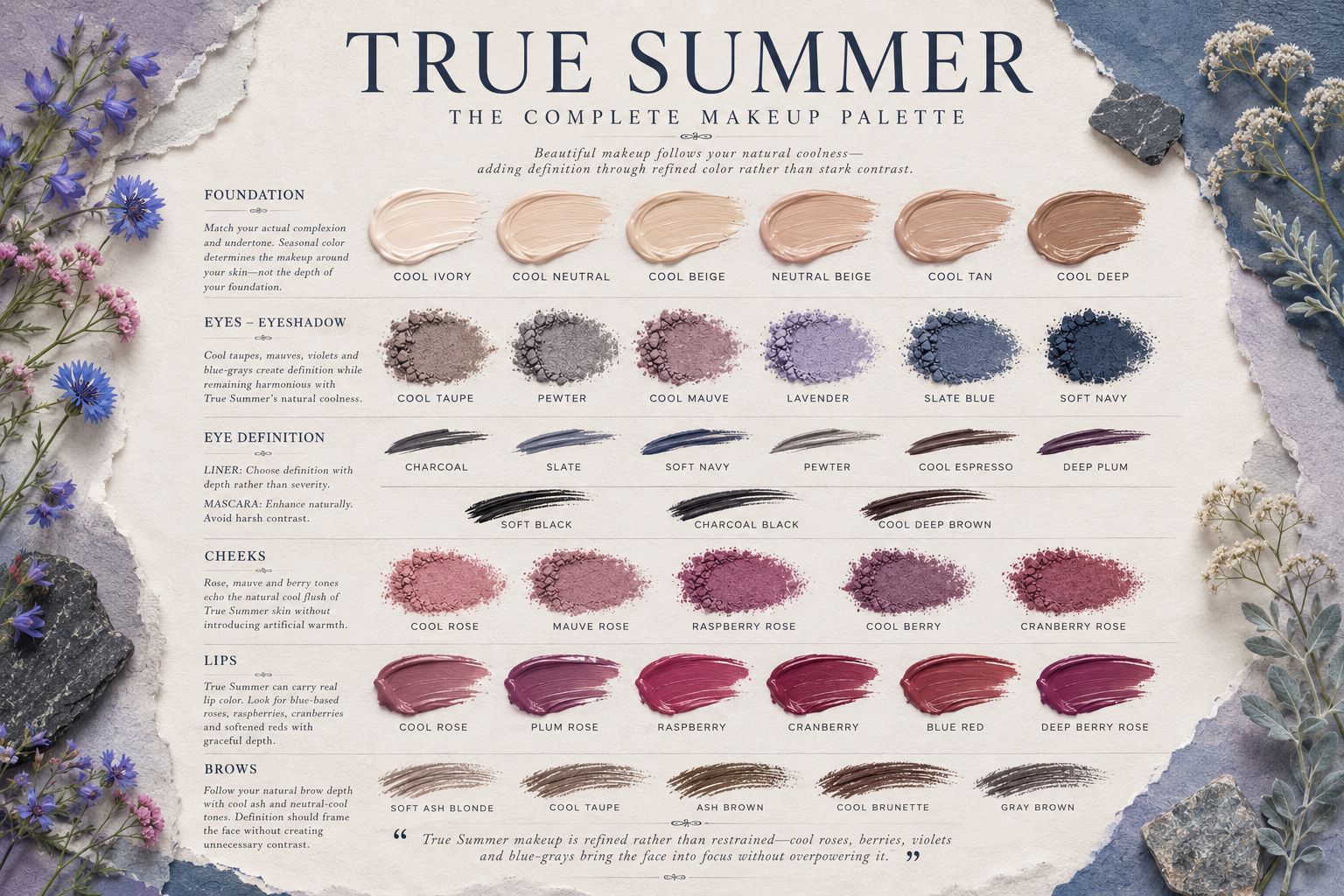
Makeup is one of the places where small shifts in undertone become especially noticeable. Rose, berry, mauve, plum, pewter, slate, and blue-gray give True Summer plenty of range, from understated daytime makeup to a stronger lip or evening eye.
Texture deserves equal attention, particularly as skin changes with age. Satin, softly luminous, and finely milled finishes tend to be flattering on mature skin, while heavy frost, visible glitter, and dense matte formulas can emphasize texture.
Foundation
Foundation should match your skin rather than your seasonal palette.
True Summer complexions occur across many skin depths and may be cool or cool-neutral. Redness isn't proof of a cool undertone, and a True Summer shouldn't automatically reach for the pinkest foundation at the counter. Look for a shade that disappears into the complexion and remains believable across the face, neck, and chest.
The same applies to concealer. Correct what you want to correct without making the under-eye area conspicuously lighter than the surrounding skin.
Eyes
Cool Taupe, Pewter, mauve, heather, lavender, slate, blue-gray, softened navy, and plum give you a versatile eye palette.
Taupe and Pewter make excellent everyday neutrals. Mauve and heather introduce subtle color, while Plum, Slate, and softened navy can add depth at the outer corner or along the lash line.
For eyeliner, Charcoal, Slate, Soft Navy, Pewter, Cool Espresso, and Deep Plum offer alternatives to black. Soft Black, charcoal-black, and cool deep brown are good mascara options, with the depth adjusted to your natural lashes and hair.
On mature lids, fine satin and softly diffused matte textures are generally easier to work with than chunky shimmer. A little luminosity can be beautiful when you decide where you want the light.
Cheeks
Rose, mauve-pink, raspberry, cranberry rose, and cooler berry shades are natural blush directions for True Summer.
Your own flush is a useful reference, but the product also needs enough depth to register on your complexion. A pale rose that works beautifully on fair skin may disappear completely on deeper skin; the answer is more pigment, not a warmer blush.
Peach, coral, terracotta, and heavily bronzed shades introduce warmth quickly. If you enjoy adding dimension to the face, a neutral-cool bronzer or taupe-rose sculpting shade may be worth comparing with a traditional golden bronze.
Lips
True Summer has far more to offer than pale pink. Rose, mauve-rose, raspberry pink, Cool Watermelon, and soft berry work well for everyday wear, while Cranberry, Blue Red, Deep Raspberry, and plum-rose provide more depth.
“Nude” lipstick deserves a closer look. Many shades sold under that name lean caramel, peach, or yellow-brown. Rose-beige, pink-mauve, and softened berry can give you an understated lip while retaining enough color to define the mouth.
I particularly like Raspberry and Cranberry on True Summer women who enjoy a stronger lip. They can bring a surprising amount of life to the face with very little additional makeup.
Brows
Choose brow color according to your natural hair and coloring rather than the seasonal palette itself.
Ash blonde, taupe, cool brown, gray-brown, and deeper neutral-cool shades cover a wide range of True Summers. If your hair has become silver or gray, reassess the brow color you've used for years; something slightly softer or cooler may now sit more naturally with the hair.
Watch brunette brow products for unexpected red or gold. The warmth can be much more obvious once the product is applied than it appeared in the pencil or pot.
The Best Hair Colors for True Summers
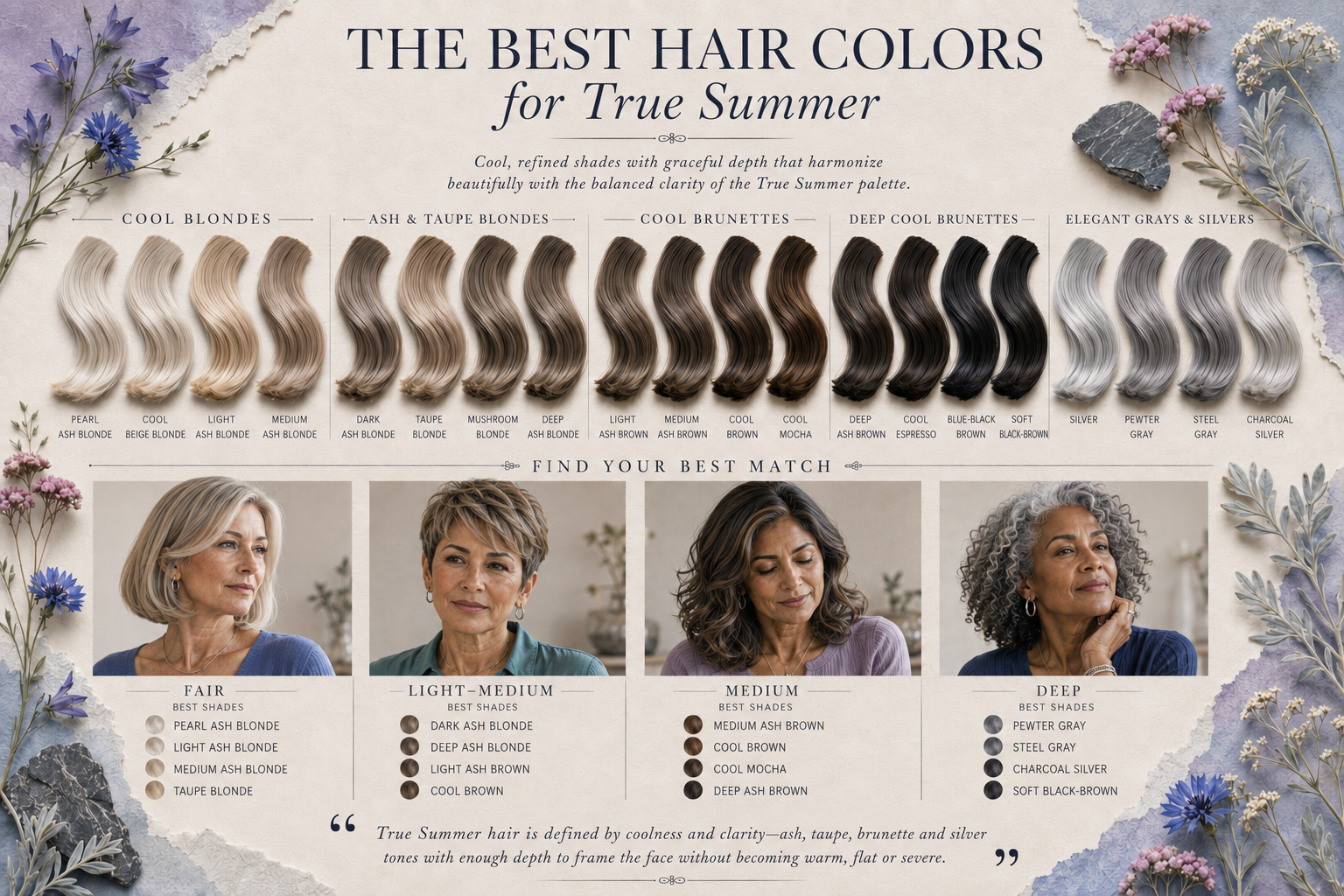
Hair occupies a large area around the face, so changes in temperature or depth can have a noticeable effect on the complexion. True Summer hair commonly has an ash, neutral-cool, or softly smoky quality, with natural depth ranging from blonde through deeper brunette.
Blonde
Ash blonde, cool beige blonde, dark ash blonde, and softly pearled shades are good directions for True Summer.
With highlights, watch the gradual accumulation of gold. I've seen blonde clients begin with beautifully dimensional highlights, then become progressively lighter and warmer with each salon visit. Leaving some natural depth between the lighter pieces helps preserve dimension and keeps the result from drifting toward buttery blonde.
Brunette
Mushroom brown, cool medium brown, smoky brunette, and deeper neutral-cool brown all work within the season.
Brunettes don't automatically need blonde highlights for dimension. Subtle variation within the brown can be beautiful, and when lighter pieces are added, mushroom, taupe, or cool beige usually integrates more naturally than caramel or honey.
Gray and Silver
Silver, pewter, steel gray, salt-and-pepper, and blended gray are especially compatible with True Summer coloring.
If you're transitioning from previously colored hair, gray blending or carefully placed lowlights can help connect new silver growth with the older lengths. Previously colored hair may also need some attention as lingering gold or red becomes more noticeable beside cooler new growth.
Hair Colors to Consider Carefully
The shades most likely to compete with True Summer coloring are those that introduce substantial warmth or create more contrast than your individual coloring supports.
These include:
Golden and honey blonde
Buttery blonde
Caramel
Copper
Cinnamon
Warm auburn
Mahogany
Golden or warm chestnut
Strongly reddish brunette
Blue-black or near-black on naturally lighter True Summers
High-contrast golden highlights
Very dark color deserves a different kind of consideration. A naturally deeper brunette may be completely at home with substantial depth, while blue-black or near-black can create a dramatic change on a naturally fair True Summer.
If you color your hair, your original shade is useful information. Old photographs can help you and your colorist see the depth and temperature you started with before years of highlights, permanent color, sun exposure, or gray changed the picture.
The Best Nail Colors for True Summers
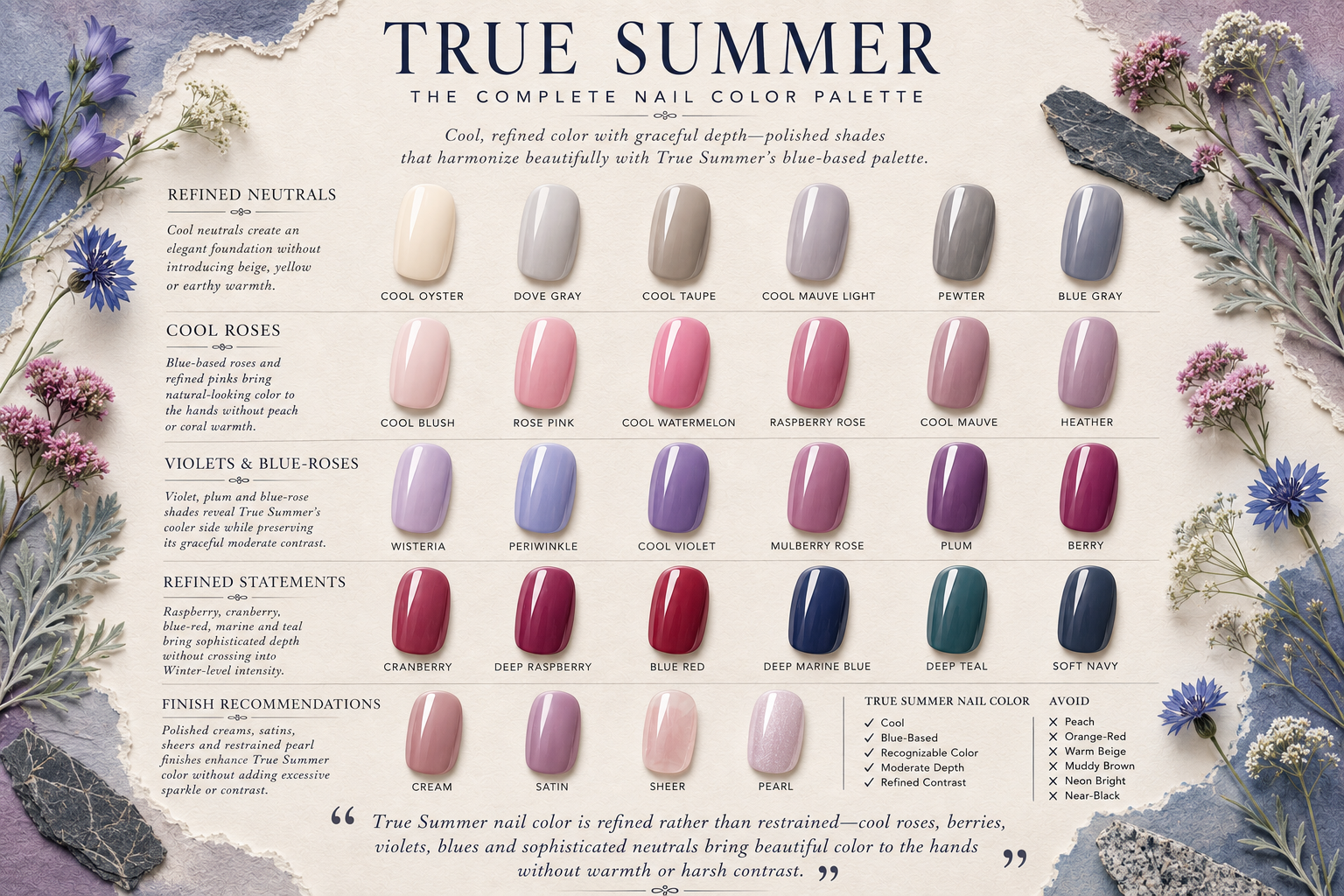
Nails are an easy place to explore more of the True Summer palette. Because polish sits away from the face, deeper berries, blues, violets, and teals can be just as useful as quieter roses, mauves, and neutrals.
Everyday Neutrals
For a polished, understated manicure, look for:
Cool Blush
Rose Pink
Cool Mauve
Cool Oyster
Dove Gray
Cool Taupe
Pewter
Gray-mauve
Pay attention to the base color, particularly with sheer pink and taupe. A pale pink may turn peachy after the second coat, while taupe frequently shifts toward caramel or khaki once opaque. Gray, rose, or mauve in the base usually points you in a better direction.
Classic True Summer Colors
For an everyday manicure with more color:
Raspberry Rose
Cool Watermelon
Cranberry
Berry
Summer Cherry
Blue Red
Heather
Wisteria
Denim Blue
Slate Blue
Blue Jade
Cool Teal
Summer Cherry and Blue Red give you classic reds without the orange cast of tomato or brick. Raspberry, Cranberry, and Berry are especially useful when traditional burgundy starts looking brown.
Elegant Statement Colors
For a deeper or more distinctive manicure:
Deep Raspberry
Mulberry Rose
Plum
Cool Violet
Deep Teal
Deep Marine Blue
Blue Charcoal
Pewter metallic
I particularly like these deeper shades on short, neatly shaped nails. Plum and Deep Teal have plenty of presence on their own, while Pewter offers a metallic option that still feels sophisticated.
Colors to Consider Carefully
These shades tend to move farther from the True Summer palette:
Peach
Warm Coral
Tomato Red
Orange-red
Terracotta
Caramel
Warm Beige
Khaki
Olive
Golden Brown
Neon Pink
Bright Turquoise
Polish names are notoriously unreliable, so judge the finished color whenever possible. Berry may dry brown, a supposed nude may turn peach, and turquoise can contain considerably more yellow-green than it appeared to in the bottle.
Finish Matters
Cream, sheer, jelly, pearl, and fine shimmer finishes can all work beautifully. A sheer berry reads very differently from the same color in an opaque cream, while pearl or subtle shimmer adds light without substantially changing the shade.
If your nails have become more ridged with age, finish may matter as much as color. Dense frost tends to emphasize an uneven nail plate, while a ridge-filling base beneath cream or sheer polish usually creates a smoother result.
Jewelry & Gemstones for True Summer
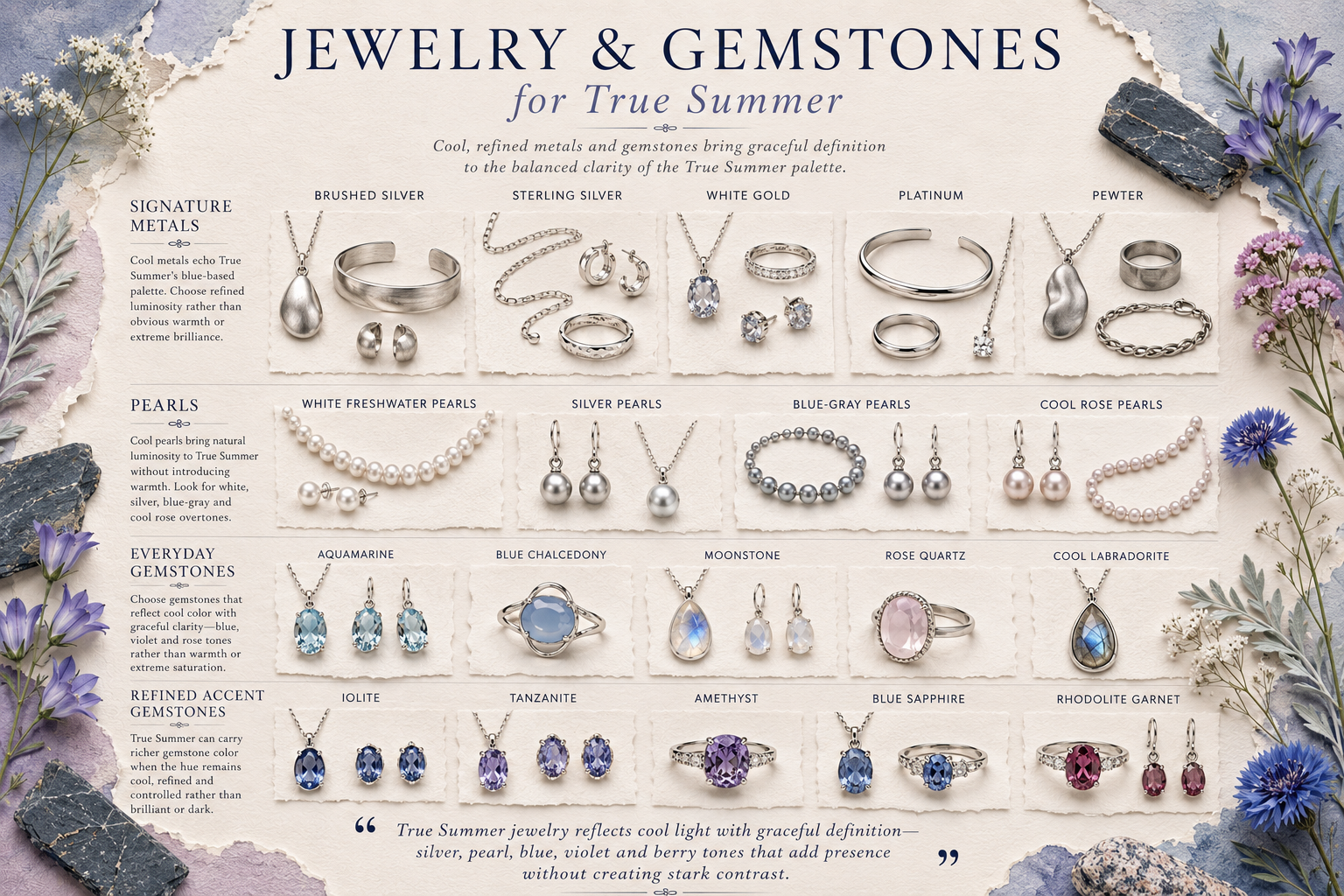
Jewelry brings color and light close to the face, so metal temperature and gemstone color are worth considering. Silver-toned metals are especially easy to wear, with gemstones extending into blue, blue-green, rose, berry, and violet.
Silver & White Metals
Silver, white gold, platinum, and pewter are natural choices for True Summer.
Finish changes the effect considerably. High-polish silver reflects more light, while brushed, satin, hammered, and antiqued finishes have a softer character. This gives you plenty of range, from a broad sculptural cuff or substantial watch to fine chains and delicate earrings.
Gold can work too. When choosing a new piece, compare pale champagne or muted gold with strongly yellow or orange versions. Rose gold varies considerably; some pieces have a restrained pink cast, while others are distinctly coppery.
Pearls
Look for white, silver-white, gray, lavender, and cool pink pearls. Tahitian pearls are another beautiful option, particularly those with blue, violet, green, or silvery overtones.
Cream and golden pearls bring more warmth, so compare them directly with cooler strands rather than relying on the description.
Baroque pearls are especially interesting here because their irregular surfaces catch gray, violet, blue, and pink reflections differently as they move. A pearl doesn't have to be perfectly round or traditionally styled to take advantage of those cooler tones.
Choosing Stones
True Summer has an excellent range of gemstones:
Aquamarine
Blue sapphire
Blue topaz
Blue or blue-green tourmaline
Cooler turquoise
Pink sapphire
Cool pink tourmaline
Ruby
Amethyst
Iolite
Selected garnets and spinels
Diamonds and other clear stones
The individual stone matters more than its name. Turquoise can range from clear blue to earthy green; garnet may be berry-red or heavily brown; amethyst moves from delicate lavender into saturated purple.
Iolite is particularly beautiful for True Summer. Its blue-violet character fits naturally within the palette and offers something less expected than sapphire or amethyst.
When shopping for colored stones, look at them against your skin if possible. Transparency, inclusions, surrounding metal, and reflected light can change their appearance considerably.
Jewelry to Consider Carefully
These materials introduce more warmth:
Bright yellow gold
Orange-toned gold
Copper
Brass
Strongly coppery rose gold
Golden or creamy pearls
Warm amber
Carnelian
Coral-orange stones
Brown or orange garnets
Yellow-green turquoise
A warm metal or stone becomes more noticeable in a large necklace or pair of earrings than it does in a ring or bracelet farther from the face. That gives you some flexibility with pieces you already own or simply love.
Common Styling Mistakes True Summers Make
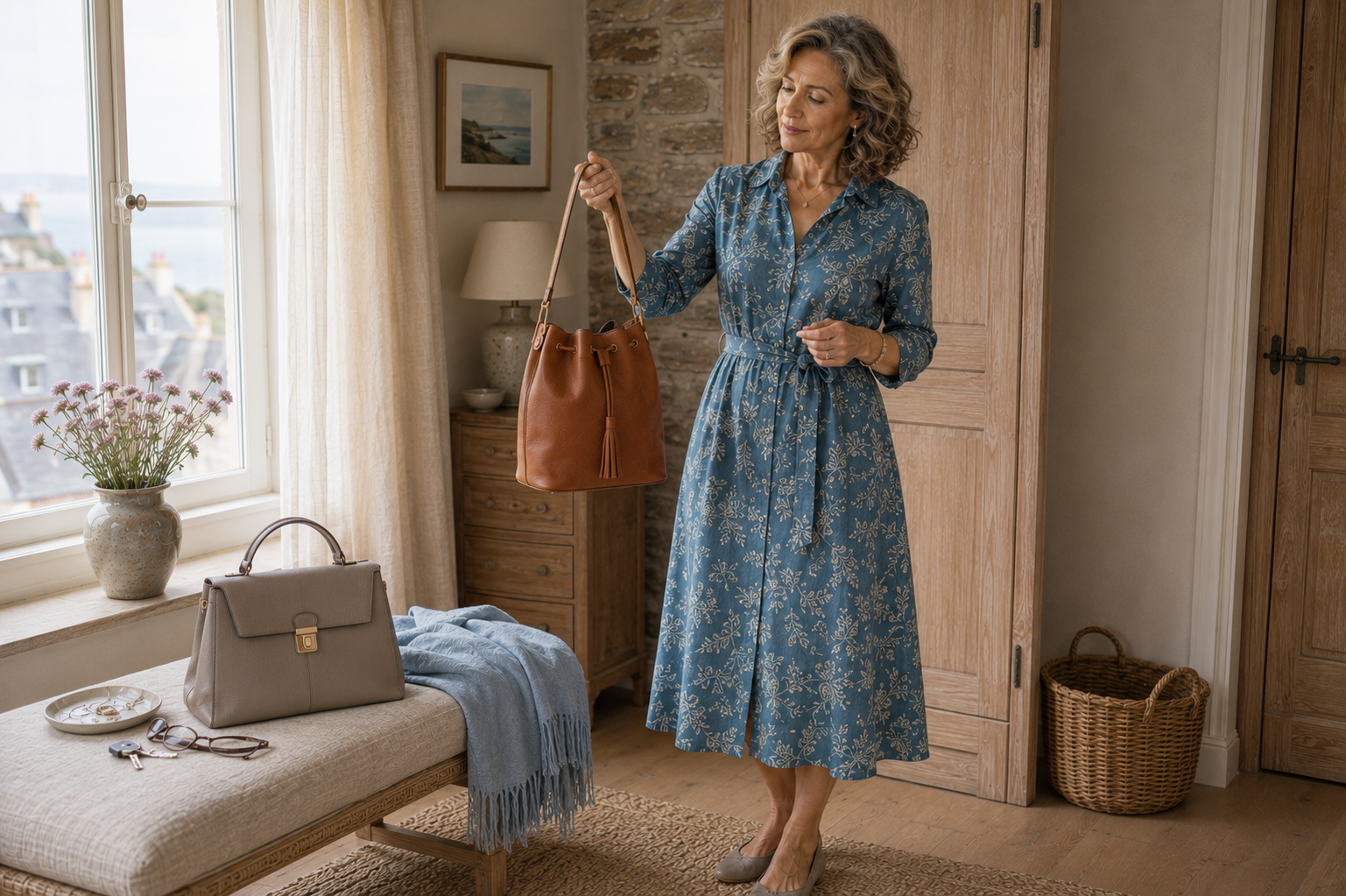
Many True Summer near-misses are surprisingly close to the palette. The temperature may be right but the color is too bright, the depth may work but the undertone is too warm, or a softened shade has gone so gray that it loses too much color.
Recognizing those near-misses makes shopping much easier.
Defaulting to Black
Black is practical and easy to find, but it can create more contrast than some True Summers naturally carry.
Before automatically choosing it, compare black with Soft Navy, Blue Charcoal, or Deep Marine Blue near your face. Pay attention to the shadows around the eyes and mouth and whether you notice the clothing before you notice your features. The difference may be subtle, but it's worth seeing for yourself.
Choosing Warm Neutrals
Camel, cognac, golden beige, warm chocolate, and rust are common wardrobe neutrals, which makes them easy to buy without giving the undertone much thought.
This becomes especially important with investment pieces. A handbag, boots, tailored jacket, or wool coat in a cooler neutral is likely to connect with more of a True Summer wardrobe than the same piece in camel or cognac.
Going Too Dusty
True Summer color should retain some clarity.
A mauve that has become mostly gray, a muddy rose-brown, or a faded sage may sit closer to Soft Summer. Rose should still read as rose; violet shouldn't disappear into gray.
Going Too Bright
A shade can be cool and still have too much intensity. Electric cobalt, brilliant fuchsia, vivid emerald, and highly saturated red may overwhelm True Summer even though their undertones seem promising. This is an easy mistake to make when shopping because bright cool colors can initially seem more flattering than warm ones. Compare them with a slightly softened version and watch what happens to your face.
Creating Too Much Contrast
True Summer can carry noticeable contrast, but very sharp combinations may become more prominent than the woman wearing them.
Black with optic white is an obvious example. Compare it with a combination that reduces one end of the contrast—perhaps navy instead of black or Pearl White instead of brilliant white—and watch what happens to the face.
This is especially useful when choosing prints. A pattern can contain suitable individual colors and still create too much contrast when very light and very dark areas sit beside one another.
Adding Warmth Around the Face
Hair and makeup have more influence on the complexion than a warm shoe or handbag.
Golden highlights, caramel brunette, peach blush, orange-red lipstick, and heavily golden bronzer can introduce warmth even when the clothing is well chosen. If an outfit seems right but something still feels slightly off, look at the colors immediately surrounding the face before questioning the entire wardrobe.
How Does True Summer Compare to the Other Summer Seasons?
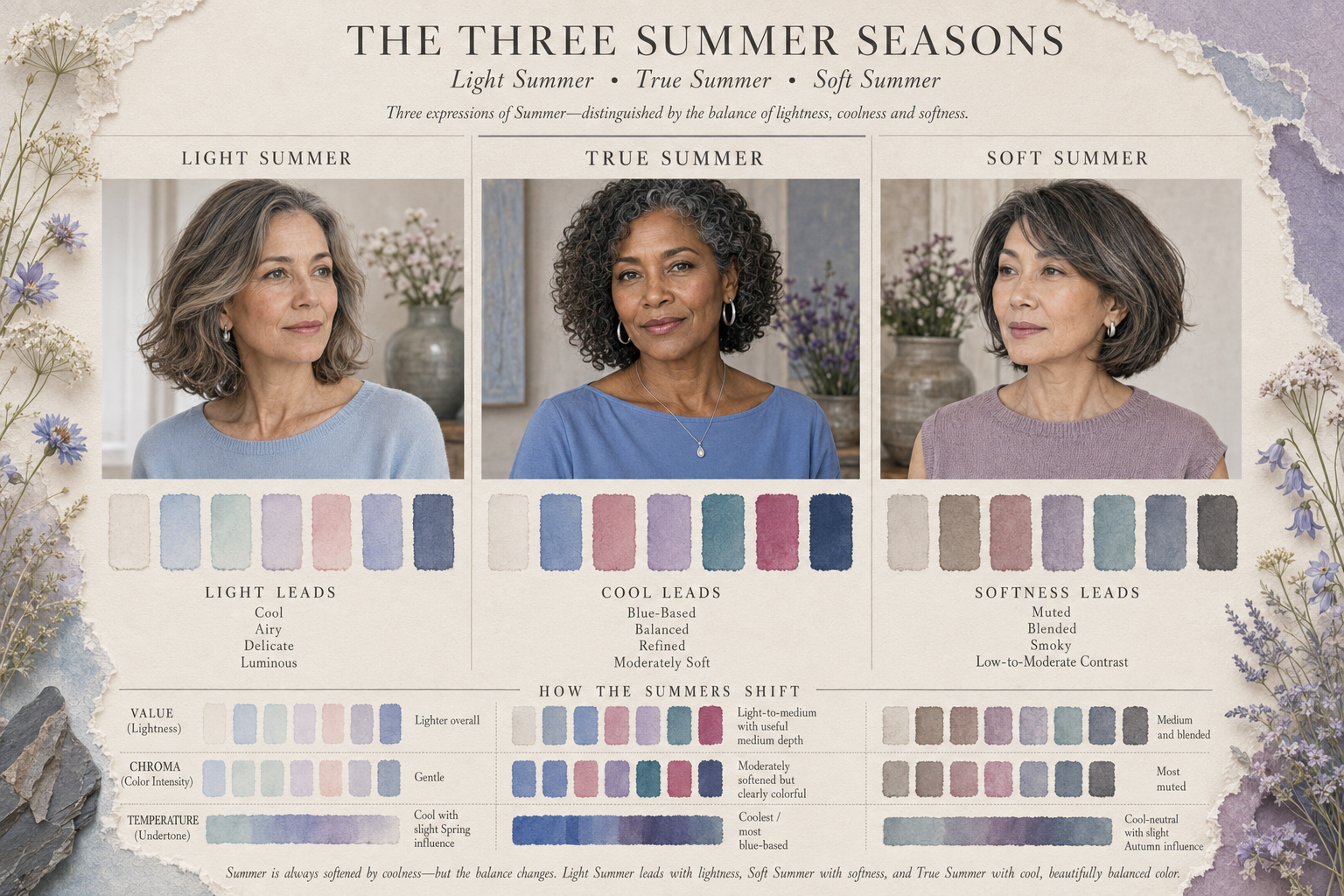
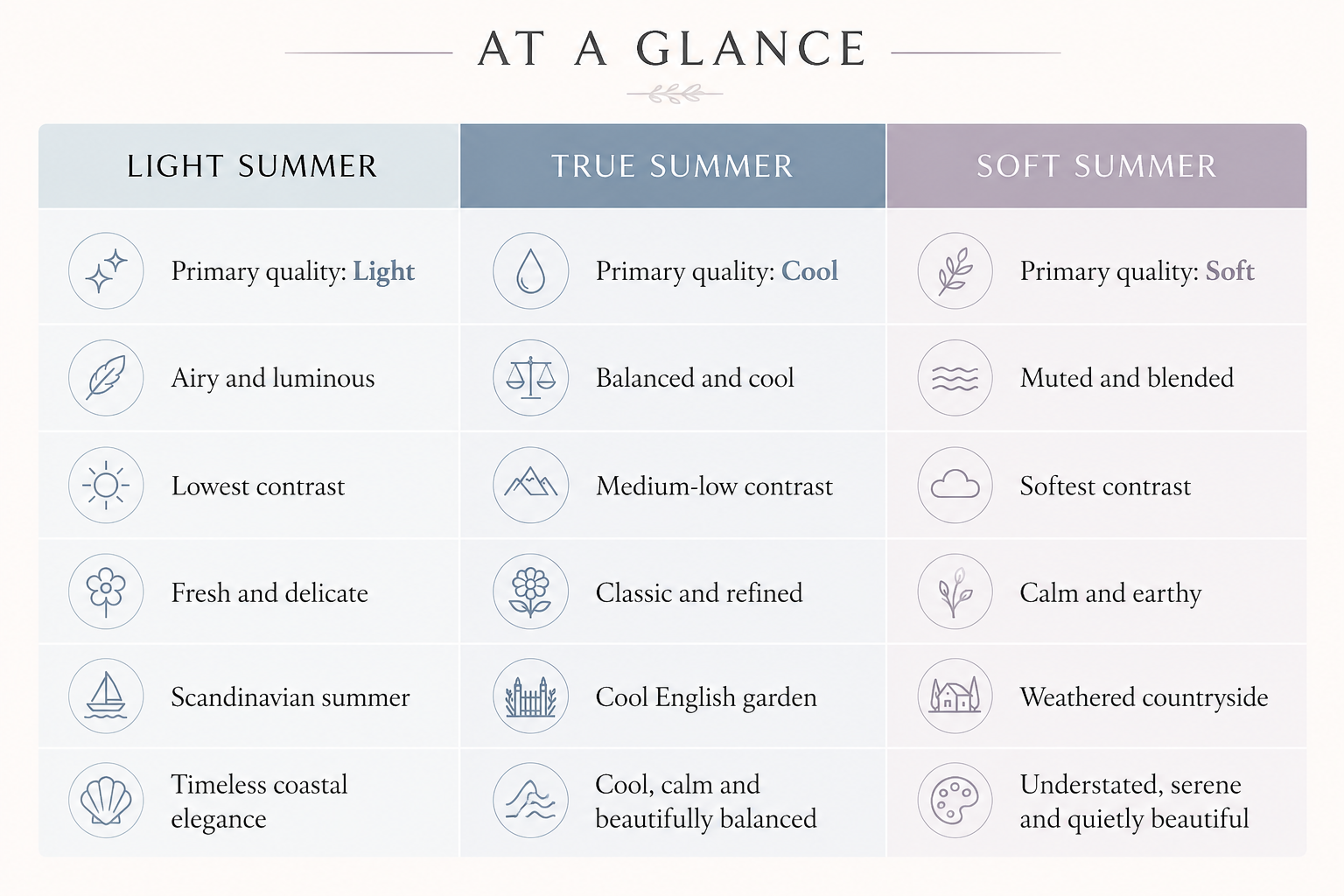
All three Summer seasons share a cool foundation, but they differ in what matters most. Light Summer is led by lightness, Soft Summer by softness, and True Summer by coolness. Those differences are easiest to recognize when similar colors are compared side by side.
Light Summer
Light Summer carries a slight Spring influence, giving it a lighter, fresher quality. Its blues, pinks, greens, and violets remain predominantly cool, but the palette has less depth overall.
The difference becomes clearer in the middle and deeper values. A True Summer can usually carry more depth without the color beginning to overpower her. If Light Summer shades consistently seem too delicate or leave you wanting more definition, compare them with cooler midtones from True Summer.
Soft Summer
Soft Summer moves toward Autumn, bringing more neutrality and gray into the palette. Its colors tend to look smokier and more blended.
True Summer retains more recognizable color. Compare dusty rose with a cooler, clearer rose, mushroom with Pewter, or a muted green with Blue Jade. If the smokier version makes your complexion seem dull while the cooler version brings back definition, True Summer deserves a closer look.
True Summer
True Summer sits at the coolest point of the Summer family. It has more depth than Light Summer and more clarity than Soft Summer, while remaining moderately softened.
If you're deciding among the three, compare the same color family rather than three unrelated swatches. Try a Light Summer blue, True Summer blue, and Soft Summer blue beside the face. Repeat the comparison with pink, green, or a neutral. Keeping the color family consistent makes it much easier to see whether lightness, coolness, or softness gives you the best result.
Frequently Asked Questions About True Summer
Can True Summers Wear Black?
Yes. Black may create more contrast than some True Summers carry naturally, particularly near the face, so compare it with Soft Navy, Deep Marine Blue, or Blue Charcoal and see which does more for your complexion.
Black farther from the face is usually much less consequential, making trousers, shoes, handbags, and belts easy places to keep it in your wardrobe.
Can True Summers Wear White?
Yes. Pearl White and Cool Oyster are particularly reliable, although some True Summers wear a crisper white beautifully.
Be more cautious with ivory and creamy whites. The issue isn't how light the white is, but how much yellow it contains.
Can True Summers Wear Red?
Absolutely. Look for reds that lean toward blue rather than orange.
Summer Cherry and Blue Red are the clearest examples in the True Summer palette, while Cranberry, Berry, and Raspberry offer related options with more pink or violet in them. Tomato, paprika, and brick reds move in a warmer direction.
Can True Summers Wear Yellow?
Yes, although yellow occupies a much smaller part of the True Summer palette than blue, rose, or violet.
Icy Lemon and Primrose show the direction: cool, relatively light yellows without a strong golden or mustard cast. If yellow has always been difficult for you, there's no reason to force it simply because a version appears in the palette.
Can True Summers Wear Gold?
Yes. Silver, white gold, platinum, and pewter tend to relate most easily to True Summer coloring, but gold isn't off limits.
When you're buying something new, compare the actual metals. Pale champagne or muted gold may sit more comfortably beside the skin than strongly yellow or orange gold.
Can True Summers Have Brown Eyes, Dark Hair, or Deeper Skin?
Yes to all three.
True Summer is determined by how your coloring responds to color, not by a required combination of pale skin, blue eyes, and ash-blonde hair. Brown eyes, brunette hair, deeper complexions, and many combinations of those features can occur within the season.
This is one reason draping is more reliable than trying to identify your season from a physical-traits checklist.
Does Going Gray Change Your Season?
Not automatically.
Gray hair changes the coloring you see around your face and may alter your apparent contrast, but it doesn't necessarily change the underlying color relationships that made True Summer flattering in the first place.
You may find yourself favoring a different part of the palette as your hair becomes silver. That is an adjustment in how you use your colors, rather than evidence by itself that your season has changed.
Are True Summer and Cool Summer the Same Thing?
Usually, yes. True Summer and Cool Summer are commonly used for the coolest Summer subtype, although terminology varies among seasonal color-analysis systems.
The name matters less than the characteristics of the palette. You're looking for the Summer season where coolness is the dominant quality, with moderate softness and more depth than Light Summer.
Do I Have to Wear Only True Summer Colors?
No. A seasonal palette is most useful when you're making decisions about the colors that have the greatest visual or financial impact—something worn near the face, a new hair color, makeup, or an expensive wardrobe purchase.
You don't need to audit everything you own against forty swatches.
Final Thoughts
Learning your seasonal colors changes the way you notice color. After a while, you stop seeing a rack of twenty blue sweaters as twenty versions of the same thing. You notice the one that has just enough gray, the one that turns slightly green, the one that's too bright, and the one you somehow knew would work before you even took it off the hanger.
Your favorite part of the True Summer palette will probably become apparent with time. You may discover that you wear the blues constantly, that raspberry does more for you than any pale pink ever did, or that Pewter finally solves the neutral problem you've had for years. Those preferences are what turn a seasonal palette into a wardrobe that feels personal.
Eventually, the color fan spends more time at home. You already know which direction to walk when you enter a shop.
Shop the True Summer Guide
You don't need every shade in the palette; a few well-chosen wardrobe staples, beauty essentials, and accessories can create a strong foundation.
The following collection reflects the cool, balanced character of True Summer, with enough depth and color to make it useful throughout the year.
Modern Wardrobe Essentials
Build around versatile pieces in cool neutrals, softened blues, and a few of the richer colors you naturally reach for.
Jewelry That Complements True Summer
Cool metals and gemstones drawn from the blue, violet, and rose families sit naturally within the palette.
Cool white or gray pearl necklace
Beauty Favorites
Cool rose, berry, mauve, taupe, and pewter give you plenty of options for an everyday makeup wardrobe.
Makeup
Brushes
Nails
Choose a small range that takes you from understated to more colorful manicures.
Beautiful Accessories
Accessories are an easy place to introduce more of the palette without committing to another major wardrobe piece.
Style Inspiration
Continue exploring True Summer and seasonal color analysis.
Editor’s Note
A seasonal palette becomes more useful with time. You begin noticing which colors you already wear well, which pieces work easily together, and where a different undertone might make your next purchase more successful.
There is no urgency to rebuild a wardrobe around True Summer. Use what you've learned when something needs replacing or when you find a color that makes you wonder why you haven't been wearing it all along.
Disclosure: This article may contain affiliate links. If you make a purchase through these links, I may earn a commission at no additional cost to you.
