

How to Create a Summer Evening Garden Party That Feels Effortlessly Beautiful
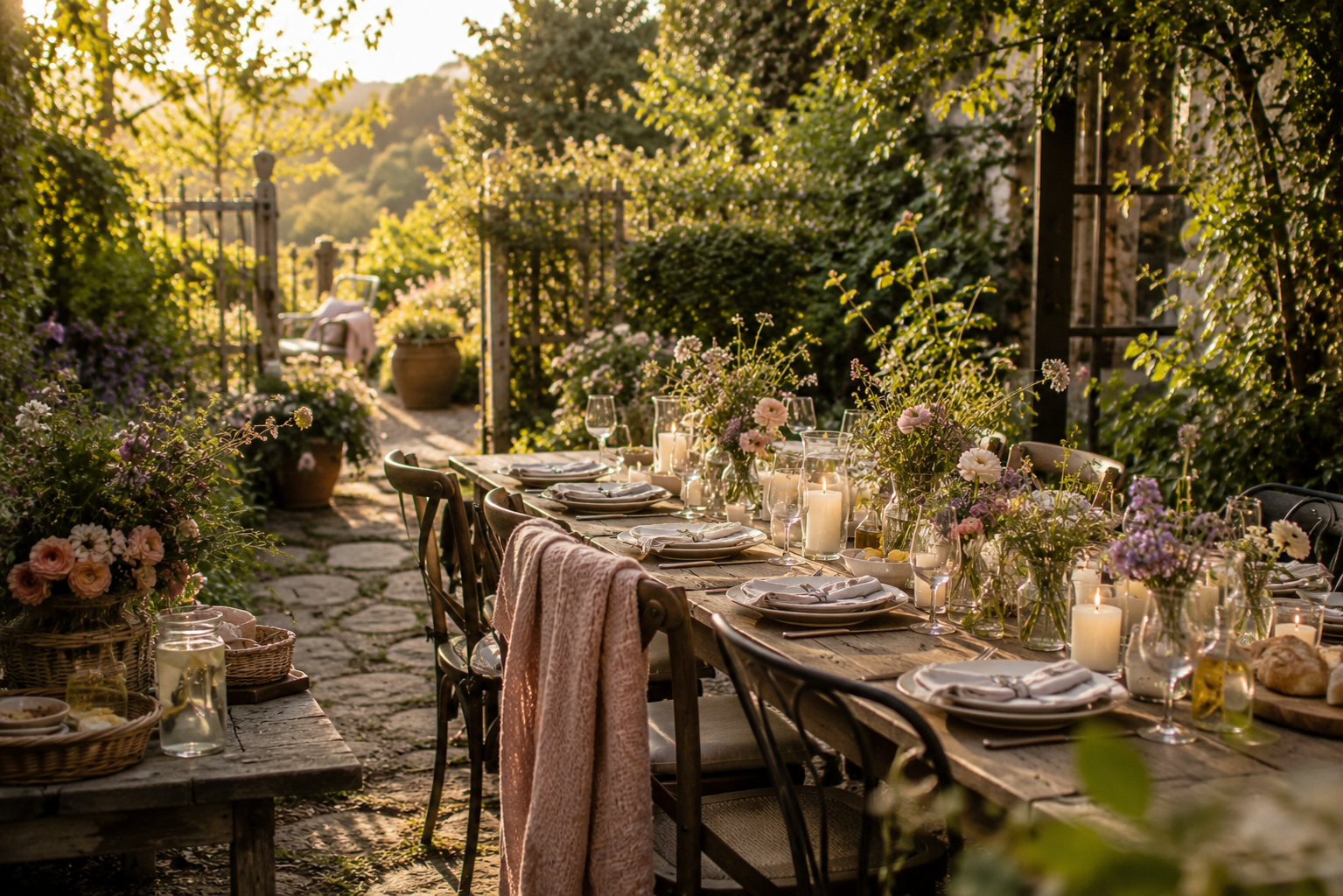
There’s a moment I look forward to at every summer gathering, and it always seems to arrive right around sunset.
Dinner is finished. The plates are cleared. The sky shifts from gold to that soft, moody blue. Someone stands up and says, “Well… I should probably get going.”
But they don’t.
Someone else begins a story. Another glass of wine is poured. A few people wander toward the garden. Candles flicker to life. And before anyone realizes it, an hour has slipped by.
I’ve always been drawn to that moment — not because it can be orchestrated, but because it can’t. It only happens when people feel so at ease, so welcomed, that the thought of leaving simply drifts away.
I’ve attended beautifully styled events where guests left the moment dessert was served. And I’ve sat in the simplest backyards where conversations stretched long past sunset and no one seemed in a hurry to check the time. The difference was never the flowers or the menu or the table settings.
It was the atmosphere.
Not the curated, Pinterest‑perfect kind — the kind that unfolds naturally when people feel relaxed, connected, and unhurried.
Years in hospitality taught me that the gatherings people remember most aren’t the ones executed flawlessly. They’re the ones where people feel good in your space. I used to watch how guests moved through a room — where they gravitated, where they lingered, what made them settle in, and what made them drift away.
Why did everyone cluster in one corner and ignore another? Why did some evenings feel effortless while others felt a little stiff? Why did certain nights stay with people long after they ended?
Eventually, I began to see the pattern: people linger when they feel comfortable, connected, and genuinely welcomed.
A warm greeting, a thoughtful introduction, a sense of where to land — these small gestures help people relax quickly. When they see laughter, small groups forming, and easy conversation, they naturally join in. When the environment quietly says “stay awhile,” they do.
Tiny cues matter more than we realize. Candlelight softens a space. Music fills the quiet moments. A room that feels lived‑in rather than staged puts people at ease. Even the simple act of kicking off your shoes and sinking into a comfortable chair tells guests this isn’t an evening to rush through.
And of course, the host sets the tone. When you’re present — not darting around, not fussing — guests feel it. They match your energy. If you’re enjoying yourself, they will too.
Somewhere along the way, I stopped thinking of entertaining as a performance. I think many women reach that point. We stop trying to impress and start focusing on how we want people to feel.
We want our homes to feel warm. We want our tables to invite conversation. We want our guests to leave feeling nourished, not overwhelmed. And we want to enjoy the evening right alongside them.
That’s why summer gatherings feel so special to me. Summer softens everything. The garden becomes the décor. The air loosens its grip. The light lingers. The pace slows just enough for connection to take the lead.
Some of my favorite memories — from travel and from home — involve outdoor evenings: a tucked‑away courtyard café, dinner beneath string lights, friends lingering long after the meal ended.
What they all shared was atmosphere.
And the beautiful thing is: you can create that same feeling at home. You don’t need a sprawling garden or an elaborate menu or expensive decorations. Just a few thoughtful elements working together to create a space people want to linger in.
In this guide, I’m sharing what years of event planning, hospitality, and hosting have taught me about creating a summer evening garden party that feels beautiful, welcoming, and wonderfully effortless.
Not perfect. Not staged. Just the kind of gathering people remember long after the last candle burns out.
Why Summer Evenings Feel Different
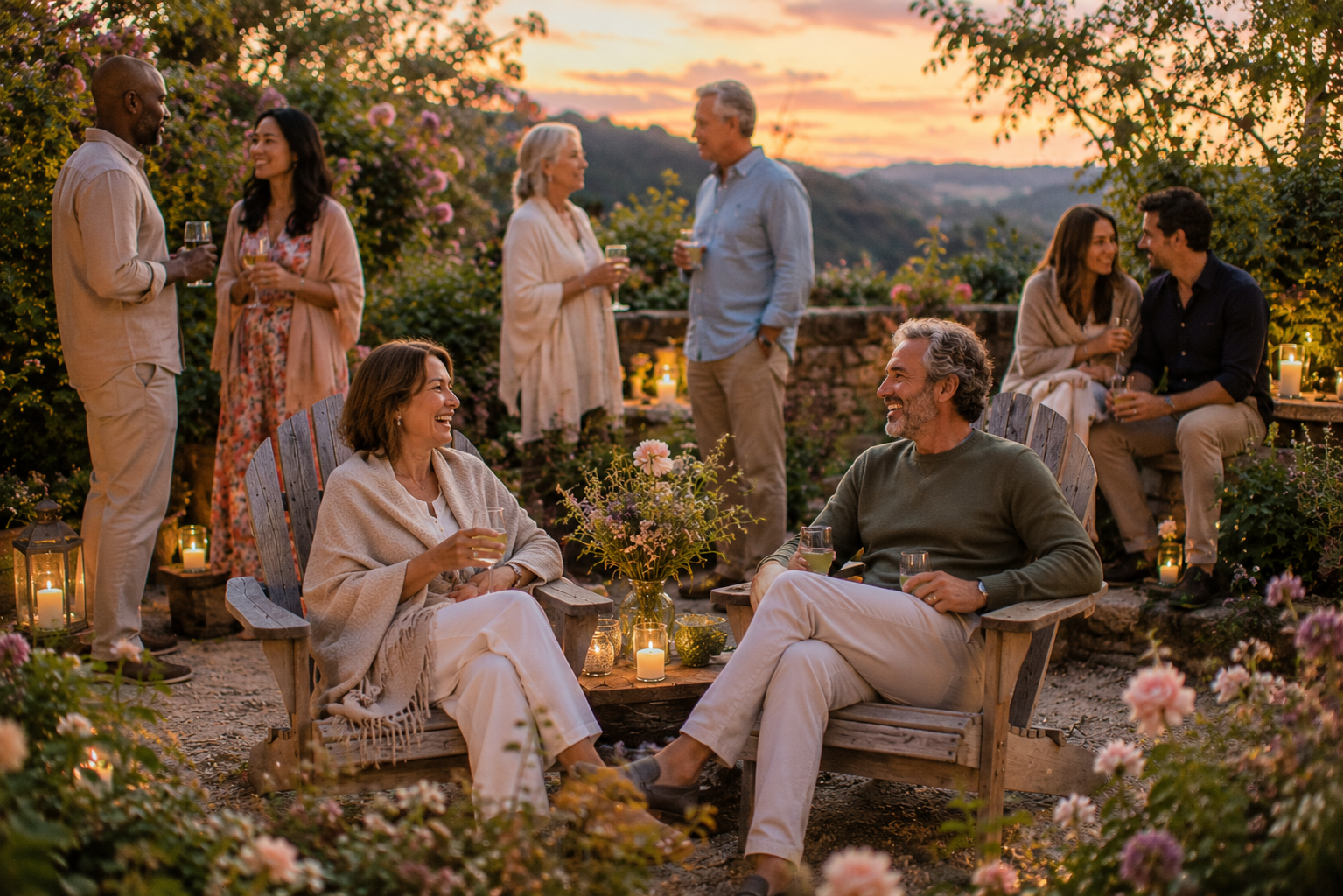
I’ve often wondered why certain gatherings stay with us while others fade almost as soon as we leave. It’s rarely because of what was served. I’ve forgotten more menus than I can count. I couldn’t tell you what I ate at half the beautiful dinners I’ve attended — but I can still recall exactly how those evenings felt.
I remember sitting outside long after sunset in the garden of a French chateau, reluctant to stand even though the meal had ended hours earlier. I remember summer dinners with friends when someone finally lit a candle because none of us wanted to go inside yet, the laughter settling around us like a warm blanket. I remember conversations that drifted easily from one topic to the next as the sky deepened overhead.
The common thread was never the food or the setting. It was the feeling — that gentle sense that there was nowhere else we needed to be.
Summer seems especially good at creating that kind of ease. Maybe it’s the long evenings, or the way the season nudges us outdoors after months of moving between houses, offices, and obligations. Summer slows us down just enough to notice things again: the scent of roses blooming near the fence, the soft hiss of sprinklers in the distance, the way the last light settles across a garden before slipping away, the first stars appearing like a quiet invitation to linger.
Those details are always there, of course. Summer simply gives us more chances to see them.
I’ve also come to appreciate how forgiving summer entertaining can be. Winter gatherings come with layers — literal and figurative. There’s timing, weather, expectations. Summer asks for so much less. A table outside. A shared meal. A few comfortable chairs. The garden does most of the work — flowers already blooming, trees offering shade, the sky shifting colors like its own kind of décor. Even the simplest backyard can feel magical on a warm evening.
Garden parties blur the line between everyday life and celebration. You don’t need a special venue or elaborate decorations or a sprawling space. There’s something deeply charming about gathering right where life already happens — the garden you’ve tended all season, the patio where you drink your morning coffee, the table where your family eats dinner. Inviting people into those spaces feels more personal than inviting them into something perfectly staged. It’s like welcoming them into a favorite chapter of your life rather than presenting a polished performance.
And maybe that’s why summer gatherings linger in our memories. They’re not trying too hard. They have a natural ease to them. A guest arrives with flowers from her garden. Someone helps carry dishes outside. A neighbor stops by for a moment and ends up staying an hour. Nothing unfolds exactly as planned, yet somehow the evening becomes better because of it.
The older I get, the more certain I am that beauty and perfection are not the same thing. Perfection creates pressure. Beauty leaves room for spontaneity. A slightly crooked flower arrangement. An extra chair pulled up at the last minute. Dessert served later than intended because everyone was still talking. Those small imperfections are often what make an evening feel human.
And summer, more than any other season, gives us permission to embrace them. The light lingers. Schedules loosen. People soften. They pause. They stay. They savor.
In a world that moves so quickly, that might be summer’s greatest gift.
What Years of Event Planning Taught Me About Atmosphere
When people hear “event planning,” they tend to picture timelines, seating charts, and color‑coded to‑do lists. And yes, those things certainly play a role. As an event planner, I spent plenty of time focused on those details — but what always captivated me most were the people.
I loved watching how they moved through a space, how they gravitated toward one another, how certain corners of a room seemed to spark conversation while others stayed quiet. Over time, I began to notice something I hadn’t expected: the events people talked about years later weren’t the most elaborate or the most expensive. They weren’t even the most “perfect.”
Some of the most memorable gatherings I’ve ever been part of had very little to do with flawless décor or meticulously executed plans. What they had was atmosphere.
Atmosphere is tricky to define, but unmistakable when you feel it. It’s that immediate sense of comfort when you walk into a room. It’s conversation that begins without effort. It’s guests lingering long after they said they should leave.
I’ve often wondered why one gathering feels warm and inviting while another — equally beautiful on paper — feels a little stiff.
The answer, surprisingly, has almost nothing to do with perfection. In fact, perfection can create distance. A room that feels too precious makes people cautious. A table styled like a magazine spread can leave guests wondering if they’re allowed to relax. And a host who’s constantly adjusting things, even with the best intentions, can unintentionally signal that the details matter more than the people.
The most welcoming gatherings always had room to breathe. Guests could exhale. Nothing felt overly scripted. People felt free to be themselves.
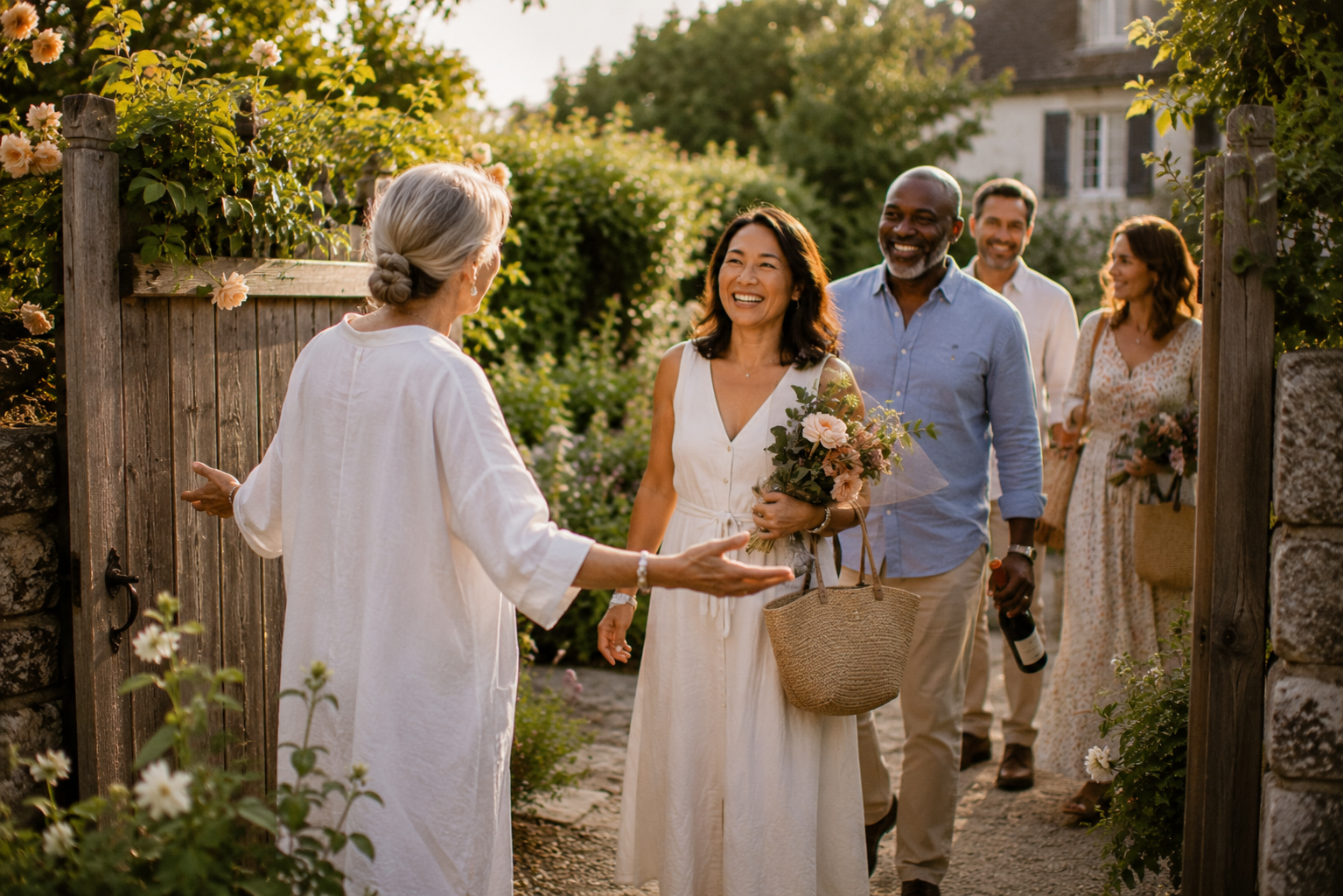
I used to watch guests arrive and could often tell within seconds how the evening would unfold. When they were greeted with genuine warmth — when the host was present and happy to see them rather than preoccupied — everything softened. Those tiny moments at the beginning set the tone for the entire night.
And the longer I’ve done this, the more I’ve come to understand that people are shaped far more by what they feel than by what they see. They might admire the flowers or compliment the table, but what stays with them is something deeper: the comfort, the care, the sense of belonging. Years later, they may not remember the menu or the centerpiece, but they’ll remember how it felt to sit around the table — the laughter, the ease, the sense that for a little while, they were exactly where they wanted to be.
That’s why I believe atmosphere is one of the most overlooked forms of hospitality. You can’t buy it. You can’t order it. You create it through intention and warmth and a hundred small choices that quietly say, without ever speaking the words, I’m glad you’re here.
And that’s part of what makes summer garden parties feel so magical. The setting already does half the work. The open air, the fading light, the slower pace — everything nudges people toward ease. The garden provides the backdrop, but it’s the atmosphere that turns it into something unforgettable.
Start With the Feeling, Not the Decorations
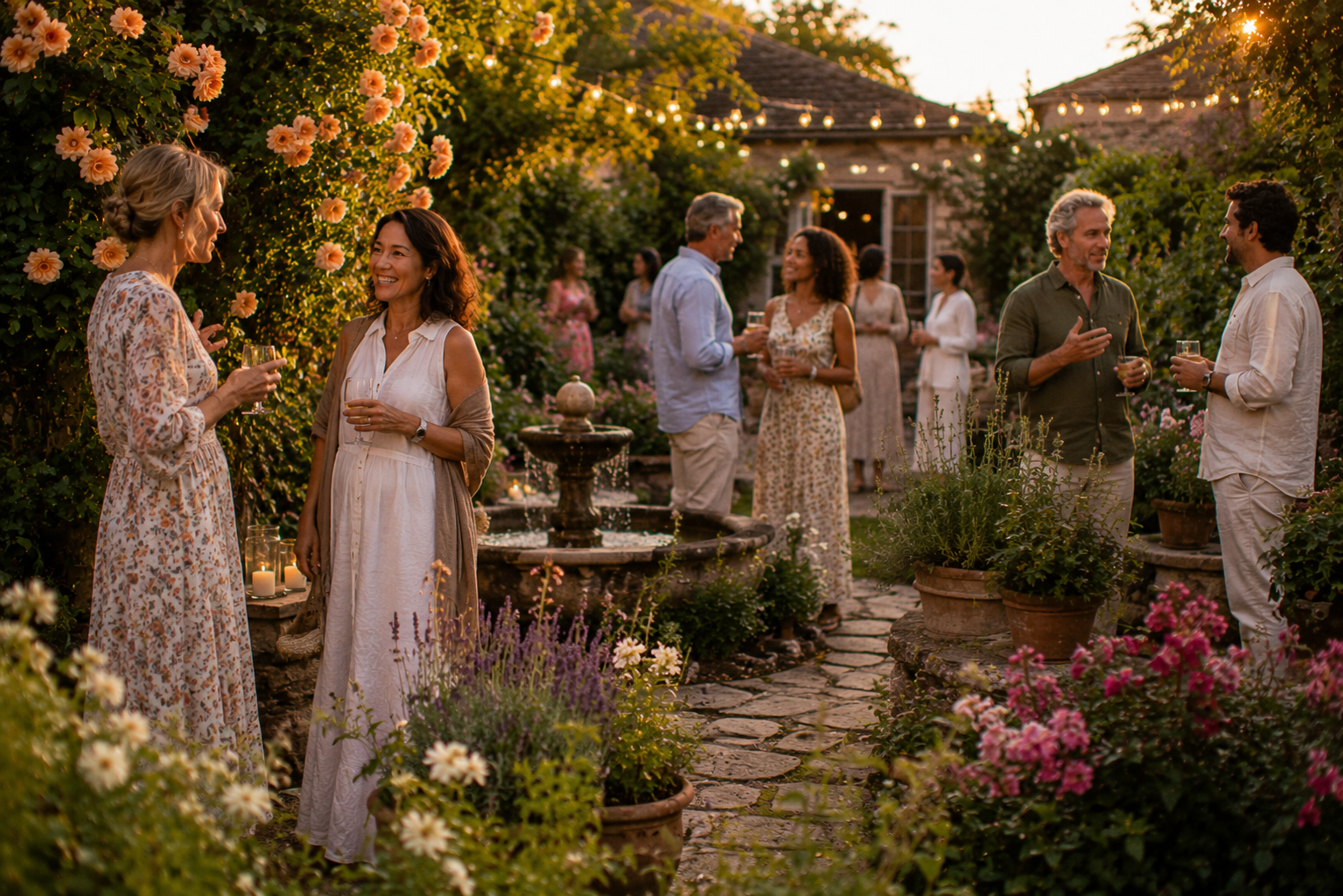
I’ve come to realize that one of the biggest missteps in planning a gathering is starting with the details instead of the experience. We jump straight into scrolling for tablescapes, saving photos of flower arrangements, debating menus and napkin colors. Before long, we’re knee‑deep in décor decisions without ever pausing to ask the question that actually shapes the entire evening: How do I want this to feel?
That question comes to me almost instinctively now, because experience has taught me that every memorable gathering has a feeling at its center. Sometimes it’s warmth. Sometimes celebration. Sometimes intimacy or joy or that lovely sense of ease that makes people forget about time altogether. The details simply support that feeling — they don’t create it.
It reminds me of travel. When I think back on my favorite places, I don’t remember every reservation or hotel detail. What lingers is the feeling of wandering through a village at sunset, lingering over dinner in a courtyard café, or sitting beside a river with nowhere else I needed to be. The details mattered, but they weren’t the experience. They were the backdrop.
Gatherings work the same way.
Before I choose flowers or plan a menu, I like to imagine the evening already unfolding. What does it look like? How are people moving through the space? Are they gathered around a candlelit table telling stories? Drifting through the garden with a glass of wine? Is the night slow and unhurried, or lively and full of energy?
Those little glimpses guide everything that follows. If I want the evening to feel relaxed, I avoid a complicated menu that will trap me in the kitchen. If I want conversation to flow, comfortable seating matters far more than a perfectly styled table. If I want intimacy, I might invite fewer people and create smaller pockets where connection can happen naturally.
Once the feeling becomes clear, the details almost choose themselves.
The Elements That Make People Stay Longer
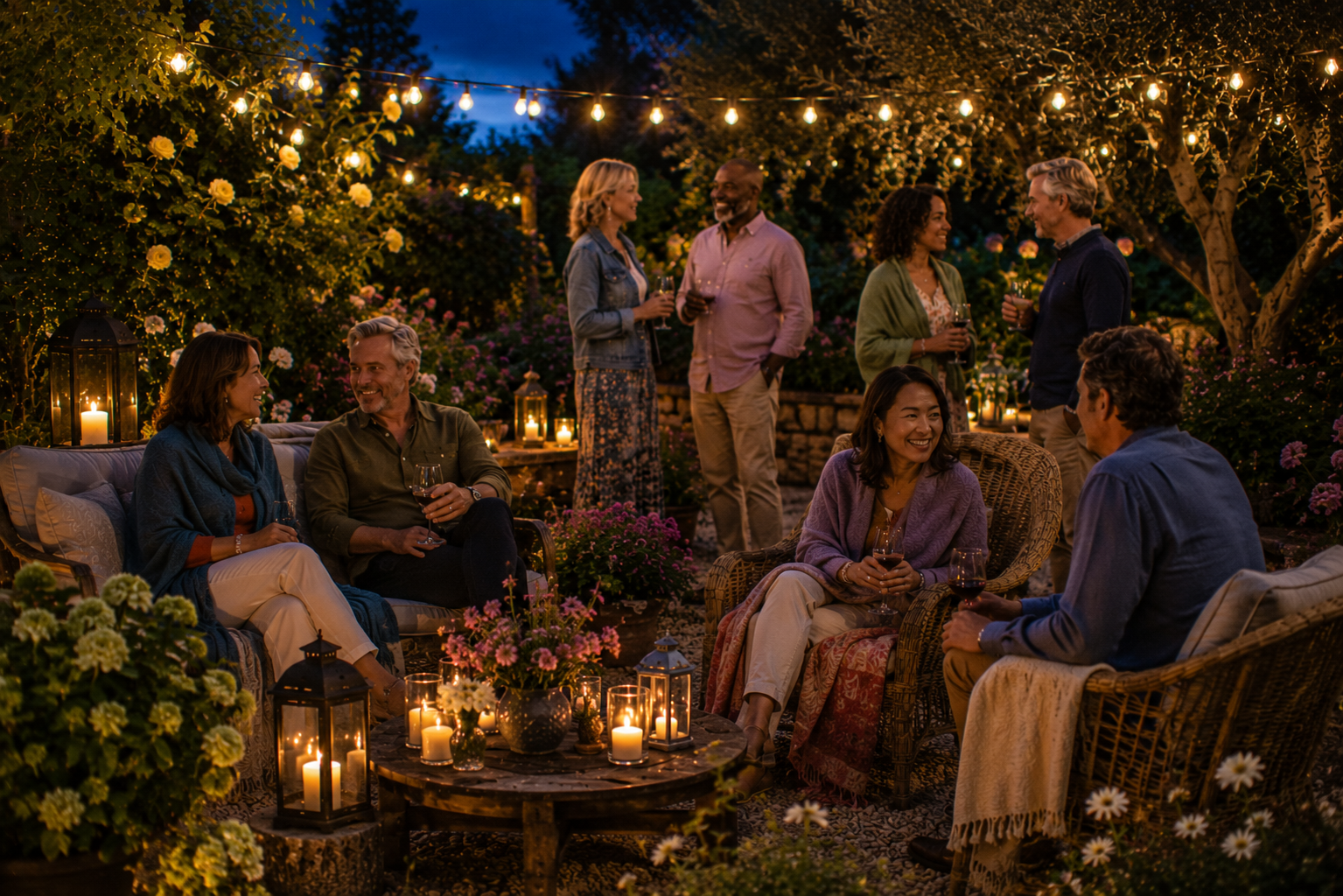
Years ago, I realized something that completely shifted the way I think about entertaining. The gatherings people loved most were never the ones that looked Pinterest‑perfect. They were the ones where people felt comfortable — not in a sweatpants‑and‑takeout way, though that has its charm, but in the sense that they could truly relax into the evening. They didn’t feel rushed or self‑conscious or as if they were participating in a performance. They felt at home.
Once I started paying closer attention, I began noticing all the tiny things that quietly encouraged people to stay. Lighting was one of the first. There’s a reason restaurants dim the lights at night. Bright light wakes us up; soft light settles us. I don’t think I’ve ever met a candle that didn’t make a gathering better. String lights help, lanterns are lovely, but candlelight does something special — it softens everything it touches. Faces look warmer, conversations feel closer, and the whole evening seems to slow just a little. It’s never about brightness. It’s about glow.
Comfort plays its own role too. I sometimes joke that more conversations have been cut short by uncomfortable chairs and chilly breezes than by any social awkwardness — and I’m only half kidding. People stay where they feel physically at ease. Outdoors, that might mean cushions, a bit of shade, blankets for when the temperature drops, or simply enough seating so no one ends up hovering at the edge of the group holding a plate and wondering where to land. Very few guests remember your centerpiece. Many remember whether they had a comfortable place to sit.
And then there’s the way a space flows. Some areas naturally invite connection, while others unintentionally create barriers. A long table can be beautiful, but smaller pockets of space often make conversation easier. I’ve noticed that people naturally migrate throughout the evening — starting at the table, drifting toward the garden, gathering near the drinks, settling into a pair of chairs beneath a tree. The most enjoyable gatherings leave room for that movement. They give the night somewhere to go.
Conversation has its own rhythm as well. One of the kindest things a host can do is simply help it begin — not by forcing anything, but by opening the door. Introducing people who might enjoy each other. Asking a thoughtful question. Offering something beautiful or interesting to notice. Gardens are wonderful for this. Flowers become talking points. Travel stories surface. Recipes get exchanged. Before long, the conversation is carrying itself.
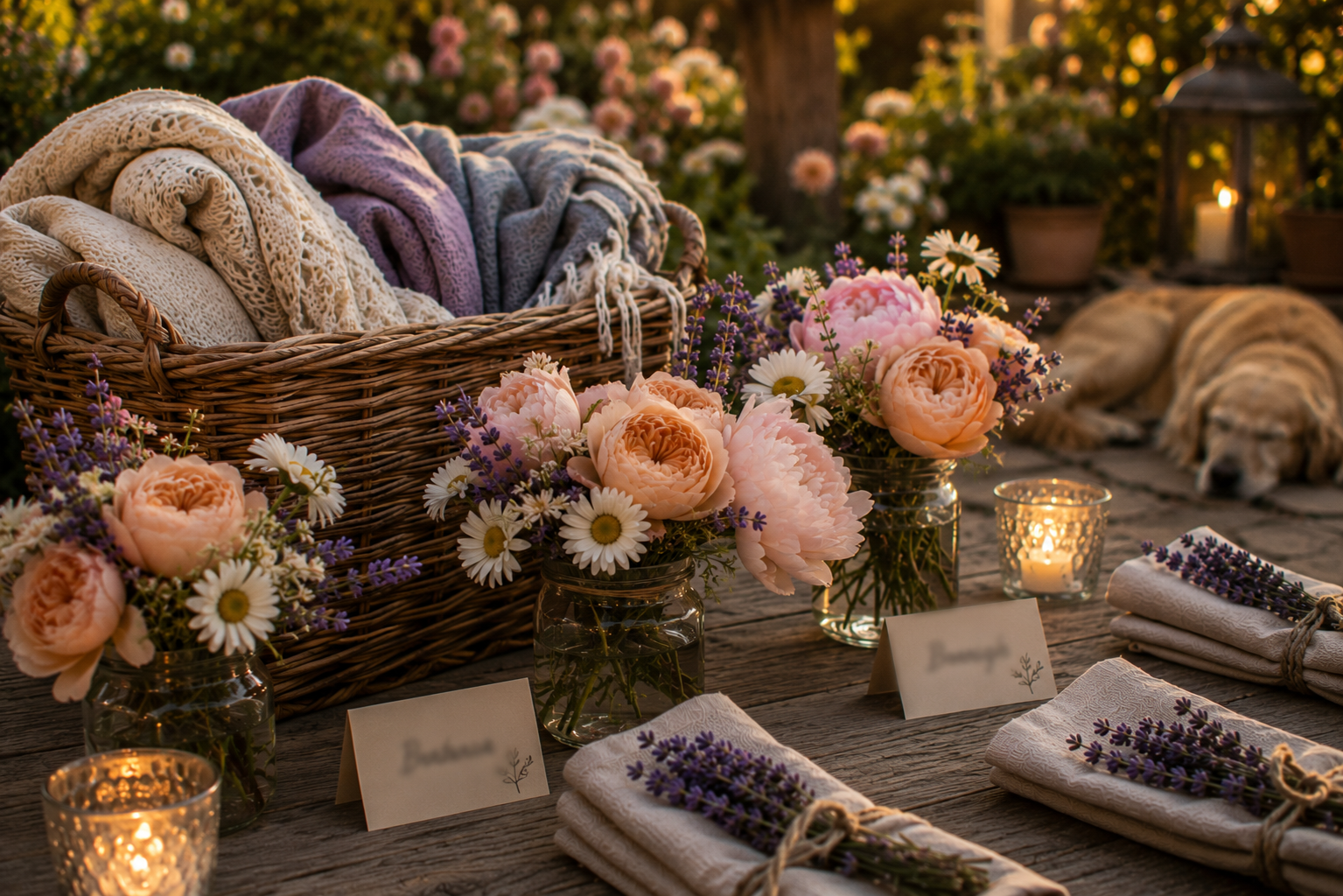
I’ve also learned that people remember personal touches far more than expensive ones. A handwritten place card. A sprig of herbs tucked into a napkin. A family recipe. A basket of blankets brought out after sunset. These small gestures say something meaningful: someone thought about this… someone thought about us. And that feeling lingers.
One of my favorite hosting memories involves a tiny moment of unexpected delight. At the end of a summer gathering, the host handed each guest a little kraft bag with homemade cookies. Nothing fancy — just a simple, sweet surprise offered under the stars. I still remember it, not because of the cookies (though they were delicious), but because of the gesture. It made the evening feel just a little more magical than anyone expected.
I’ve found that the most memorable gatherings often have one of those moments — a spontaneous toast, an unexpected dessert, a guest who pulls out a guitar, a little after‑dinner sip someone brought back from a trip. Something small. Something thoughtful. Something that makes people smile.
When you look closely, the things that make people stay longer have very little to do with trends or perfection. They have everything to do with how welcome people feel. The lighting whispers, relax. The seating says, stay awhile. The conversation says, you belong here. And the atmosphere quietly offers the message every host hopes their guests will feel:
There’s no hurry. Enjoy the evening.
A Simple Formula for a Beautiful Summer Garden Party
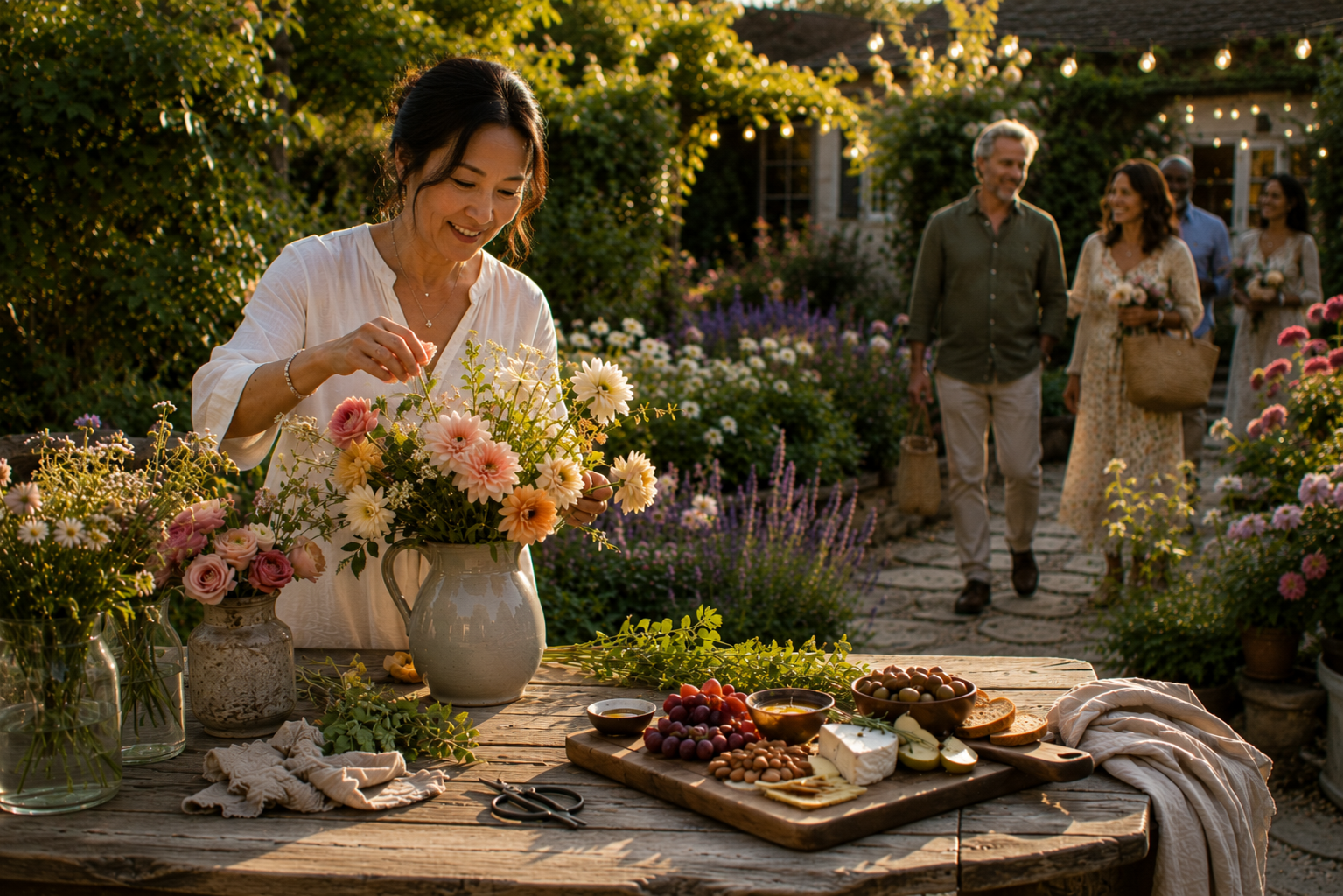
After all these years, I’ve realized that creating a beautiful gathering has very little to do with doing more. It’s almost always about paying attention to the right things. Whenever I begin planning a summer garden party, I find myself returning to the same simple rhythm.
I always start with the setting — not because it needs to be impressive, but because every gathering needs a place for people to naturally land. Sometimes that’s a table tucked beneath a tree. Sometimes it’s a patio filled with potted flowers. Sometimes it’s just a few chairs arranged to catch the best view of the evening sky.
One of the loveliest outdoor dinners I’ve ever attended took place under a pergola. Nothing elaborate. No dramatic installations. No rented furniture. Just a long table beneath wisteria vines and a few strands of café lights glowing softly as the sun slipped away. The setting was beautiful, yes — but the feeling is what stayed with me. That distinction has become more important over time.
Once I know where people will gather, my attention drifts to flowers. Not because they’re essential, but because they tie the evening to the season. I’ve never been drawn to arrangements that feel too formal or too perfect. In summer, I love flowers that look as though they were gathered that morning — hydrangeas from the garden, lavender in little jars, roses clipped from a backyard bush. Even a handful of greenery can feel lovely when it’s arranged with a relaxed hand. There’s something welcoming about things that look real rather than styled.
Food comes next, and my philosophy has become almost embarrassingly simple: choose the menu that lets you enjoy your own party. Truly. I’ve learned to avoid any recipe that demands constant attention once guests arrive. Summer offers so many easy, generous options — fresh salads, grilled vegetables, family‑style dishes, desserts that can be made ahead. A relaxed host creates a relaxed evening, and people feel that.
And then there’s the moment I think of as the shift into evening. It’s subtle, but it changes everything. During the day, the garden carries the atmosphere on its own. But as the sun begins to fade, the responsibility shifts to you. Candles are lit. Lanterns begin to glow. Music softens the edges of the night. Maybe blankets appear on the backs of chairs. It’s a gentle transition — from dinner to evening, from activity to atmosphere, from a meal to an experience.
If there’s one lesson I’ve carried with me from years of hosting, it’s that people rarely remember how much effort something required. They remember how it felt. The flowers don’t need to be extravagant. The menu doesn’t need to be complicated. The table doesn’t need to be perfect. What lingers is the feeling of sitting beneath the fading light, sharing stories, laughing with friends, and realizing everyone stayed a little longer than they meant to.
And really, that’s the heart of it: a welcoming place to gather, something fresh and seasonal on the table, simple food, soft light, and good company. Everything else is just decoration.
How to Make Outdoor Entertaining Feel Less Stressful
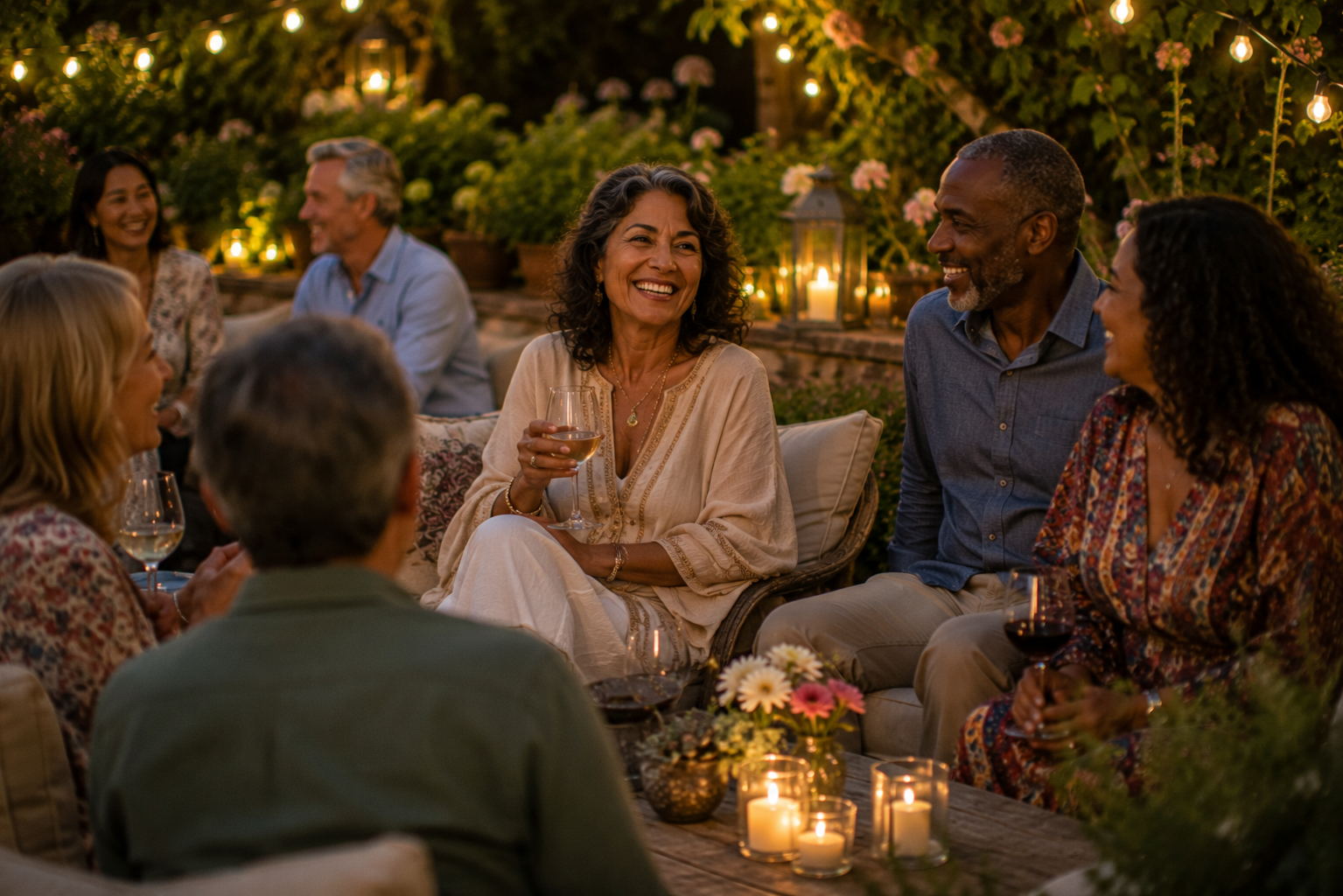
If there’s one thing I wish more hosts could truly see, it’s this: guests are never experiencing a gathering the way we are. They’re not noticing the one flower arrangement that didn’t cooperate. They have no idea the salad was supposed to have basil you forgot to pick. They certainly aren’t comparing the evening to the polished version you’ve been carrying around in your head for weeks.
And yet, that’s exactly what so many of us do.
I’ve done it myself — more times than I’d like to admit. You plan for days. You tidy things that didn’t need tidying. You second‑guess the menu. You rearrange the flowers, then rearrange them again. And right before guests arrive, you find yourself standing in the kitchen wondering why on earth you thought hosting was a good idea.
Somewhere along the way, entertaining became tangled up with performance, as if hosting meant presenting a flawless version of ourselves and our homes. But the older I get, the less interested I am in that kind of entertaining. In fact, some of the most enjoyable gatherings I’ve ever been part of would never have passed a “perfect” test.
A goat once jumped onto the dinner table — yes, really. A gust of wind sent place cards tumbling across the yard. A surprise summer shower forced everyone to huddle under a canopy. A dessert came out looking nothing like the recipe photo. And yet those evenings were wonderful. Not despite the mishaps — sometimes because of them. They gave everyone something to laugh about, something to remember, something human.
Over time, hosting has taught me that the easiest way to reduce stress is to decide ahead of time what actually matters. For me, it’s never been about flawless presentation. It’s about whether people feel welcome. Whether there’s enough food. Whether guests are comfortable. Whether conversation flows. Everything else falls into the category of “nice if it happens.”
That shift alone feels like a deep exhale.
I’ve also learned that preparation and perfection are not the same thing. Preparation is grounding — it lets you relax. It means lighting the candles early, setting the table before the rush, choosing recipes you trust. Perfection, on the other hand, is a moving target. No matter how much you do, there will always be one more thing to tweak. One more detail to fuss over. One more reason to keep adjusting instead of letting the evening begin.
One of my favorite hosting habits now is giving myself permission to stop. About an hour before guests arrive, I put everything down. I stop tweaking. I stop scanning the room for flaws. I change clothes, pour myself something to sip, light the candles, and take a moment to enjoy the space before anyone else steps into it. It’s a small ritual, but it shifts everything. The evening stops feeling like a project and starts feeling like a gathering.
And maybe that’s the real secret. Guests don’t remember how hard you worked. They remember how you made them feel. They remember whether you were present — whether you joined the conversation, laughed at the stories, and seemed genuinely happy they were there.
The most gracious hosts I’ve known all had one thing in common: they weren’t trying to create a perfect evening. They were simply enjoying it alongside everyone else. And somehow, that made everyone else relax too.
Because hospitality has never been about perfection. It’s always been about connection. And connection doesn’t require perfection — not even for a moment.
The Small Details Guests Always Remember
For all the time we spend fussing over centerpieces and menus and whether everything is coming together exactly as we imagined, I’ve come to see something that still surprises me: the details people remember are almost never the ones we expect.
No one has ever called me months later to rave about a napkin fold. Not once. But they do remember the things that made them feel something.
I still think about a gathering I attended years ago where the host tucked a sprig of fresh lavender into each place setting. It wasn’t elaborate. It probably took her a few minutes. But every time someone lifted their napkin, the scent drifted into the air. I couldn’t tell you what we ate that night — but I remember that lavender as if it were yesterday.
And then there was the evening when dinner stretched long past sunset. The air cooled, and without saying a word, the host brought out a basket of blankets and set it near the patio. Within minutes, everyone had wrapped themselves in one. The conversation kept going. Nobody hurried. Nobody shivered. Years later, I can still feel that blanket around my shoulders, the stars overhead, the warmth of a glass of wine in my hand.
I’ve come to believe that hospitality often lives in these small, quiet gestures — the ones that say, without saying anything at all: I thought about your comfort. I thought about your experience. I’m glad you’re here.
Sometimes it’s a handful of flowers gathered from the garden that morning. Sometimes it’s remembering that someone prefers sparkling water to iced tea. The gestures themselves aren’t what matter. It’s the thought behind them.
And the lovely thing is, these touches don’t require a bigger budget or a grand plan. In fact, the most memorable ones are usually the simplest: a basket of rolled hand towels in the powder room, fresh herbs scattered down the center of the table, music drifting through the house as guests arrive, lawn games set out on the grass. None of it is necessary — and yet these little things have a way of turning an ordinary evening into something people carry with them.
Maybe it’s because they signal care. And care is something people rarely forget.
I also think the details that linger tend to be the ones that feel personal — not copied from a magazine, not curated for a photograph, but rooted in your life. The bowl that belonged to your grandmother. The recipe everyone asks for. The story behind the flowers. The dog who insists on greeting every guest like he’s been appointed head of hospitality.
Those are the things that give a gathering its character. Those are the details that make it yours. And maybe that’s why they’re the ones that stay with us. The gatherings I remember most always reflected the people hosting them.
Long after the table has been cleared and the candles have burned down, what remains isn’t the décor. It’s the feeling. The warmth. The laughter. The small acts of thoughtfulness woven quietly through the evening.
The details people remember are rarely the biggest ones. They’re simply the ones that made them feel welcome.
Beautiful Garden Party Color Ideas
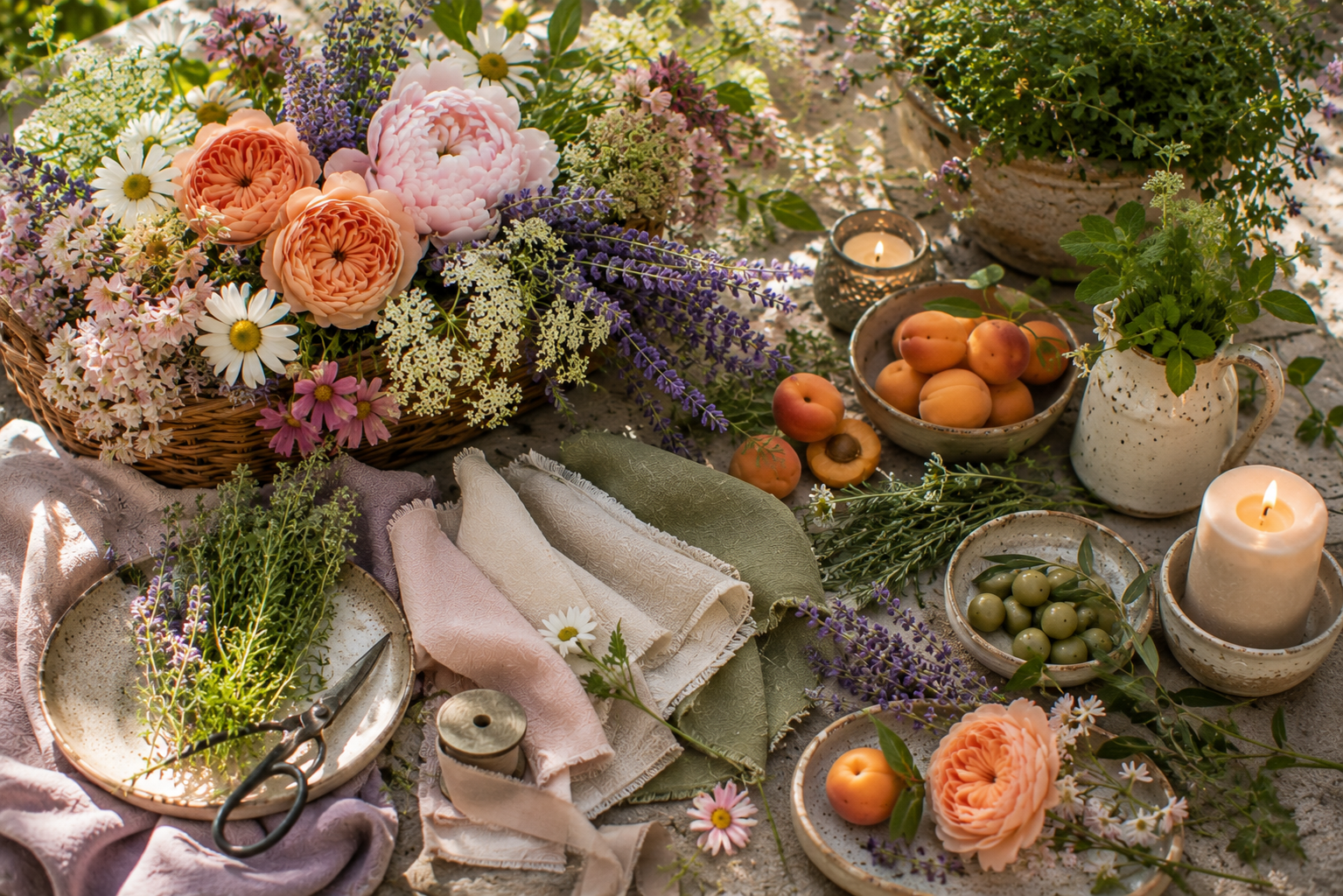
What I’m drawn to most about entertaining outdoors is the way nature quietly steps in as the designer. Indoors, we’re the ones choosing color palettes and trying to make everything feel cohesive. But outside, the garden does most of the work if you let it. The roses blooming along the fence, the lavender spilling over the path, the deep greens of late‑summer leaves, the colors of berries on the table, the golden light that settles over everything just before sunset — those are the cues I find myself following.
Some of the most beautiful gatherings I’ve ever attended didn’t seem to have a color palette at all. And yet, when I look back at photos, there’s always this sense of harmony, as if the colors were borrowed straight from the landscape. Maybe that’s why those evenings felt so effortless. Instead of imposing a look on the garden, the hosts let the garden guide them.
In early summer, I’m drawn to softer shades — blush roses, creamy whites, pale lavender, the gentle blue of hydrangeas. There’s something romantic about those colors, especially as the light begins to soften in the evening. The whole atmosphere feels relaxed and feminine without tipping into formality.
Later in the season, I find myself reaching for richer tones — coral dahlias, apricot roses, deep berry hues, golden flowers gathered from the yard. By then, the garden feels fuller, more abundant, almost celebratory, as though summer itself is reaching its peak.
Sometimes my inspiration comes from places I’ve traveled. A garden party doesn’t need to look themed to borrow a feeling from somewhere else. The soft blue and white of the Greek islands. The terracotta and olive tones of Tuscany. The lavender and stone of Provence. The layered greens and creams of the English countryside. Those influences show up in small ways — flowers, linens, dishes, candles. It’s never about recreating a destination. It’s about capturing a mood.
Over time, I’ve found that restraint is often more elegant than excess. When too many colors compete, the whole scene can feel busy. A smaller palette feels calmer, more intentional, more inviting — not because of rules, but because the eye has somewhere to rest.
And of course, there’s no single “right” palette for a summer garden party. The best one is usually the one already growing around you — the flowers in your yard, the colors you naturally reach for, the dishes you’ve collected over the years, the linens that make you smile when you unfold them. Those personal choices give a gathering its character. They make it yours.
Maybe that’s why the most beautiful gatherings never feel copied. They feel rooted — in a place, in a season, in a person.
Just like a garden.
A Few Beautiful Sources of Inspiration
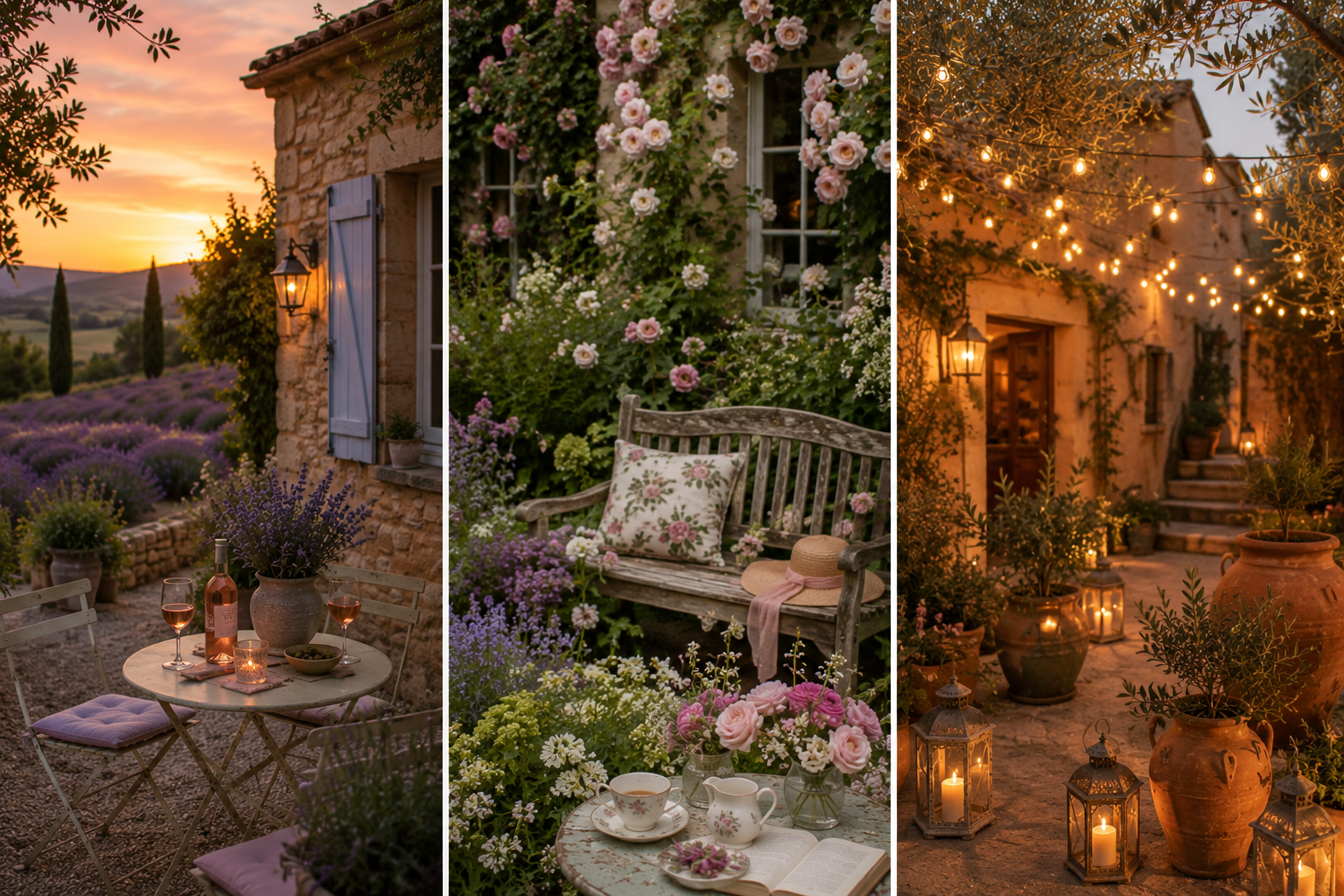
I’ve come to realize that when I’m planning a gathering, I’m almost always drawn to a certain mood before anything else. Sometimes it comes from a place I’ve traveled. Sometimes it’s sparked by a flower blooming in the garden. Sometimes it’s as simple as rediscovering a tablecloth I’d forgotten I owned, tucked away on a shelf waiting for “just the right occasion.”
The best gatherings, at least in my experience, begin with a feeling rather than a plan.
One summer, that feeling reminded me of Provence. Not in a themed, costume‑party sort of way — no striped shirts or berets required — but in the atmosphere. Lavender tucked into little jars. A simple table beneath the trees. Fresh bread torn by hand. Rosé catching the last of the evening light. Everything felt easy and sun‑warmed, the way summer evenings in the South of France always seem to be.
Another year, I found myself leaning toward the charm of the English countryside. There’s something comforting about gatherings that feel collected rather than coordinated — garden roses spilling from pitchers, mismatched china, a table that looks like it evolved over time instead of being purchased all at once. Nothing too perfect. Nothing too polished. Just a relaxed kind of elegance that makes people settle in without thinking about it.
And then there are the Mediterranean‑inspired evenings I always seem to return to. Not because they’re extravagant, but because they celebrate everything I love about summer: simple food, beautiful surroundings, and long, unhurried hours that stretch into the night. I think of sun‑washed stone, terracotta pots overflowing with herbs, olive branches in simple vessels, tables set beneath strings of lights as the sky deepens into blue. Warm whites, terracotta, olive green, golden candlelight — maybe a touch of cobalt for good measure. Nothing formal, yet everything intentional.
What I love most about those gatherings is their sense of abundance without excess. A table filled with fresh bread, seasonal fruit, olives, cheeses, dishes meant to be shared. Conversation drifting lazily. Guests pouring themselves another glass of wine. The feeling that no one is in a hurry and the night still has room to unfold.
Sometimes, though, the inspiration comes from nothing more than the season itself. A midsummer table overflowing with dahlias, berries, peaches, armfuls of flowers gathered from the garden. No destination in mind. No theme. Just summer being summer — generous and full and alive. Those evenings often end up being the most beautiful because they’re rooted in exactly where you are.
And maybe that’s the thread that ties all my favorite gatherings together. They’re never really about a theme. They’re about atmosphere. About the feeling in the air. About the story that quietly unfolds around the table.
A theme asks, What should this look like? Atmosphere asks, How do I want people to feel?
And that question always leads somewhere more interesting.
Because people rarely remember a theme. They remember a feeling — candlelight flickering across the table, laughter drifting through the garden, that soft, unmistakable sense of not wanting the evening to end.
If a gathering leaves people with that, I think it’s already a success, no matter what inspired it in the first place.
Final Thoughts
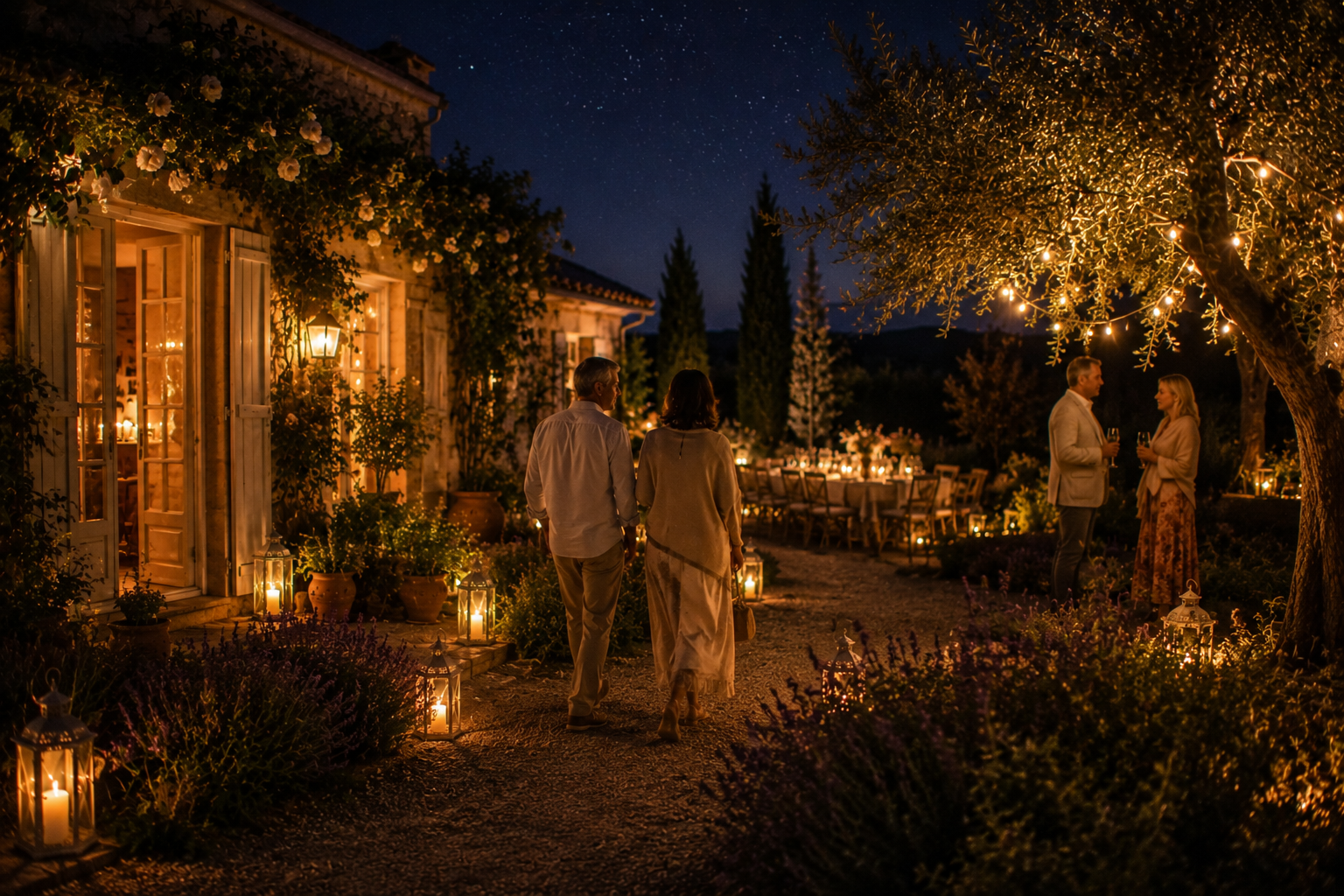
When I think about the gatherings I’ve loved most, very few stand out because everything went according to plan. If anything, the memories that rise to the surface are the ones shaped by something unexpected — the moments that remind you you’re sharing an experience, not producing an event. And maybe that’s why they stay with us.
It’s so easy to believe that beautiful entertaining requires more — more planning, more décor, more effort, more perfection. But the longer I spend around tables and gardens and people gathered together, the more convinced I am that it often requires less. Less pressure. Less performance. Less worrying about whether everything is exactly right.
Disclosure: This article may contain affiliate links. If you make a purchase through these links, I may earn a commission at no additional cost to you.
