

Amsterdam Canal Colors: A European Color Story
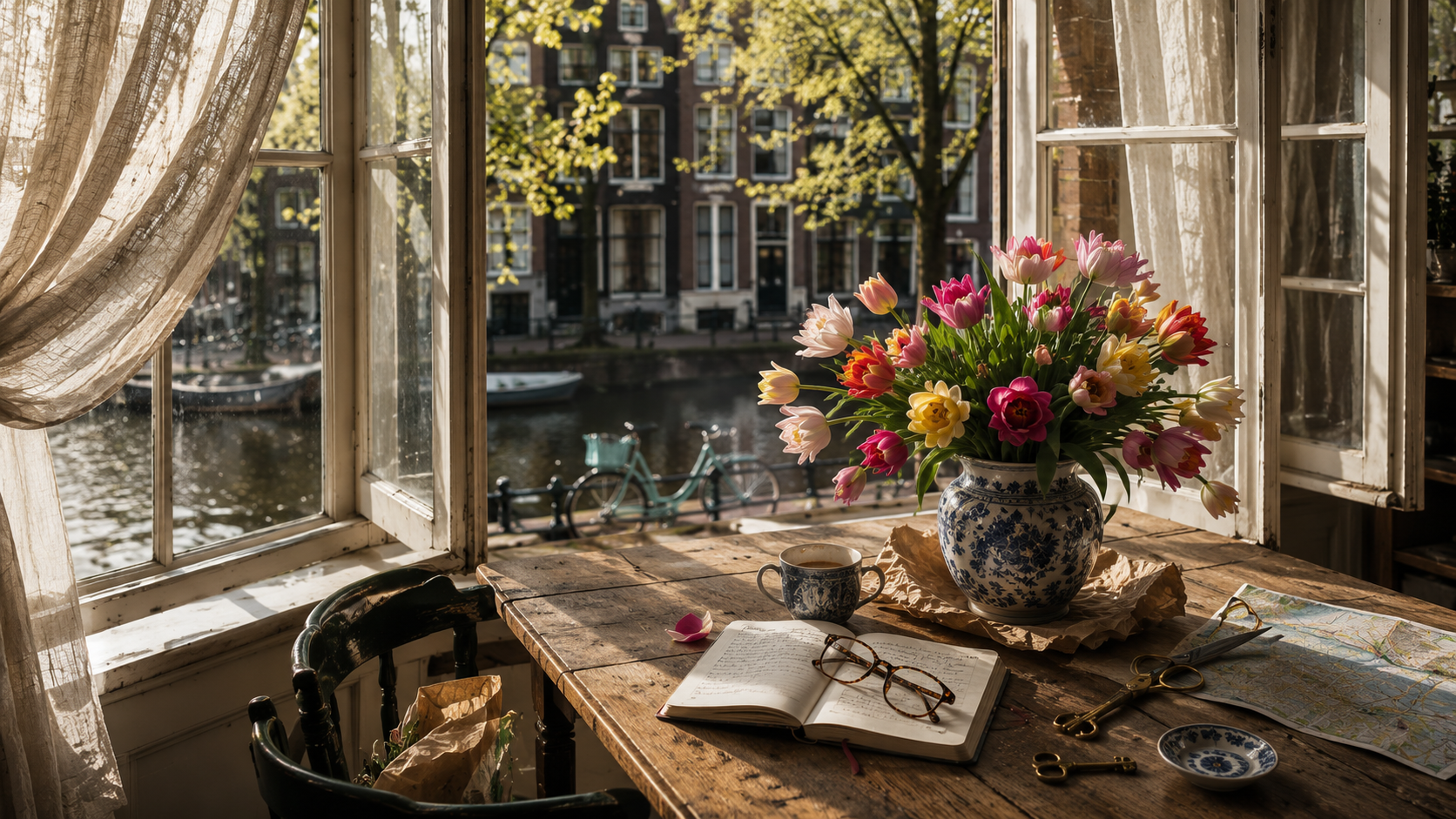
Where Reflections Become Color
Some cities greet you with grand gestures.
Amsterdam doesn’t. It leans in softly.
Its beauty reveals itself in the subtle conversation between water, light, and centuries‑old architecture—unhurried, understated, never trying too hard.
Along the canals, rows of narrow brick houses rise toward the sky, their mirrored images so clear you sometimes forget which version is real. Morning clouds drift overhead, diffusing the light and mellowing every surface. Trees cast shifting patterns across the water. And as bicycles skim over arched bridges, their colors flicker for a moment before dissolving into the canal’s muted ripples.
Walking through Amsterdam feels less like sightseeing and more like relearning how to notice.
The city slows your pace.
It asks you to see the honeyed glow of brick after a spring rain. The deep green doors worn smooth by generations. Pale limestone trim framing windows that have watched centuries unfold. Amber café light stretching across the canals as evening settles in.
And just when you’ve settled into its palette of weathered blues, charcoal, and brick, Amsterdam offers a small delight.
A butter‑yellow bicycle leaning against a bridge. A copper window box overflowing with crimson geraniums. Coral and ivory tulips brightening a tiny garden. Bright green reflections shimmering across the canal like impressionist brushstrokes.
These moments never insist.
They simply remind you that beauty often arrives quietly, almost shyly, if you linger long enough to see it.
Maybe that’s why Amsterdam feels so calming.
Its colors don’t compete. They reveal themselves over time, like a story told in low tones.
If Barcelona is shaped by Mediterranean minerals, and Florence by Renaissance pigments, Amsterdam is composed of mirrored light.
Here, water becomes part of the architecture. Light becomes part of the palette. And every season paints the city anew, creating a masterpiece that is never quite the same twice.
The Amsterdam Palette
Every city has colors.
Amsterdam has reflections.
Its palette doesn’t arrive in bold declarations or dramatic vistas. It gathers gradually—brick warmed by late‑day light, canal water echoing the sky, old doors softened by time, and small bursts of color appearing exactly where your eye needs a moment of delight.
These are the tones that linger long after you’ve gone home.
Canal Blue
The canals feel like the city’s pulse.
Some days they’re an open‑sky blue. On subdued mornings they shift to silvery gray. At sunset they deepen into navy, carrying mirrored bridges, passing bicycles, and amber café windows across their surface like slow, drifting brushstrokes.
This shifting blue is the city’s calm—an anchoring hue that holds everything together.
Historic Brick
Amsterdam’s canal houses aren’t the bright red you might expect.
Their brick has mellowed over centuries into earthy, sun‑washed tones—weathered, imperfect, deeply inviting.
Rain deepens them. Golden light softens them.
Together they create a feeling that is both historic and quietly comforting.
Deep Forest Green
Once you begin noticing it, deep green appears everywhere.
Front doors worn smooth by time. Window shutters. Iron bridges and railings. Tree reflections stretching across the water.
It’s a grounding color—steady, understated—and it shapes much of Amsterdam’s serene character.
Soft Limestone
Look closely and you’ll see pale limestone framing windows, bridges, and historic façades.
This muted neutral keeps the city’s richer tones from feeling heavy. It adds balance and brightness, the way a calm voice can steady a room.
Like Amsterdam itself, it never seeks attention. It simply helps everything around it feel more harmonious.
Weathered Charcoal
Charcoal is the city’s structure.
Wrought‑iron bridges, slate rooftops, bicycle frames, old lamp posts—these deeper tones anchor the palette, offering contrast without sharpness.
They give the softer colors room to breathe.
Delft Blue
No Dutch color story feels complete without Delft Blue.
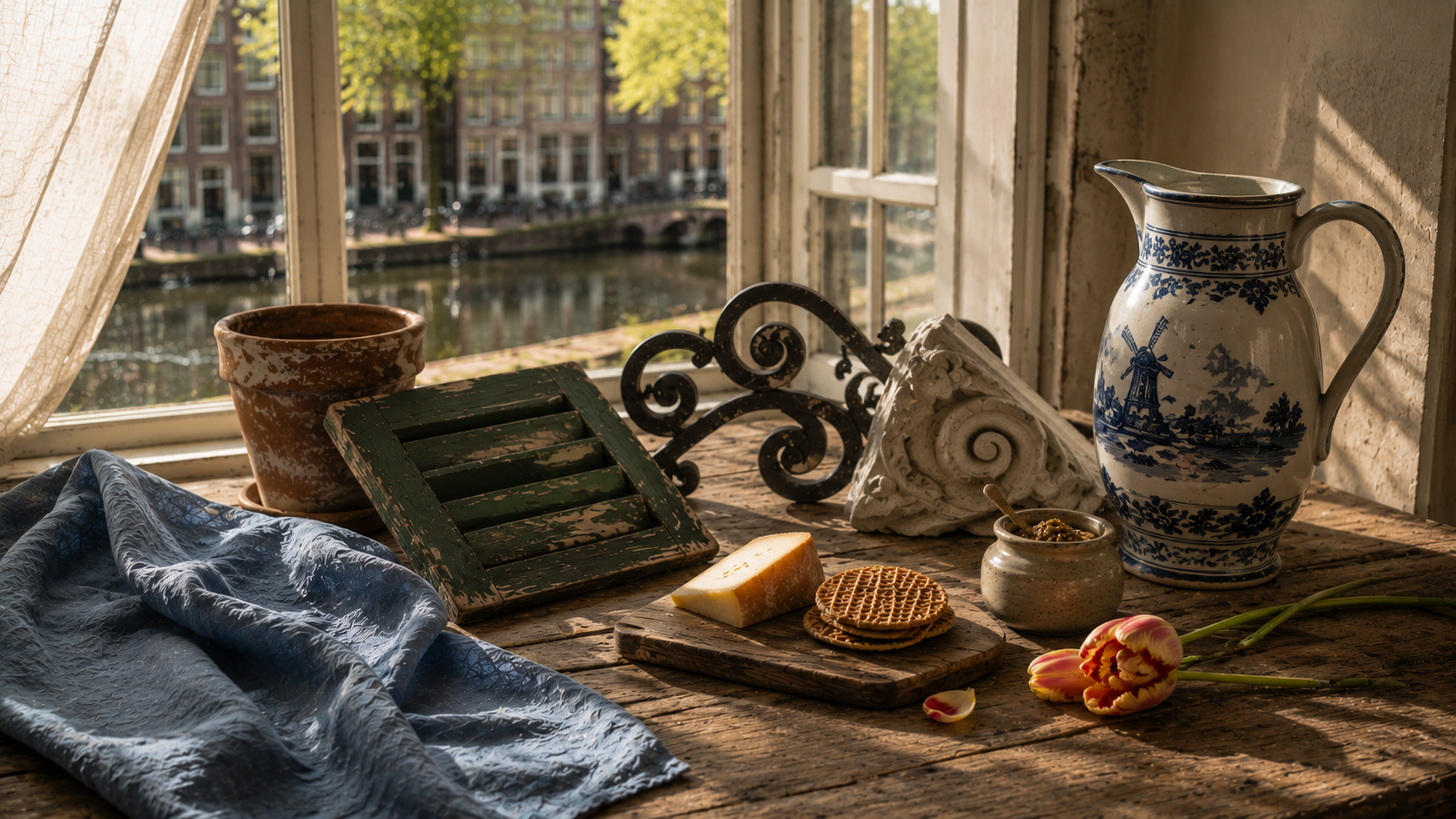
Inspired by hand‑painted ceramics woven into the Netherlands’ artistic heritage, this crisp blue appears in pottery, decorative details, and museum collections. You won’t find it on every Amsterdam street, but its presence feels iconic—an accent threaded through the country’s history.
Used sparingly, Delft Blue brings a fresh brightness to the palette, the way a beautifully painted vase can transform a simple oak table. It reminds you that even quiet interiors can hold something extraordinary.
The Unexpected Colors
And then come the colors that catch you off guard.
A butter‑yellow bicycle leaning against a bridge. Coral tulips brightening a small garden. Crimson geraniums spilling from a copper window box. Hyacinths in lavender, blush, and deep blue announcing spring. Bright green reflections dancing across the canals beneath leafy trees. Golden café lights shimmering across the water after sunset.
These colors never compete with the city.
They appear like small discoveries—reminders that Amsterdam’s beauty often lives in the details you almost miss.
If you'd like to recreate this palette at home, look for natural materials, handcrafted ceramics, weathered wood, and simple glass vessels that become more beautiful with everyday use.
Editor’s Finds:
The Lesson Amsterdam Teaches
Every city sends you home with something.
Amsterdam sends you home with a way of seeing.
Long after I returned, I realized I wasn’t replaying famous landmarks or grand architectural moments. I was remembering small flashes of light.
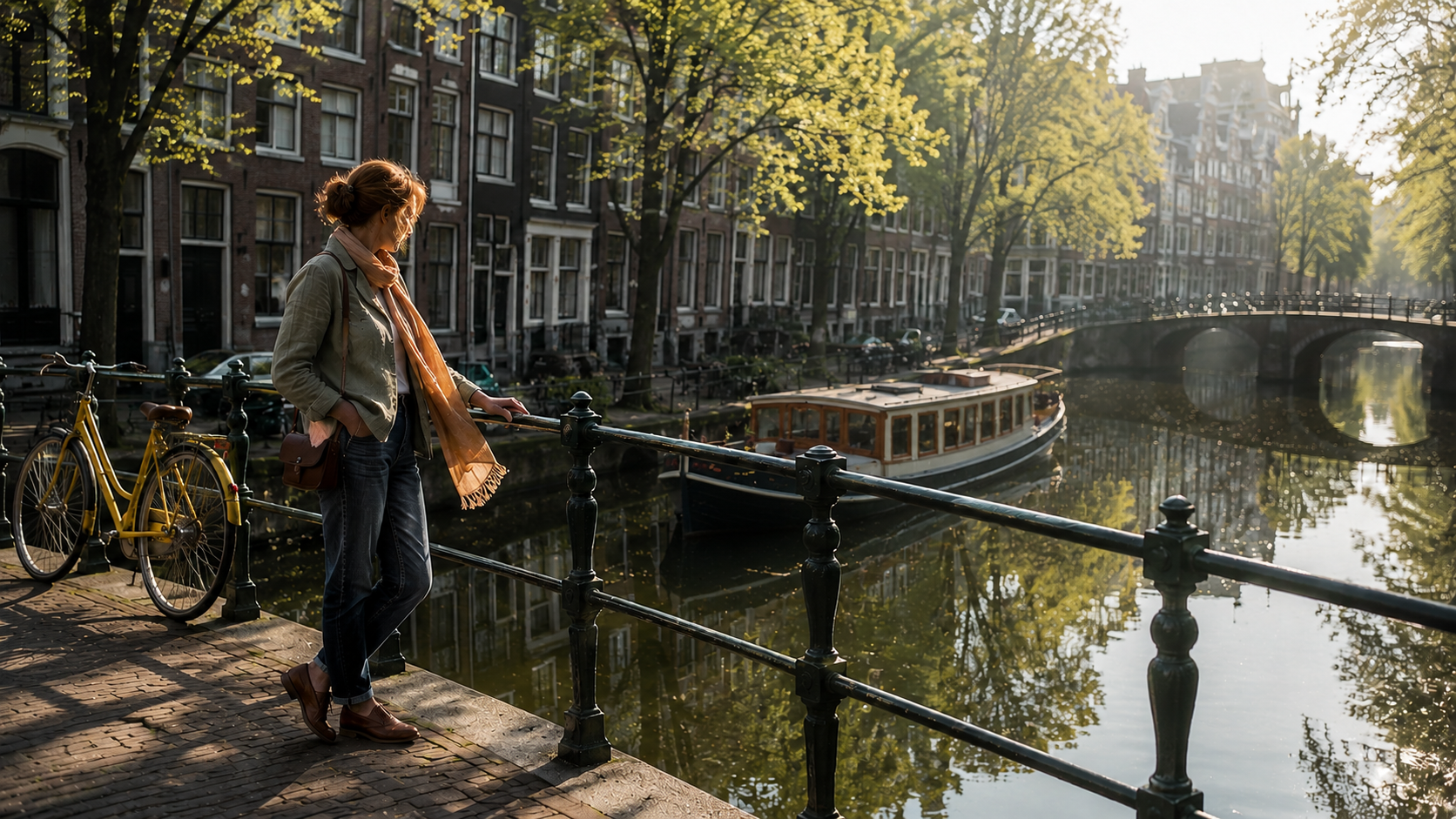
A bridge stretching across still water. Café windows glowing on a rainy evening. A single yellow bicycle brightening a tranquil street. Tulips catching the first warm sun outside a narrow canal house.
None of these moments were extraordinary on their own.
But together, they stayed with me.
Maybe that’s Amsterdam’s gift.
It reminds you that beauty doesn’t always declare itself. Sometimes it waits—unhurried—until you slow down enough to notice.
That’s why the city feels so restorative.
Nothing competes for your attention. Instead, each detail guides you gently to the next.
A doorway. A mirrored surface. A window box. A bicycle. A bridge. A tree reflected in the canal.
Before long, you realize you’ve stopped searching for highlights and started appreciating harmony.
There’s a lesson tucked inside that shift.
We often imagine beautiful spaces—or beautiful lives—being shaped by one dramatic gesture. Something bold. Something defining.
Amsterdam suggests something different.
Beauty gathers in layers. In deliberate details. In restraint. In leaving room for small, unexpected delights.
And that idea reaches far beyond travel.
It shapes the homes we create. The clothes we choose. The tables we gather around. Even the way we move through our everyday routines.
Perhaps that’s why Amsterdam lingers long after the trip ends.
It teaches—without urgency—that when we learn to notice the small moments of beauty, the world becomes calmer, richer, and more colorful than we ever expected.
Style Inspired by Amsterdam
Amsterdam has a way of making effortless style feel truly believable.
Maybe it’s because the city is built for walking. Maybe it’s the bicycles weaving through every street. Or maybe it’s simply that nothing here feels like it’s trying to impress you.
The women I noticed weren’t dressed to stand out.
They were dressed to belong—to the weather, to the cobblestones, to the easy rhythm of the canals.
There’s a serene confidence in that.
Clothing feels considered rather than curated. Natural rather than perfect. Beautiful because it’s lived in, not because it’s seeking attention.
Amsterdam’s palette lends itself to wardrobes that feel timeless—rooted in texture, comfort, and thoughtful simplicity.
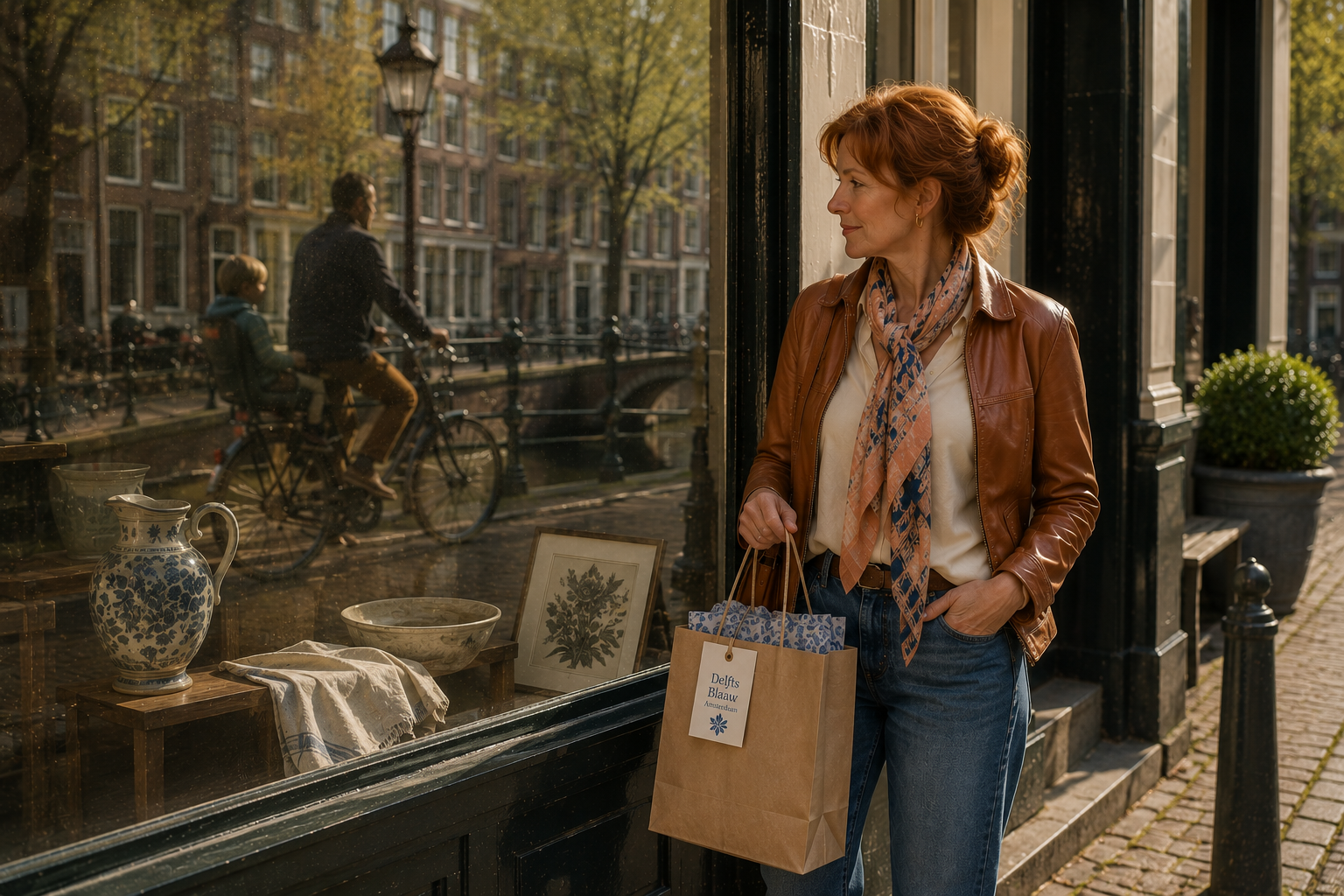
Imagine a soft linen shirt in Canal Blue or crisp parchment paired with relaxed denim. A lightweight knit in forest green beneath a cognac leather jacket or tailored charcoal blazer. Wide‑leg trousers in muted stone. Comfortable leather sneakers. A beautiful leather crossbody bag that grows richer with every journey.
And then, just as the city does, add one unexpected note of color.
A apricot silk scarf. A sunny yellow raincoat brightening an otherwise subdued day. An in Delft Blue sweater draped loosely over your shoulders on a cool spring morning. Stylish glasses with frames the color of fresh tulips.
The accent doesn’t need to dominate.
In Amsterdam, it rarely does.
Its purpose is simply to spark a small delight—like a cheerful bicycle waiting beside a canal or a window box overflowing with crimson geraniums. These subtle touches remind you that the most memorable style often comes from restraint, softened by moments of joy.
Perhaps that’s why Amsterdam’s style feels so enduring.
It isn’t driven by trends. It’s shaped by everyday beauty—comfortable enough for a morning spent wandering the canals, elegant enough for dinner in a candlelit café, and timeless enough to feel just as right years from now as it does today.
Editor’s Finds:
Home Inspired by Amsterdam
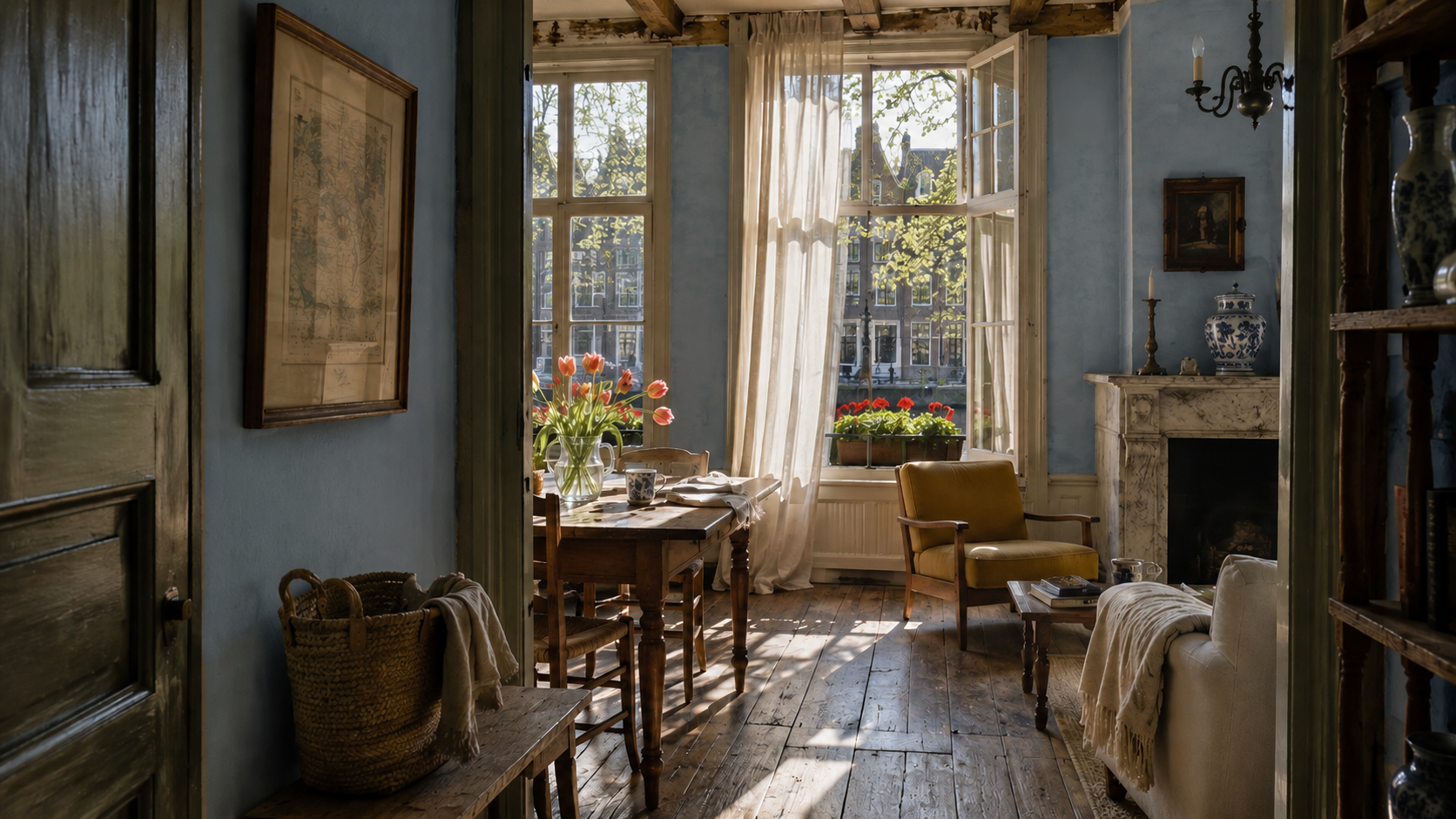
Some homes try to impress you the moment you walk in.
Amsterdam’s canal houses do something quieter. They draw you in.
Their beauty isn’t created from grand rooms or elaborate decoration. It unfolds little by little, through deliberate layers—a weathered oak floor, a Delft Blue vase catching the afternoon light, linen curtains drifting in an unhurried breeze, fresh tulips gathered in a simple glass pitcher.
Nothing feels excessive. Everything feels chosen with care.
Maybe that’s why Amsterdam interiors feel so welcoming.
They embrace restraint without slipping into coolness. Historic brick and painted wood offer a mellow warmth. Pale limestone walls shift with the changing daylight. Natural linen, wool, and aged leather add understated texture. Black iron lighting steadies the room. Brass deepens into a honeyed patina over time.
Every material seems selected not just for how it looks today, but for how beautifully it will age.
And then come the small delights.
A copper window box overflowing with crimson geraniums. A cheerful Delft Blue planter filled with white hyacinths. A butter‑yellow chair tucked into the corner of an otherwise neutral room. Fresh tulips from the market arranged without ceremony.
These touches don’t compete with the space. They wake it gently.
Amsterdam reminds us that beautiful homes don’t need constant reinvention.
They simply need meaningful details gathered slowly.
A favorite ceramic mug. A vintage map framed on the wall. Books that have actually been read. A bicycle basket resting nearby after a morning at the market. A woven basket waiting by the door after a leisurely walk.
Objects that quietly tell the story of a life well lived.
Perhaps that’s the city’s greatest lesson for our homes.
Make space for light. Make space for reflection. Make space for small, unexpected joys.
Because the most welcoming rooms—much like Amsterdam itself—reveal themselves gradually, never all at once.
Editor’s Finds
Beauty Inspired by Amsterdam
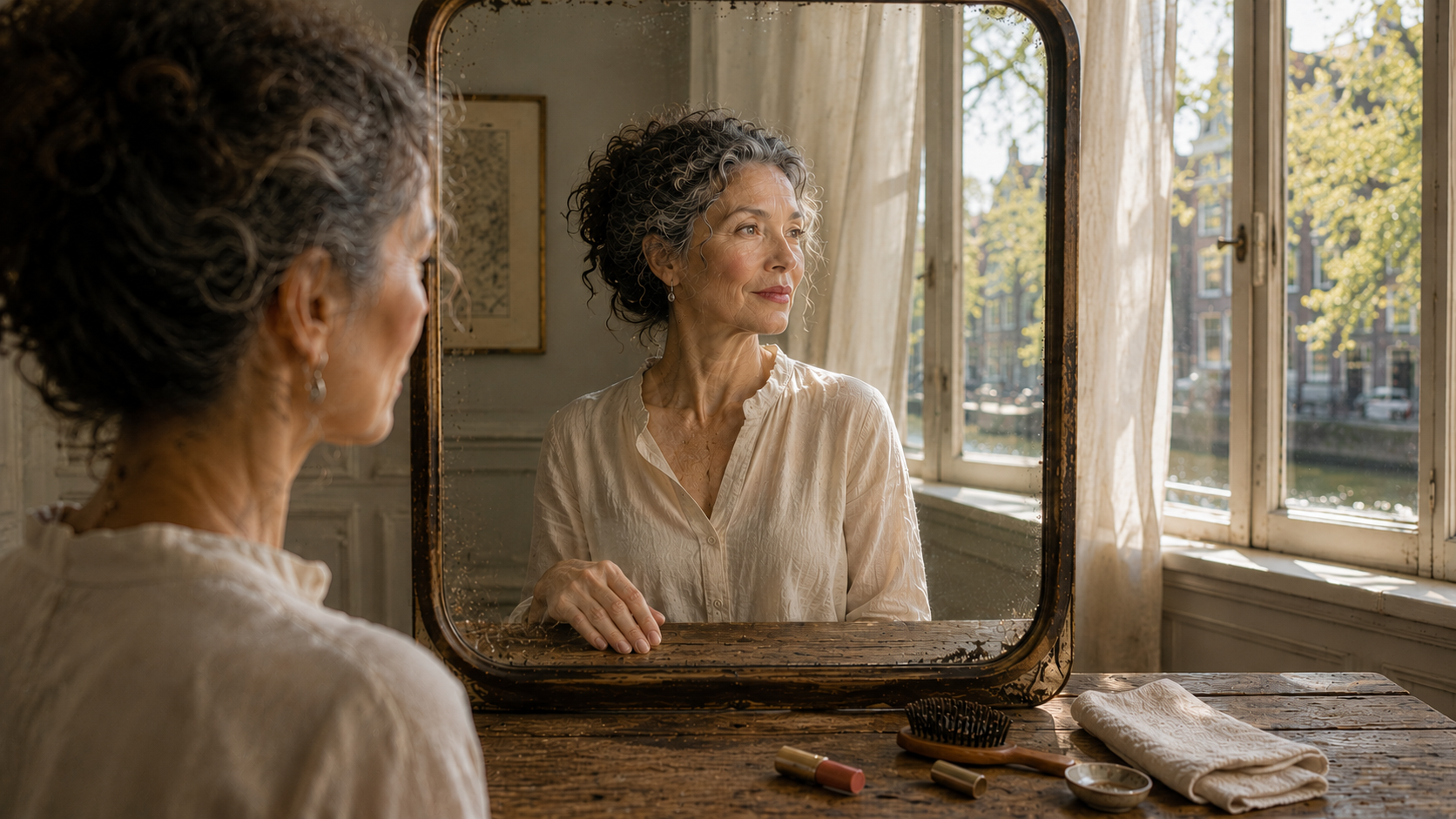
Amsterdam doesn’t ask you to look different.
It simply welcomes you to look like yourself—rested, comfortable, quietly radiant.
Maybe that’s because so much of the city’s beauty comes from natural light. Morning reflections mellow every feature. Cloudy skies diffuse the sun into a tender glow that flatters instead of overwhelming. Even after a spring rain, the whole city seems to shimmer with freshness.
The kind of beauty that feels most at home here isn’t dramatic.
It’s thoughtful. Healthy skin. Subtle color. Textural softness. Makeup that enhances rather than transforms.
Imagine skin that looks luminous without losing its natural finish—freckles still visible. Brows brushed gently into place. A wash of taupe or soft mushroom across the eyes. Mascara that defines without demanding attention. Lips in rosewood, soft berry, or muted coral—tones that feel alive rather than polished. A touch of cream blush inspired by the first tulips of spring.
Nothing feels hurried. Nothing feels overdone.
Even hair seems to follow Amsterdam’s philosophy.
Unstructured movement instead of perfect styling. A loose bun after a morning at the flower market. Natural waves stirred by the canal breeze. Silver strands allowed to shine rather than be hidden.
Beauty here feels confident enough to leave a few pieces out of place.
Maybe that’s because Amsterdam reminds us that authenticity has its own elegance. Just as the city lets weathered brick, aged wood, and shifting light become part of its charm, we don’t need to erase every line or refine every detail to look beautiful.
Sometimes the most captivating face in the room is simply the one that feels at ease.
Like the city itself, Amsterdam’s beauty isn’t about standing out.
It’s about reflecting light with easy confidence.
Beauty That Feels Effortless
Amsterdam's beauty philosophy is refreshingly simple: healthy skin, soft color, and products that enhance rather than transform.
Entertaining Inspired by Amsterdam
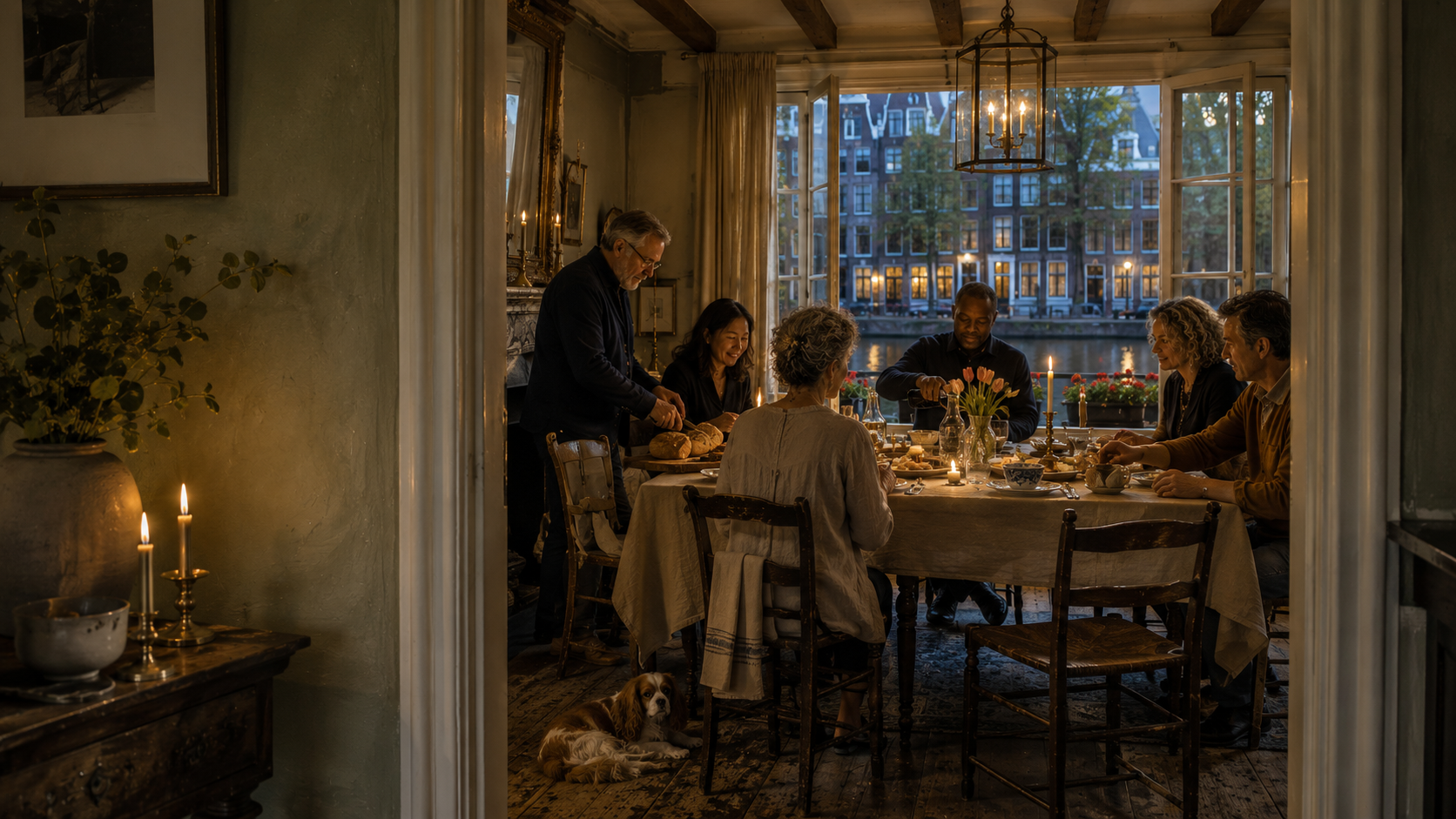
Amsterdam reminds us that the most memorable gatherings rarely begin with elaborate plans.
They begin with an open door. A kettle warming on the stove. Fresh flowers from the market. A table set simply because friends are coming.
There’s something wonderfully unpretentious about the way the city welcomes people.
Canal houses may be narrow, but they never feel small. Large windows pull in the shifting light. Candles mellow the evening. Conversations stretch long after dinner ends.
The atmosphere feels relaxed, as though everyone has permission to settle in and stay awhile.
That spirit is easy to bring home.
Start with natural materials. A linen tablecloth that wrinkles beautifully. Simple white dishes paired with a few pieces of Delft Blue pottery. Clear glassware that catches the glow of candlelight. Wooden boards layered with fresh bread, good cheese, seasonal fruit, and herbs from the garden.
Leave space on the table. Space for serving. Space for conversation. Space for whatever unfolds.
Then add the touches that quietly echo Amsterdam’s personality.
A handful of tulips gathered loosely in a glass vase. White hyacinths filling the room with their lingering fragrance in early spring. Crimson geraniums just outside an open window. Brass candlesticks warming as daylight fades. The last of the evening light mirrored in the glass. Subdued reflections dancing in glassware as candles begin to flicker.
Nothing needs to match perfectly. Nothing needs to feel staged.
The goal isn’t perfection. It’s ease.
Amsterdam reminds us that hospitality isn’t measured by how much we provide. It’s measured by how welcome people feel when they arrive—and how reluctant they are to leave.
Perhaps that’s why the city’s gatherings feel so memorable.
They leave room for laughter. Room for conversation. Room for stillness. Room for one more cup of coffee after dessert.
Because, like the canals themselves, the most meaningful moments are the ones we don’t rush past.
Editor’s Finds:
Experiencing Amsterdam's Colors
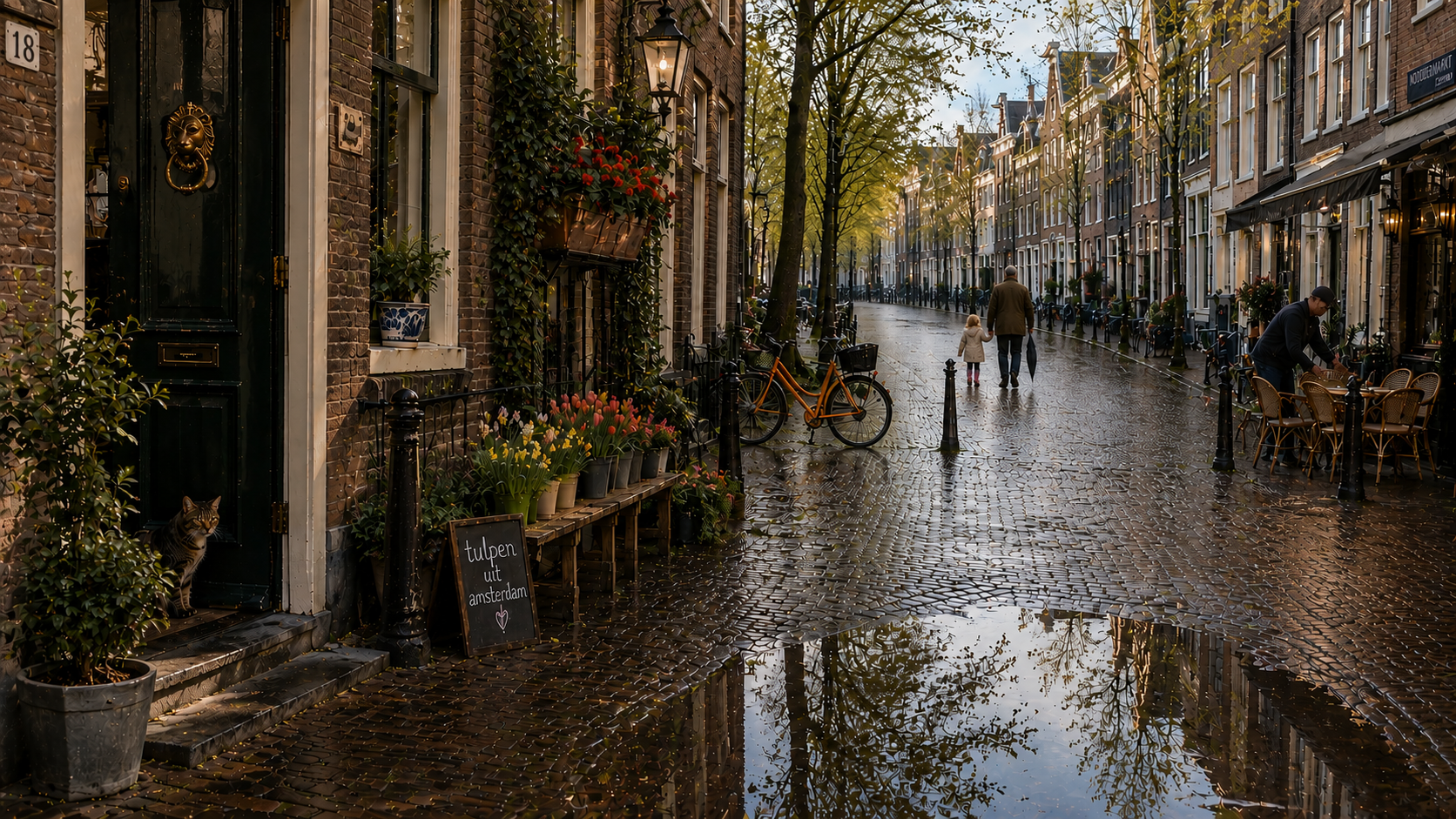
Amsterdam’s colors aren’t found in one destination.
They reveal themselves one unhurried moment at a time.
Walk along the canals early in the morning, before the city fully wakes, and you’ll see how the water mirrors the sky with a diffused softness that makes it hard to tell where one begins and the other ends.
Cross a bridge and pause for a breath. Look down as often as you look ahead. Some of Amsterdam’s most beautiful views live in its mirrored surfaces.
Wander without rushing. Turn down the smaller streets. Notice the deep green doors worn smooth by seasons. Admire the narrow canal houses leaning gently toward one another, each one carrying centuries of stories.
Look for the details most visitors move past without noticing.
A Delft Blue planter tucked into a windowsill. Fresh tulips brightening a neighborhood flower stand. A cheerful bicycle resting against an old brick wall. Crimson geraniums spilling from a copper window box. The amber glow of café lights stretching across the water as evening settles in.
If you’re visiting in spring, spend time simply walking. Tulips, daffodils, and hyacinths bloom everywhere, reminding you that even Amsterdam’s subdued palette welcomes moments of joyful color.
And if rain arrives, don’t rush indoors.
Some of the city’s most striking tones appear afterward. Brick grows richer. Trees become more vivid. The canals reflect twice as much light. The whole city seems to pause and breathe.
Perhaps that’s the best way to experience Amsterdam.
Not by seeing more. By noticing more.
Because in a city shaped by reflections, the most lasting memories are often the ones waiting quietly in plain sight.
Bringing Amsterdam Home
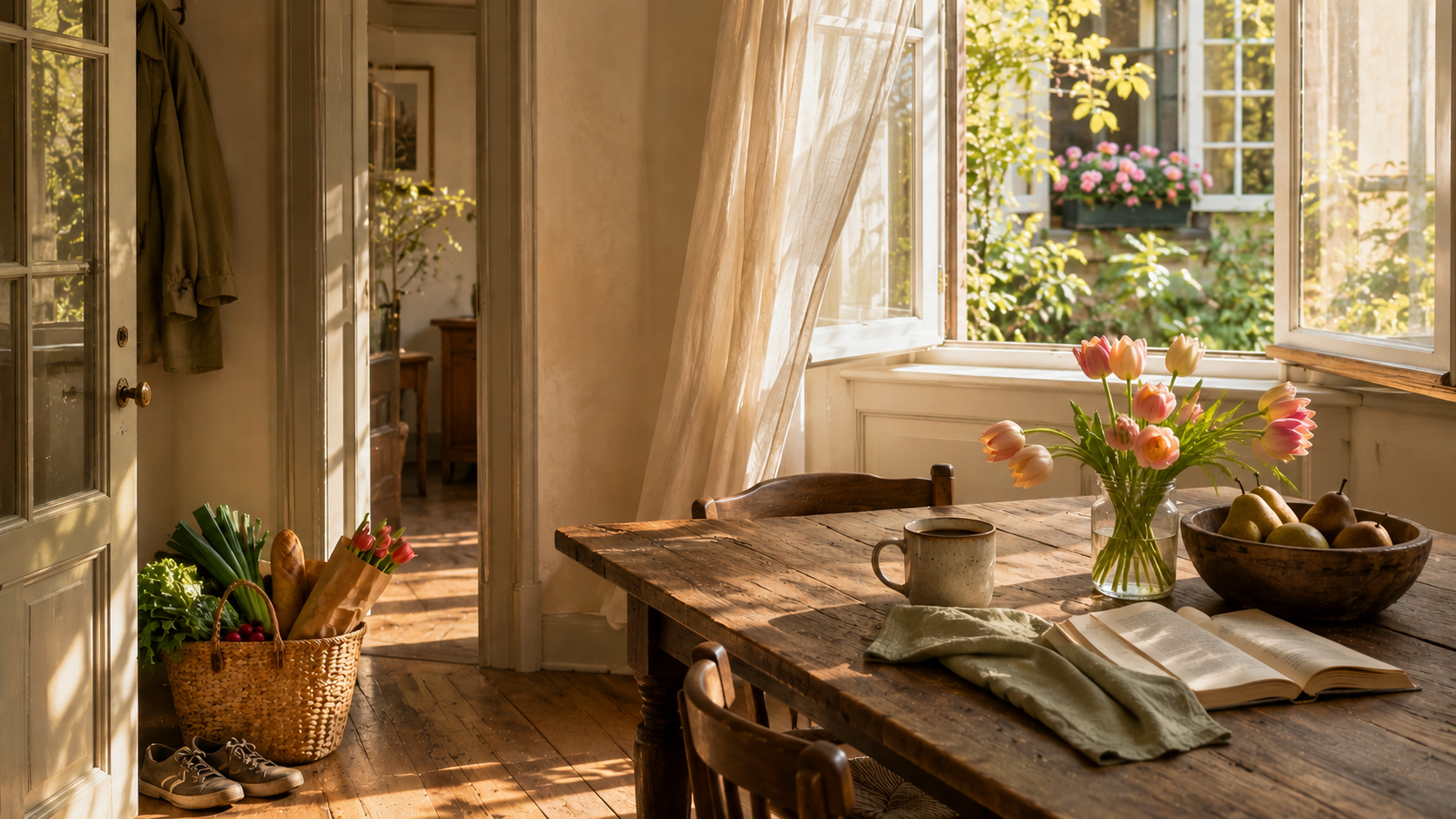
The beautiful thing about Amsterdam is that you don’t need to live beside a canal to carry a little of its spirit with you.
You simply begin to notice differently.
Maybe you pick up fresh tulips on your way home from the market—not because you’re hosting, but because ordinary days deserve flowers too.
Maybe you leave the curtains open a little longer in the evening, letting the shifting light become part of your home.
You choose natural materials that grow richer with time instead of replacing them every season.
You slow your pace just enough to enjoy the walk instead of rushing toward the destination.
You leave space on the table. Space on the shelf. Space in your calendar. Space in your conversations. Space to breathe. Space to notice.
You begin collecting meaningful objects rather than accumulating more things.
A handmade ceramic mug. A well‑loved linen napkin. An old wooden bowl. A favorite book waiting to be read again.
Small reminders that a beautiful life is built over time.
Amsterdam teaches us that beauty rarely arrives all at once. It gathers in layers—through mindful choices repeated over time.
Perhaps that’s why the city stays with us long after we’ve returned home.
Not because we remember every street or every bridge. But because we begin seeing our own lives a little differently.
We notice the morning light across the kitchen table. The reflection in a rain puddle after an afternoon shower. The flowers blooming outside a neighbor’s window. The comfort of a familiar chair at the end of the day.
And suddenly, the ordinary feels just a little more extraordinary.
Maybe that’s the greatest souvenir Amsterdam leaves behind.
Not a photograph. Not a keepsake.
A more attentive way of seeing the world.
Editor’s Finds:
Closing Reflection
When I first began noticing Amsterdam’s colors, I thought I was simply gathering inspiration.
A beautiful palette. A few photographs. Ideas for my home. Maybe a color combination to remember the next time I packed for Europe.
But somewhere along the way, I realized I was bringing home something far more meaningful.
Amsterdam hadn’t just shifted the tones I was drawn to.
It had changed the way I looked at the world around me.
I found myself lingering a little longer instead of hurrying on. Seeing mirrored light I might once have walked past. Bringing home flowers for no particular reason. Choosing objects that would grow richer with time instead of simply newer. Leaving space—for light, for conversation, for stillness, for surprise.
Maybe that’s the true gift of beautiful places.
They don’t ask us to become someone else. They simply remind us of the kind of life we’ve been hoping to create all along.
A life that notices. A life that gathers beauty with each season. A life that values craftsmanship over excess, presence over perfection, and everyday moments over extraordinary occasions.
Perhaps that’s why Amsterdam stays with us.
Not because we’ve memorized every canal or crossed every bridge. But because, somewhere between the mirrored water and the shifting light, it quietly teaches us that beauty has been waiting for us all along.
Sometimes all we have to do is slow down enough to see it.
That’s the real color story of Amsterdam.
Not the blue of its canals. Not the warmth of its brick. Not the cheerful surprise of tulips or bicycles.
But the quiet realization that the most beautiful life isn’t built all at once.
It’s reflected back to us, one thoughtful moment at a time.
Part of the European Color Stories collection, where we explore how the world's most beautiful places can inspire the way we travel, decorate, dress, entertain, and live.
Disclosure: This article may contain affiliate links. If you make a purchase through these links, I may earn a commission at no additional cost to you.
