

How to Set a Holiday Table People Remember
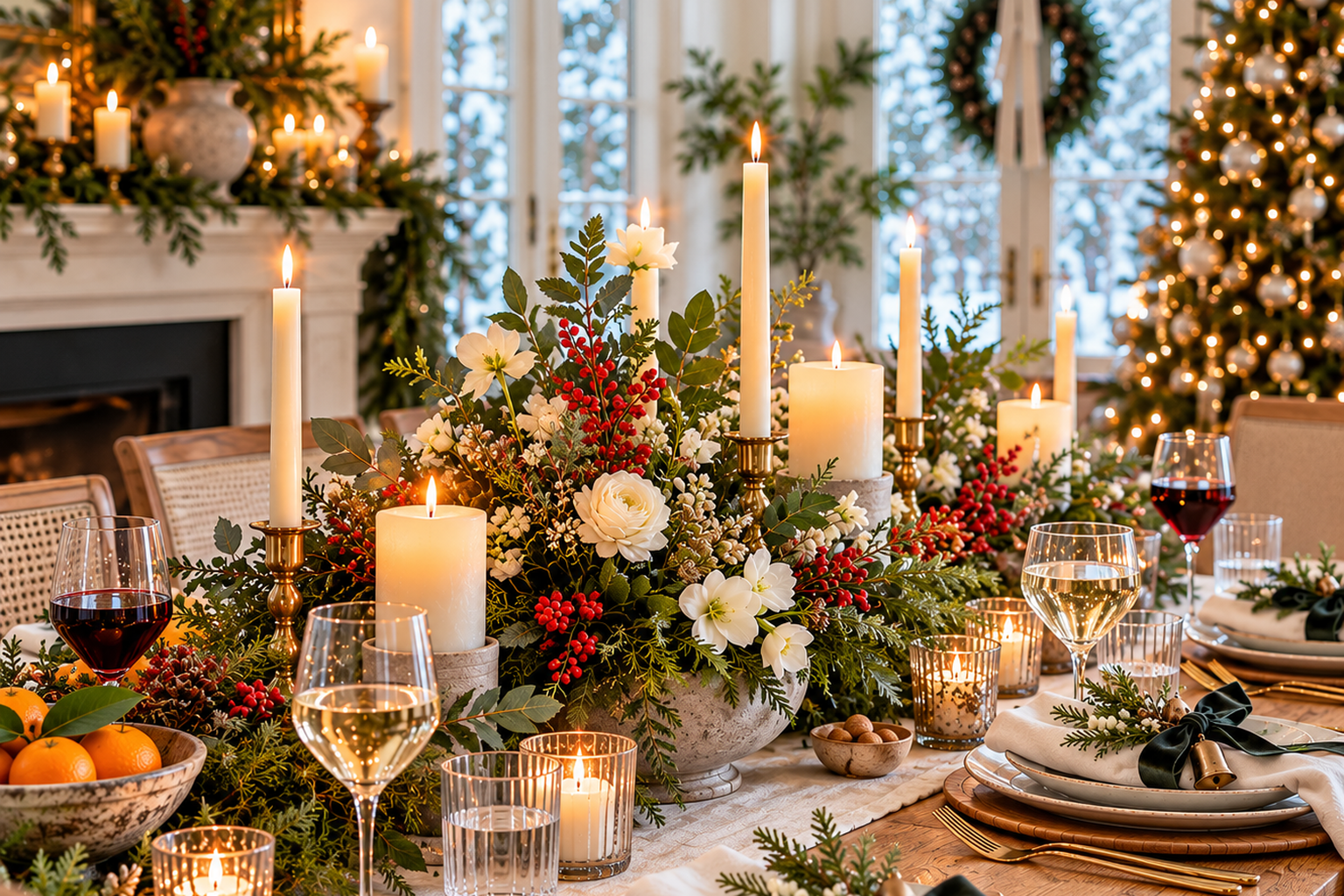
The first table I ever set for a winter holiday gathering, I got almost everything wrong.
I made the floral arrangement tall because that was what the magazines did. I stacked the centerpiece high enough that the two people at the head of the table had to lean around it to see each other. Nobody complained, but I stood at the side of the room and watched them shift in their chairs all through the first course, and I understood my mistake.
I didn’t know it then, but that table would teach me the rule I came back to again and again. That was years before I started my event planning business. After thirteen years in the industry, I learned that a table works when the people sitting at it can forget the table and talk to each other.
This is the advice I wish someone had handed me back then.
Start With the Room, Not the Table
Before you think about plates, look at where the table will actually be.
Stand in the doorway your guests will come through and look at the room the way they will. What do you see first? If the answer is a bare wall, that wall deserves your attention before the table does. One low lamp, a candle on the sideboard, or a branching stem in a vase on a shelf will change how the whole evening feels far more than a new set of dishes.
Then notice where people will sit. A round table lets everyone see everyone. A long one seats more people and tends to break into smaller conversations. Look at which chairs will face the window once the light goes, and which will have their backs to it.
Finally, work with what is already in the room instead of against it. If the walls are warm, your table will feel warmer with cream and brass than with cold silver. If the room is small, a crowded table will read as busy rather than generous. A table looks best when it belongs to the room it sits in.
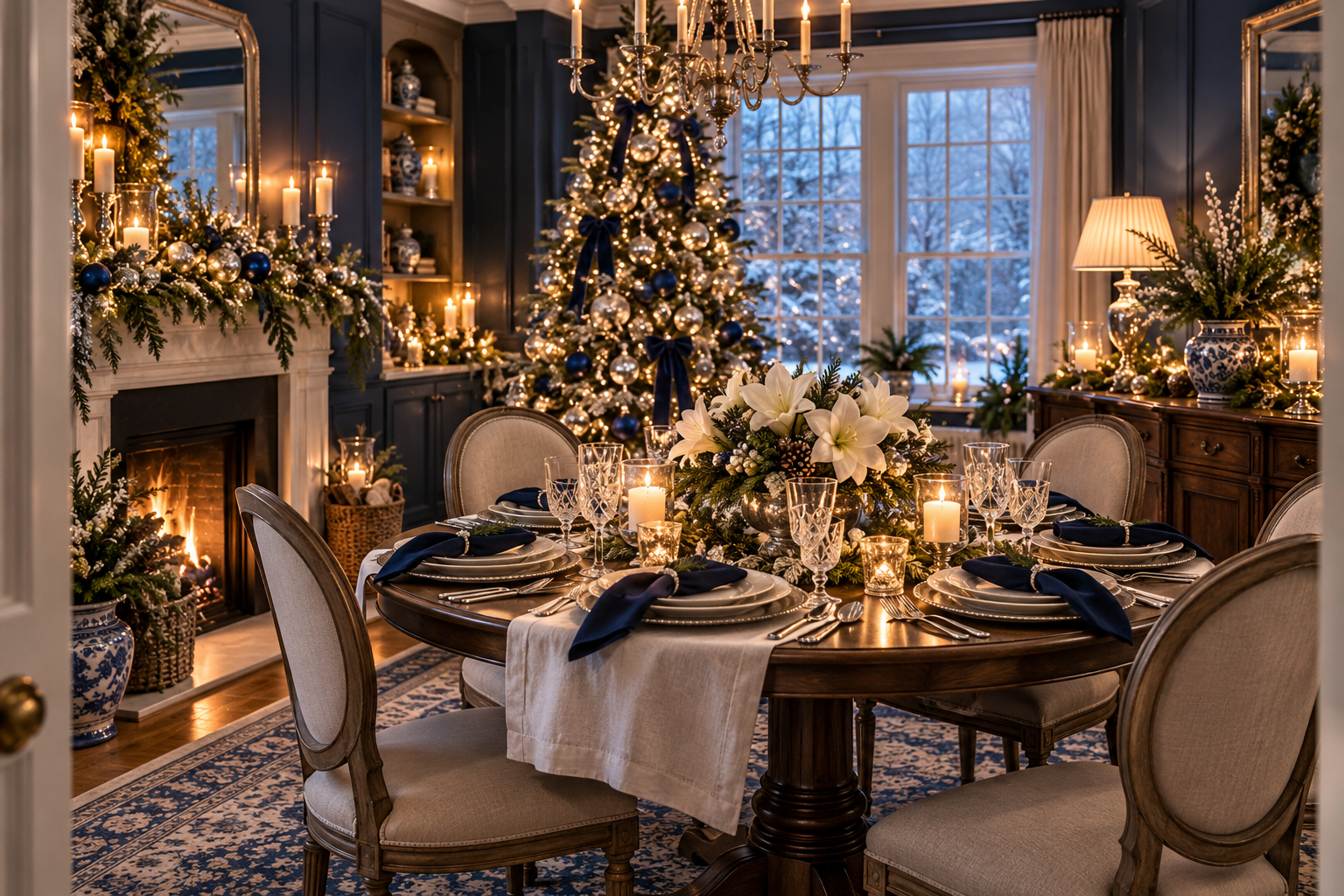
Light the Room First
Before the candles, look at the light you already have. Most holiday tables are lit by one overhead fixture, and after dark it does the room no favors. It flattens faces, drops shadows under the eyes, and makes everyone look tired at the hour you most want them to look well.
Turn it off, or dim it if you can, and build the room from smaller light. A lamp on the sideboard. A candle on the sill. Two or three low candles at the table. Warm, low, and at eye level, this is the light that makes skin look soft and faces look kind.
Set the candles low, so the flame sits beneath the face and the light rises into it. A candle in front of a guest is worth two behind her. If you can see the flame reflected in a window or a mirror, you have found a good spot.
This is also why the light matters more than the centerpiece. A table can be plain and still feel beautiful, if the light is warm and low. A table can be full of beautiful things and still feel flat, if the light is hard and overhead. Get the light right and half the decorating is done.
Use what reflects. Brass, glass, silver, and a mirror on the wall all hold light and give it back. One brass candlestick, or the good glasses on the table, will warm a room more than a new arrangement. You do not need more light. You need softer light, lower light, and more than one place for it to come from.
Choose a Color Story
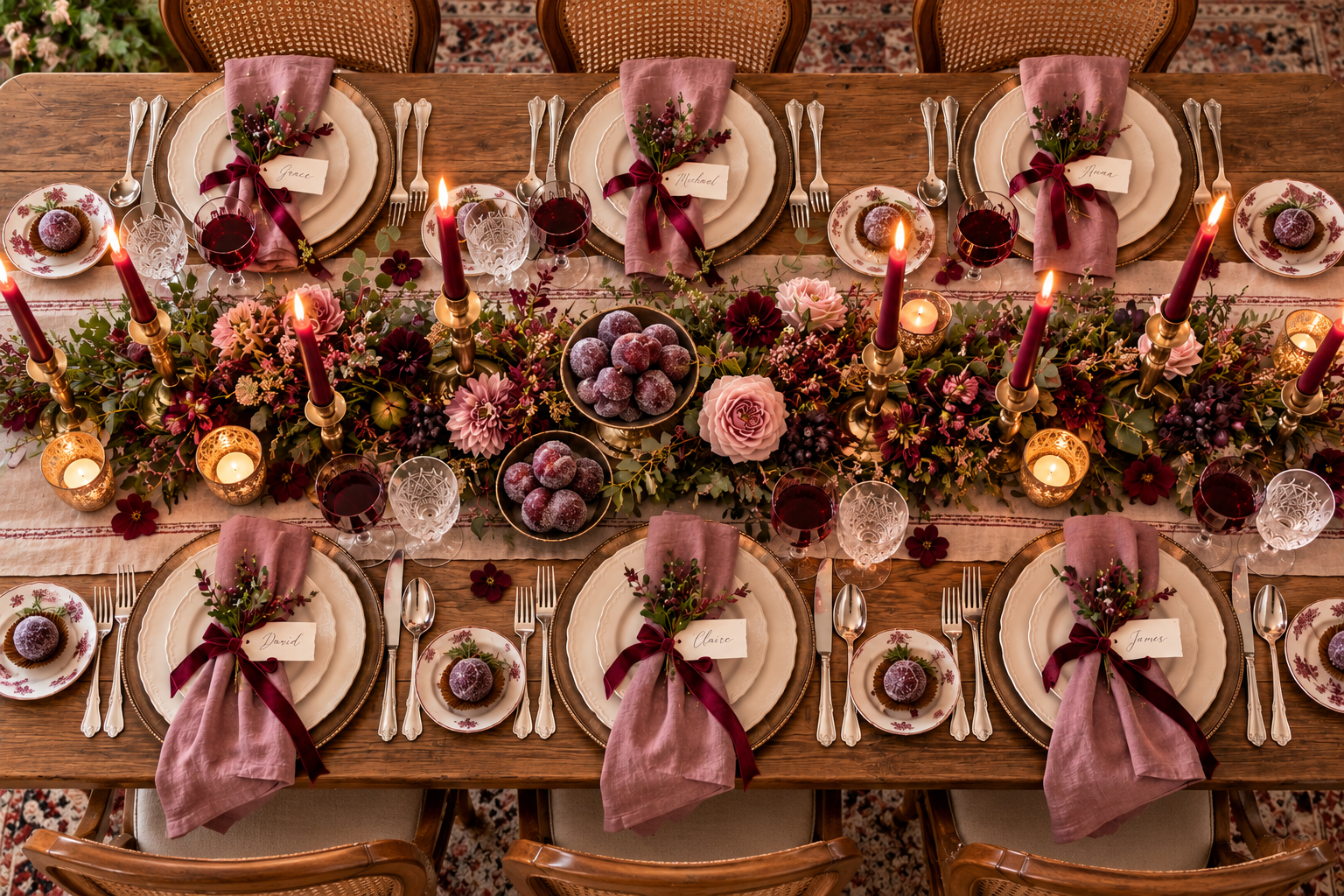
The fastest way to make a table look considered is to limit the colors.
Pick two, or three at most, and let them repeat across the linen, the candles, the flowers, and the ribbon on a place card. When the same colors appear in a few places, the eye settles and the whole table reads as intentional. A table with six or seven colors pulling for attention looks busier than it is, and the food has to compete with it.
Begin with one color you already love, then build the others around it. Cream, soft green, and a little brass will carry almost any holiday table. A deep plum, a dusty rose, and silver feel like a winter evening. If you know your seasonal colors, this is the same thinking applied to a table, and the choice gets much easier.
Decide where the color lives. I keep the plates quiet and let the candles and the flowers carry most of it. If you have one bowl or a set of glasses you love, make that your third color instead of adding another one on the plates.
A holiday is also the excuse to use the things you keep for best. The good glasses, the linen napkins, the silver you inherited. They were kept for exactly this, and a table set with them looks more like a person than a store display.
Five Moods You Can Borrow
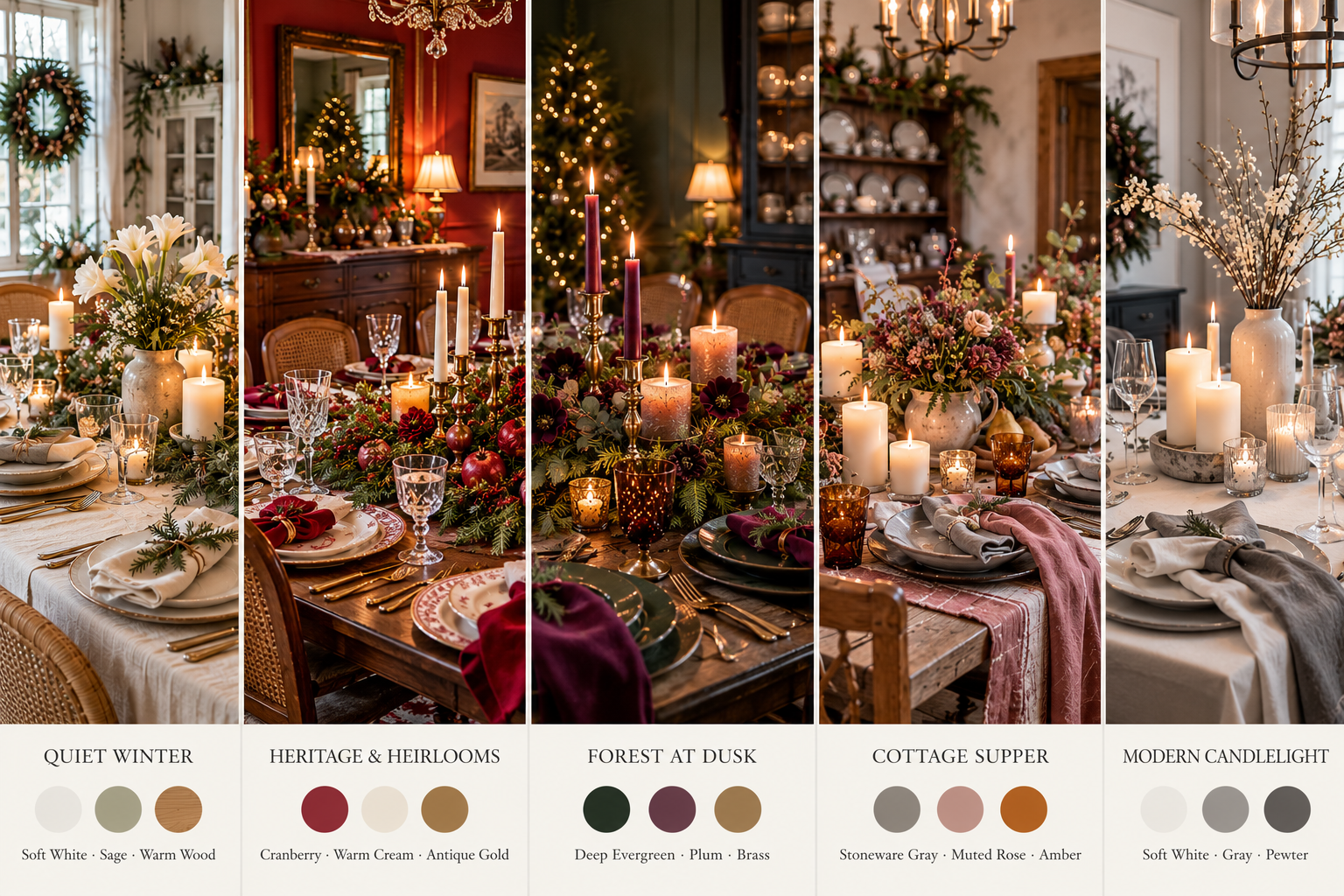
If starting from a blank page feels like a lot, borrow one of these. Each is a mood first, then three colors that carry it, and one material to lean into. Every one works on a full table or a simple one, and none of them asks you to buy a prop you will store for eleven months.
Quiet Winter
Soft white, sage, and warm wood. A table for the woman who would rather have calm than spectacle, and a gift to a house that is not heavily decorated. Lean into washed linen that looks a little sun‑bleached, a low bowl of greenery, and keep the white soft rather than bright. It reads best beside a lot of light or a lot of space.
Heritage and Heirlooms
Cranberry, warm cream, and antique gold. The classic holiday table, and the easiest to pull off, because most of us already own something red and something gold. This is the one that wants the silver and the linen napkins you inherited, the pieces that came down to you from another table. Warm undertones live happily here.
Forest at Dusk
Deep evergreen, plum, and brass. A moody, grown-up palette that comes alive by candlelight, for anyone who finds red and green a little loud. Cool undertones look especially good in it. Low light and brass candlesticks do most of the work.
Cottage Supper
Stoneware gray, muted rose, and amber. Cozy without tipping into rustic: wool at the windows, stoneware on the table, pears and branches in a plain jug. A faint scent of fruit and greenery warms the room without effort. It settles a room that already carries a lot of pattern, and it suits a smaller table or a holiday brunch.
Modern Candlelight
Soft white, gray, and pewter. Clean lines, sculptural candles, and one quiet vase. Made for smaller homes and for anyone who dislikes clutter. Sculptural candles are easy to find now, and one or two are enough. It is the calmest of the five, and the one that most rewards a single beautiful object used well.
Choose one and repeat it across the linen, the candles, the flowers, and the ribbon on a place card. Then stop adding.
The Centerpiece Rule
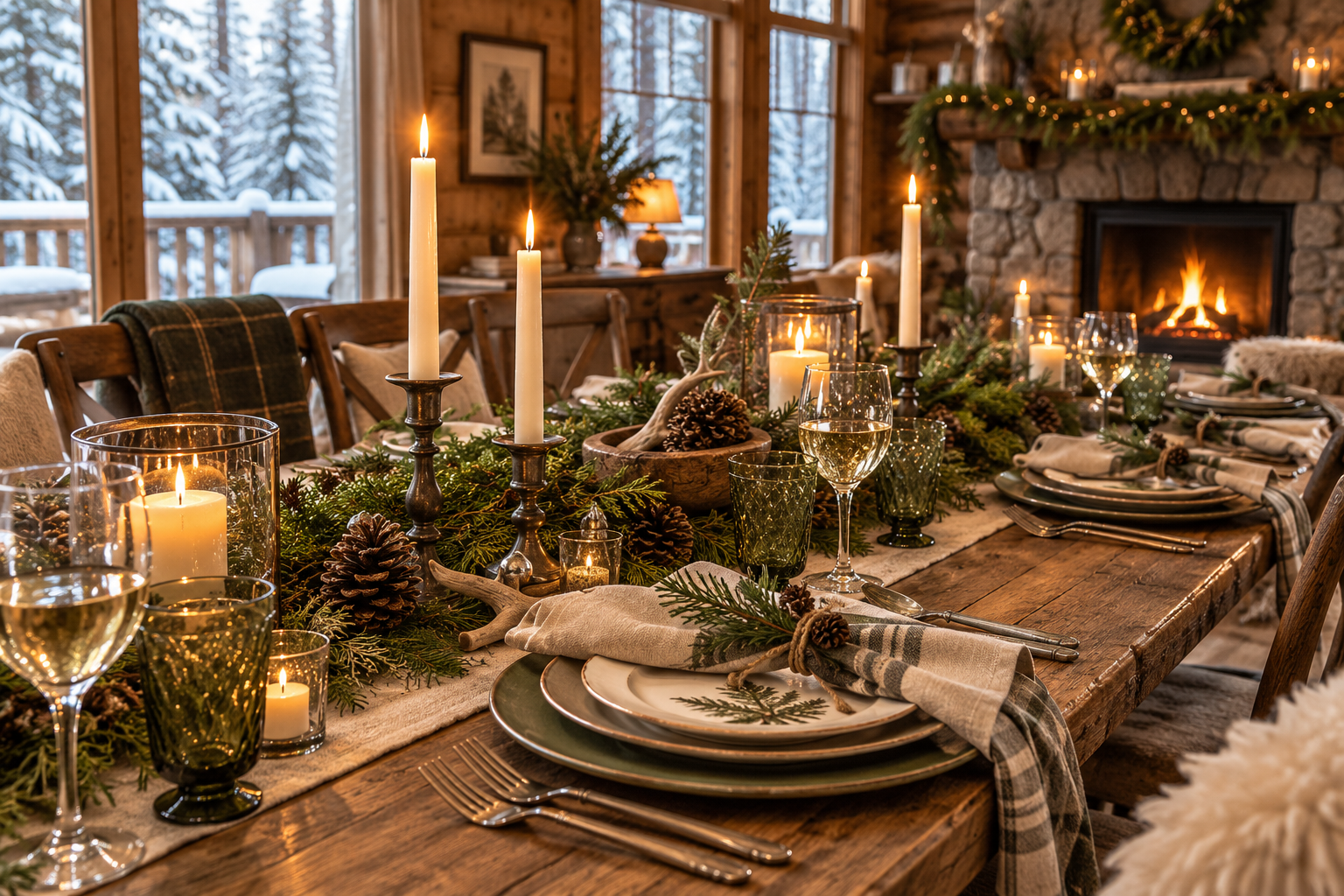
More than anything else, a centerpiece has to let people see each other.
The test is simple. Sit in a chair at your table and look across to the seat opposite. If the centerpiece meets your eyeline, it is too tall, and the two people on either side will spend the meal leaning around it without quite knowing why the conversation feels stiff. Keep it below the level your eyes travel, and let anything tall live somewhere else: a sideboard, a shelf, a corner of the room.
A low arrangement can still be generous and full while leaving the sightline open. A garland down the middle of a long table does the same, and it lets you move one aside when a dish needs the room.
Candles are the one thing allowed to rise above the eyeline, because they are thin and you see through the gaps between them. Keep them toward the middle, in odd numbers, and lit before anyone sits down.
If you love tall flowers, give them the sideboard or a hallway table. On the table itself, choose something you can see over, and let the flowers be what catches the eye from the doorway.
Layering the Table, In Order
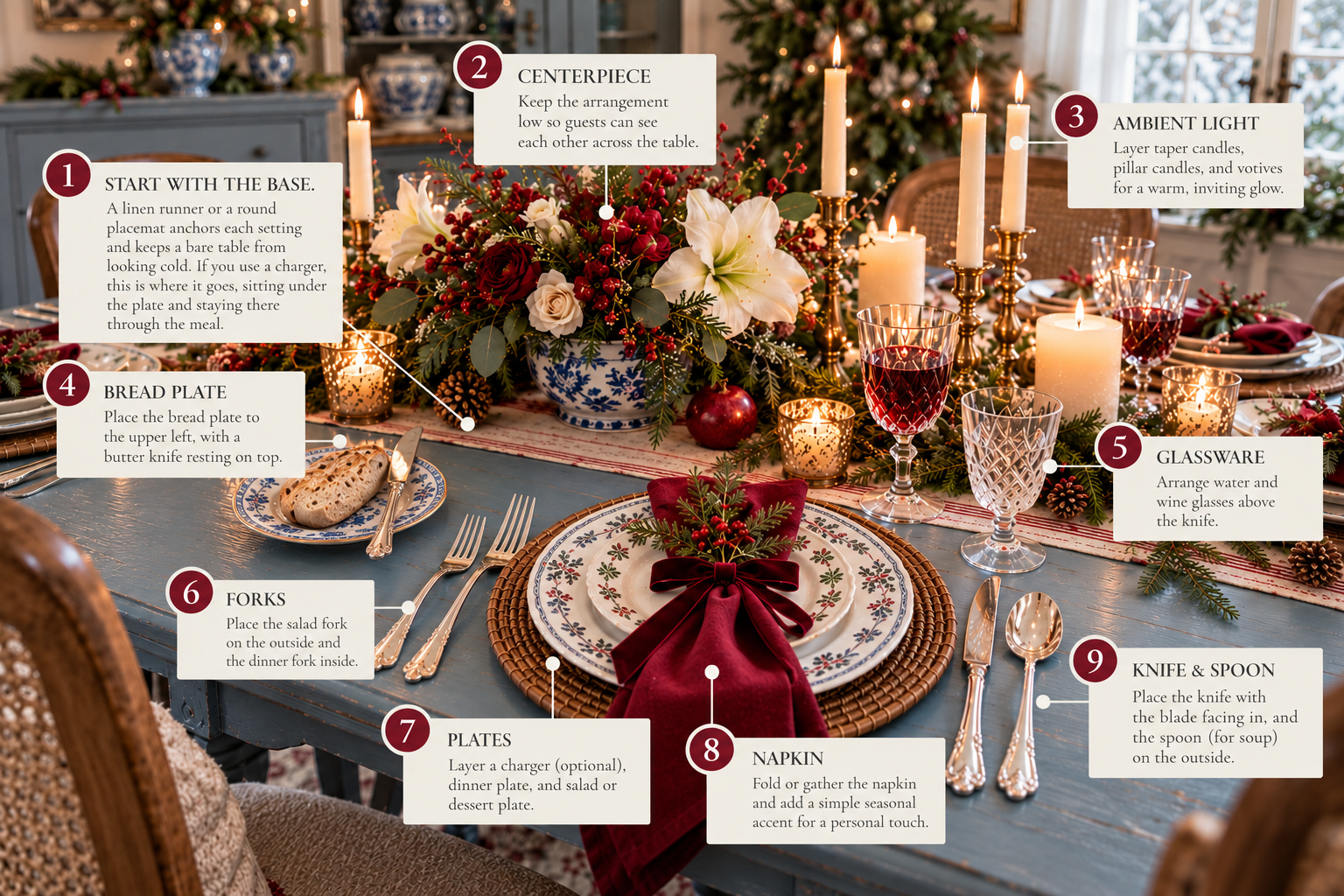
A place setting is only a stack of things, and it gets much easier once you see it that way.
Start with the base. A linen runner or a round placemat anchors each setting and keeps a bare table from looking cold. If you use a charger, this is where it goes, sitting under the plate and staying there through the meal.
Then the plate. Rest a folded napkin on top of it if you like, or lay the napkin to the left of the forks. Both look right, so choose whichever you can repeat at every seat without fussing.
Set the silver in the order you will use it, working inward. Forks on the left, knife and spoon on the right, with the knife nearest the plate and its blade turned in. If there is soup, the soup spoon sits outside the other spoon, and a salad fork goes outside the dinner fork.
Glasses sit above the knife, at the top right of each setting. Water closest to the hand, wine just beyond it. Two glasses are plenty at a family table, and one is fine if you are serving something simple.
None of this is a test, and no one at the table will check whether the forks sit in the right place. Set the pieces you will actually use, in the order you will reach for them, and the setting will look correct because it is.
Where the Money Goes
If you are going to spend on anything, spend it on the pieces you will use over the years.
Good linen and real candles are the two I would choose first. Linen softens with every wash and makes even a plain plate look cared for. Real candles give a room a warmth no battery light copies, and they cost very little for what they add.
One beautiful bowl, or a set of glasses you love, is worth more than a whole themed table. You will reach for it at other times of the year, and it will never look dated.
The things nobody notices are the ones I would skip. Coordinated chargers in a seasonal shape, napkins printed with snowflakes, plates that only work in December. They take up storage, they date quickly, and no one at the table is looking at them.
The tables I remember were the ones where the host used her good things and paid attention to the room, and that part costs nothing.
The Details People Remember
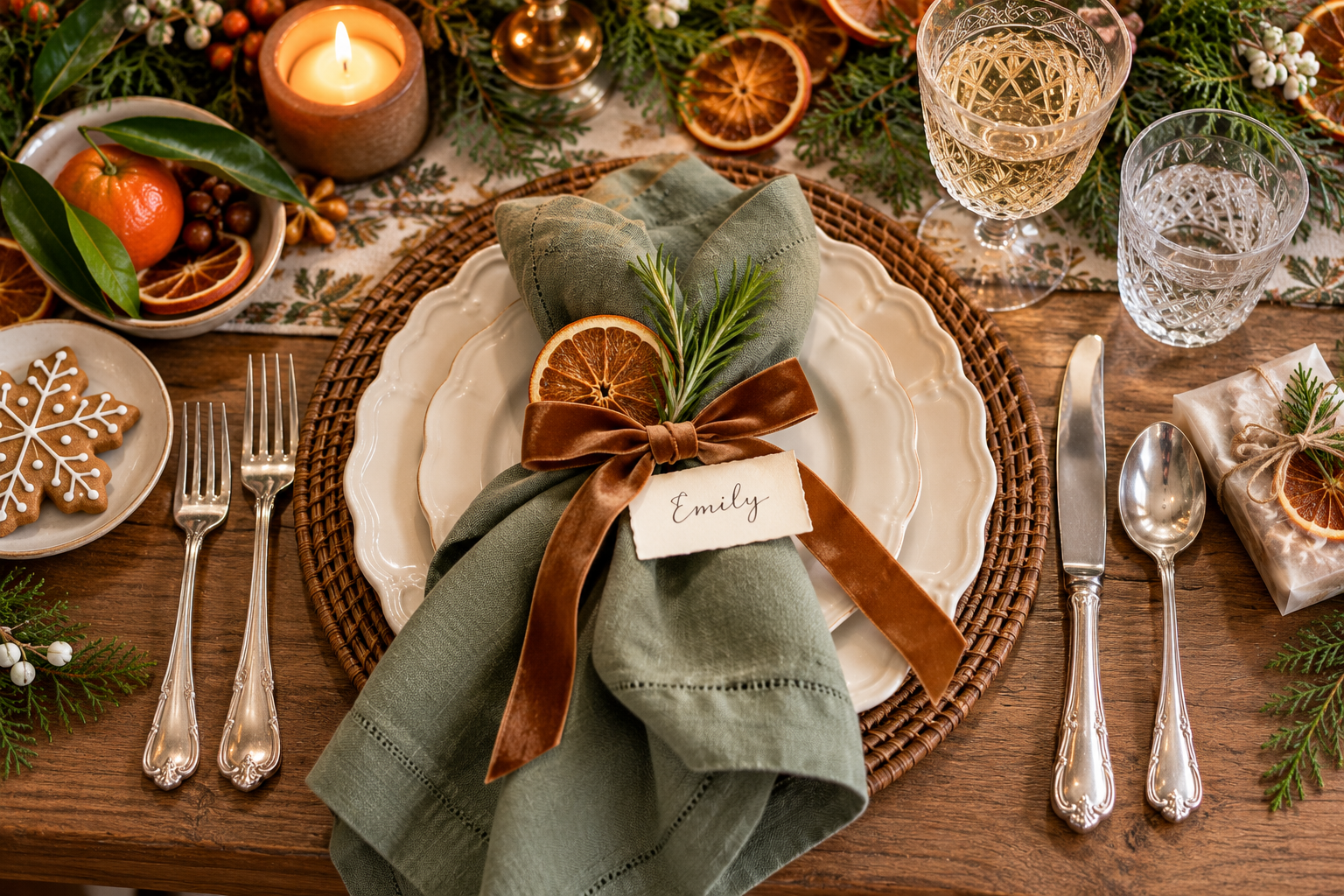
When I ask people what they remember about a dinner, they almost never mention the food. They mention a name written in ink at their seat, or a candle already lit when they walked in.
Write the place cards by hand. It takes ten minutes, and a name in your handwriting tells a guest where she belongs and that someone thought of her.
If you want to give a small gift, keep it small. A few stems tied with ribbon, a tiny jar of something you made, a chocolate at the seat. Large gifts turn a dinner into an exchange, and people start comparing what they got.
Fill the water glasses before anyone sits down. Light the candles before they arrive, not after. Take coats at the door and put them out of sight. These are the small things that let people settle, and a settled guest is the whole point.
Frequently Asked Questions
How much should I spend on a holiday table?
As little as you can while still using things you love. The parts people remember, the light, the linen, the company, are already in your cupboard or cost very little. Put your money into one or two pieces you will use for years and let the rest stay simple.
Real flowers or faux?
Whichever you will actually enjoy. Branches cut from the garden are lovely, and so is a single potted plant you can keep afterward. A pair of good faux stems you reuse every year can look beautiful if you keep them low and keep them clean. Height matters far more than the source.
What if my plates do not match?
Use them anyway. A table of mismatched plates, all in one color family, reads as collected. If the mix bothers you, put the odd ones at the ends where they are noticed least, or slide a plain charger underneath to calm the differences.
How do I set a long table?
In small clusters rather than one continuous line. A row of little vases, two or three low bowls, or candles spaced along the middle. Break the length into groups of things so the eye has places to rest, and leave a few gaps empty.
A Closing Thought
In the end, a table is a place where people put down their phones, turn to each other, and stay a while. Everything you choose, the colors, the candles, the place card with a guest’s name on it, is there to make that easier.
The first table I set taught me this the hard way, with too-tall flowers, and the last ones taught me the same thing more gently, with good linen and candles lit before anyone arrived. It does not ask for much: a centerpiece you can see over, a couple of colors you love, and the intention to let people be together.
If you’re gathering the pieces for your own table, I’ve linked a few of the things that make holiday evenings easier: linen that softens with every wash, candles that burn warm and low, simple glassware that works in every season, and a bowl or two you’ll use long after December. These are the quiet, hardworking pieces that shape the room more than any centerpiece. You may already own something perfect, but if you’re filling in a gap, the categories below are the ones I reach for most often.
Good Linen
Heavy linen tablecloths in cream, soft white, or sage
Linen napkins in muted seasonal tones
Candles
Dripless taper candles (cream, sage, plum, cranberry)
Beeswax tapers for warm, golden light
Brass or pewter candleholders
Long‑burn tealights for low, scattered glow
Glassware
Simple stemmed wine glasses
Clear or gold glass votives
Serving Pieces
One beautiful bowl (stoneware, wood, or glass)
A low, wide vase for centerpieces
Small vases for long tables
A classic wooden serving board
Flatware & Table Basics
Classic stainless or gold flatware
Chargers (wood, woven, or plain metal)
Cloth or vinyl placemats in neutral tones
Florals & Greenery
Disclosure: Some links on this page may be affiliate links. If you make a purchase through certain links, I may earn a small commission at no additional cost to you. I only recommend products I would use myself or give to someone I love. B'Inspired combines original photography, properly licensed imagery, product photography and AI-assisted editorial illustrations. AI-assisted visuals are used to interpret ideas and teach concepts, not to misrepresent actual destinations, products, people or personal experiences.
