

The Refined Beauty Edit
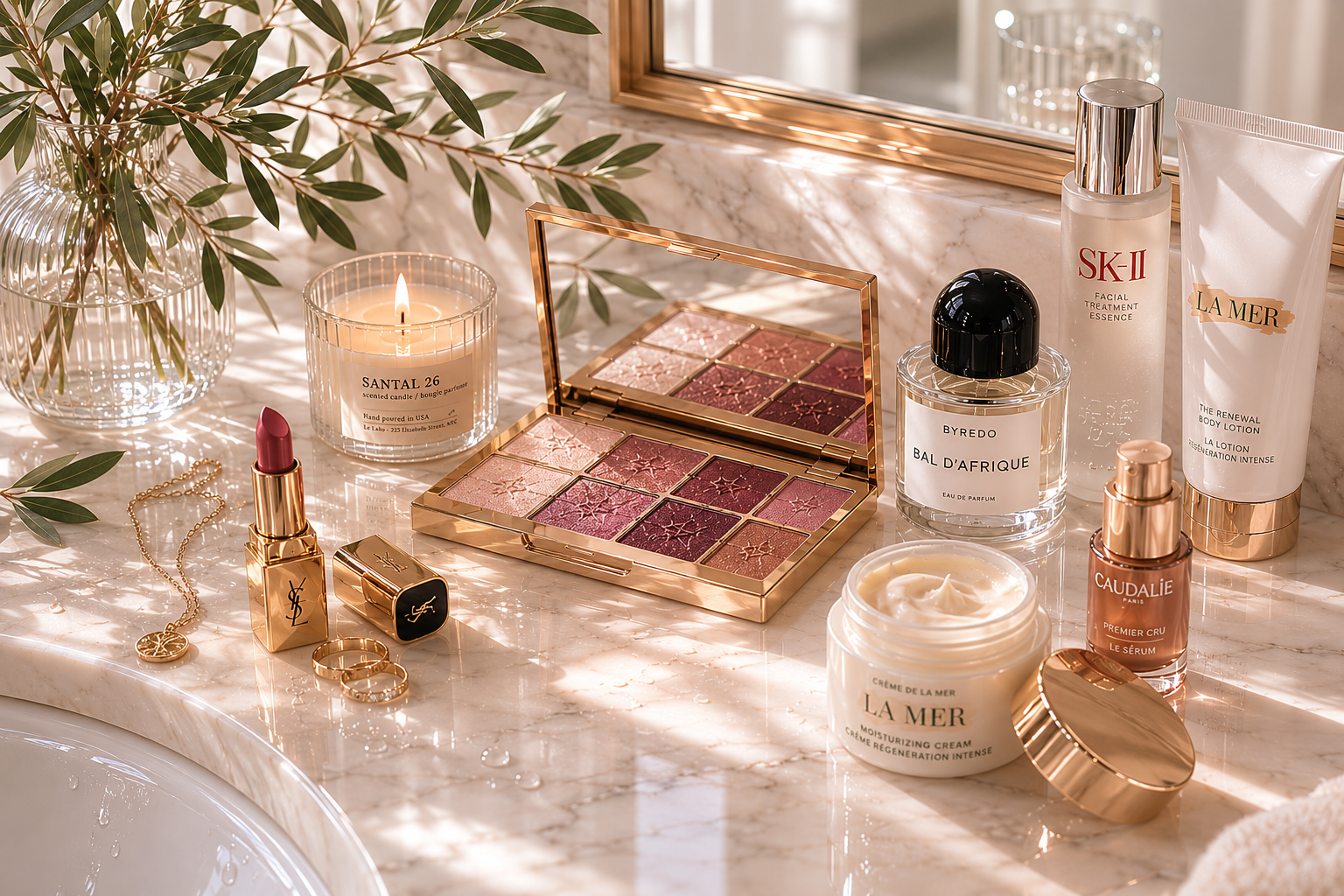
The Quiet Makeup Shifts That Make a Face Look More Rested, Lifted & Refined
Last winter, I was sitting in a softly lit hotel bathroom in Colmar trying to fix my concealer with the tiny sponge applicator from a compact I should have thrown away at least three years earlier.
Outside, everything looked impossibly charming. Timbered houses. Warm café windows glowing in the dark. Church bells somewhere in the distance.
Meanwhile, I was leaning much too close to a magnifying mirror thinking:
Why does my makeup suddenly look like it’s having a difficult emotional experience?
Not terrible. Just… heavier than I remembered.
The eyeliner looked harsher. The powder sat differently. The under-eye concealer that used to make me look polished somehow made me look more tired.
I think many women quietly arrive at this realization without talking about it very much.
At some point, makeup stops being about transformation. You no longer want to look “done.” You want to look rested. Bright-eyed. Soft. Alive. Like yourself after a good night’s sleep and two glasses of water.
And honestly, that shift feels oddly freeing.
Over time, I stopped paying attention to makeup trends almost entirely. I became much more interested in atmosphere. Texture. Light. Skin. Placement. The small details that make a face look quietly luminous instead of heavily made-up.
Most of what changed wasn’t dramatic.
Less powder. Cream textures. Softer eyeliner. Warmer tones. More attention to skincare. Better lighting. A growing understanding that mature beauty tends to look more elegant when nothing appears overly forced.
Especially in daylight. Especially while traveling. Especially after the age where your face politely refuses to cooperate with thick matte foundation anymore.
What follows is less of a traditional beauty tutorial and more a collection of observations I’ve gathered slowly over time — in airport bathrooms, softly lit restaurants, long winters, hotel mirrors, hurried mornings, and those strange moments when you unexpectedly catch your reflection in a shop window and realize your makeup either looks beautifully effortless… or slightly exhausted.
Thankfully, the difference is usually smaller than we think.
What follows is less of a rigid makeup guide and more of a collection of quiet refinements — the small techniques that consistently make mature makeup look softer, fresher, and more elevated without becoming heavy or overdone.
The Real Foundation Is Skin
The older I get, the less interested I become in foundation reviews.
Not because makeup no longer matters. If anything, I think I appreciate beauty rituals more now than I did in my thirties.
But somewhere along the way, skin became the thing.
Not perfect skin. Not “glass skin.” Just skin that looks comfortable. Rested. Alive.
I notice this constantly while traveling because travel has a way of exposing every weakness in a beauty routine within about forty-eight hours.
Dry airplane air. Humidity. Heat. Cold wind. Hotel water that somehow either removes all moisture from the face or leaves a mysterious film behind.
One summer in Brussels, my makeup slid off so aggressively in the humidity that by late afternoon my concealer had migrated far enough downward to become emotionally independent.
Meanwhile in Switzerland a few months later, the dry mountain air made the exact same products suddenly look twice as heavy.
That was probably the moment I finally stopped searching for “perfect” makeup and started paying attention to conditions instead.
Skin changes. Weather changes. Hormones change. Lighting changes. Faces change.
The routines that age beautifully tend to be flexible.
Now I pay much more attention to hydration, texture, and balance than coverage.
And honestly, many of the things that help mature skin look beautiful are deeply unremarkable.
Consistent SPF. A richer moisturizer. Not over-exfoliating. Drinking enough water on flights. Actually washing makeup off at night instead of negotiating with yourself from bed.
None of it is glamorous. But the face keeps score.
I still love makeup. I always will.
I just think makeup sits differently now when the skin underneath feels depleted, over-powdered, dehydrated, overheated, irritated, or exhausted.
And mature skin becomes very honest eventually.
It tells the truth about everything.
Why Makeup Placement Starts Mattering More
After years of working with women’s skin, I’ve become convinced most women are far kinder to everyone else’s face than their own.
I can’t count how many times someone has sat down in my treatment room and immediately pointed out everything they dislike about themselves before I’ve even adjusted the light.
The lines. The texture. The eyes. The tiredness. The changes.
Meanwhile, I’m usually noticing entirely different things.
Beautiful skin tone. Kind eyes. Great cheekbones. Expressiveness. Warmth.
I think somewhere along the way many women quietly absorb the idea that beauty means removing all evidence of living.
But faces are supposed to move. They’re supposed to change. They’re supposed to look like they’ve existed through stress, joy, travel, grief, laughter, weather, hormones, sleepless nights, long summers, difficult years, good dinners, bad lighting, and real life.
Oddly enough, I think makeup placement starts mattering more once you stop trying to erase the face and start trying to support it instead.
A little higher blush placement. Softer brows. Less under-eye product. Slightly warmer tones. More light around the eyes. Less heaviness.
Tiny changes. But they affect the entire feeling of the face.
I notice this especially while traveling because travel removes illusion very quickly.
At home, familiar lighting is forgiving. Hotel lighting is not. Neither is a train station bathroom at 6:15 in the morning after two nights of poor sleep and questionable hydration.
And somehow those are the moments that teach you what actually works.
Not perfection. Not performance. Just makeup that still looks believable on a human face.
Elevated Makeup Tips for Hooded Eyes
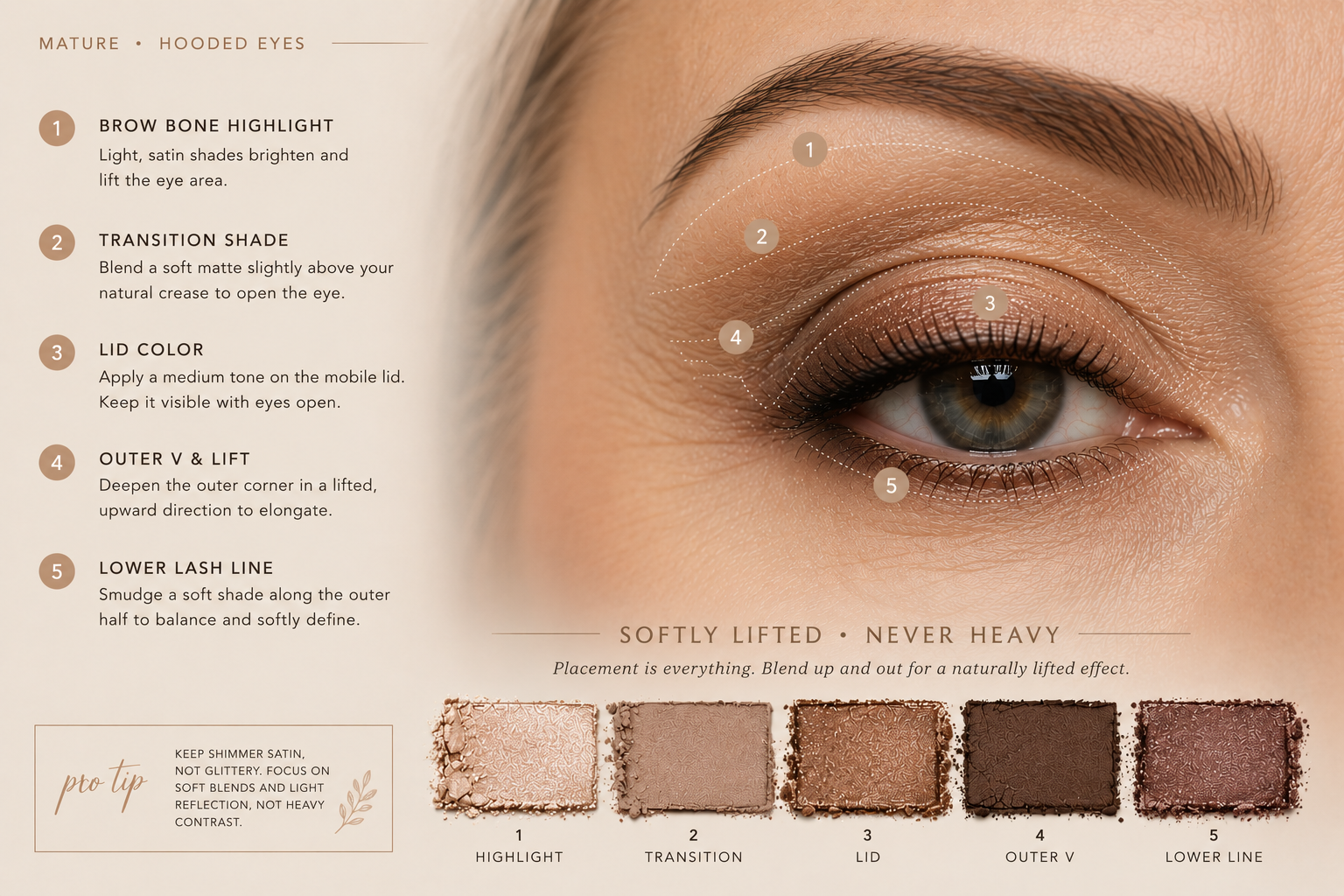
I spent years trying to apply eye makeup the way beauty magazines insisted eye makeup should be applied.
Which sounds reasonable until you realize most tutorials are demonstrated on eyes with enormous visible lid space and absolutely no evidence of real-life fatigue.
Meanwhile, many mature eyes change shape over time.
Lids become softer. The brow lowers slightly. Outer corners can turn downward. Everything becomes a little more delicate.
For a long time I kept trying to force my makeup into techniques that no longer suited my face instead of adjusting the placement itself.
That tiny shift in thinking changed almost everything.
Now I rarely place shadow directly into the natural crease anymore because much of it disappears once the eye opens.
Instead I keep color slightly above the crease and softly lift the shape outward.
Not dramatically. Not in that aggressively snatched internet makeup way.
Just enough to restore openness.
A few things consistently seem to help:
softer matte taupes instead of very dark shadow
thinner eyeliner
more lash definition at the outer eye
brightness near the center lid
upward blending instead of rounded blending
avoiding heavy under-eye liner
Humidity also changes eye makeup completely.
In dry weather I can wear slightly richer shadow textures. In heat or humidity, I’ve learned cream shadow sticks and tubing mascara are far less emotionally risky.
And honestly, one of the most flattering things mature eyes can have is space.
Space between the brow and shadow. Space between the lash line and liner. Space around the eye itself.
Heavy eye makeup often makes mature eyes look smaller. Light, softness, and restraint usually create far more lift.
Eyeliner for Mature Eyes
I still remember the years when dramatic black eyeliner felt like the answer to absolutely everything.
Bad haircut? More eyeliner. Tired? More eyeliner. Existential uncertainty? Probably still more eyeliner.
And honestly, sometimes I miss the confidence of that era.
There’s something reassuring about makeup that announces itself clearly.
But over time I started noticing that what photographed dramatically didn’t always feel the most beautiful in person anymore.
Especially in daylight. Especially in movement. Especially once the eye area becomes softer with age.
I began paying closer attention to women whose makeup looked quietly beautiful in real life. Not necessarily online. Not under studio lighting. But sitting across from you at lunch. Walking through a city. Laughing during conversation. Existing in actual weather.
Their eyeliner was almost never harsh.
Usually it was:
softened into the lash line
slightly lifted outward
thinner near the inner eye
diffused instead of graphic
brown, espresso, charcoal, or deep olive instead of severe black
And perhaps most importantly, the eye itself still looked open.
I think mature beauty becomes less about creating impact and more about preserving light.
Too much darkness around the eyes can quietly age the face faster than almost anything else.
Especially once exhaustion, menopause, travel, stress, and changing skin texture enter the conversation.
Sometimes the most flattering makeup choice is simply stopping half a step earlier than you used to.
That realization took me an embarrassingly long time.
The Soft Contouring Technique That Looks Elegant After 50
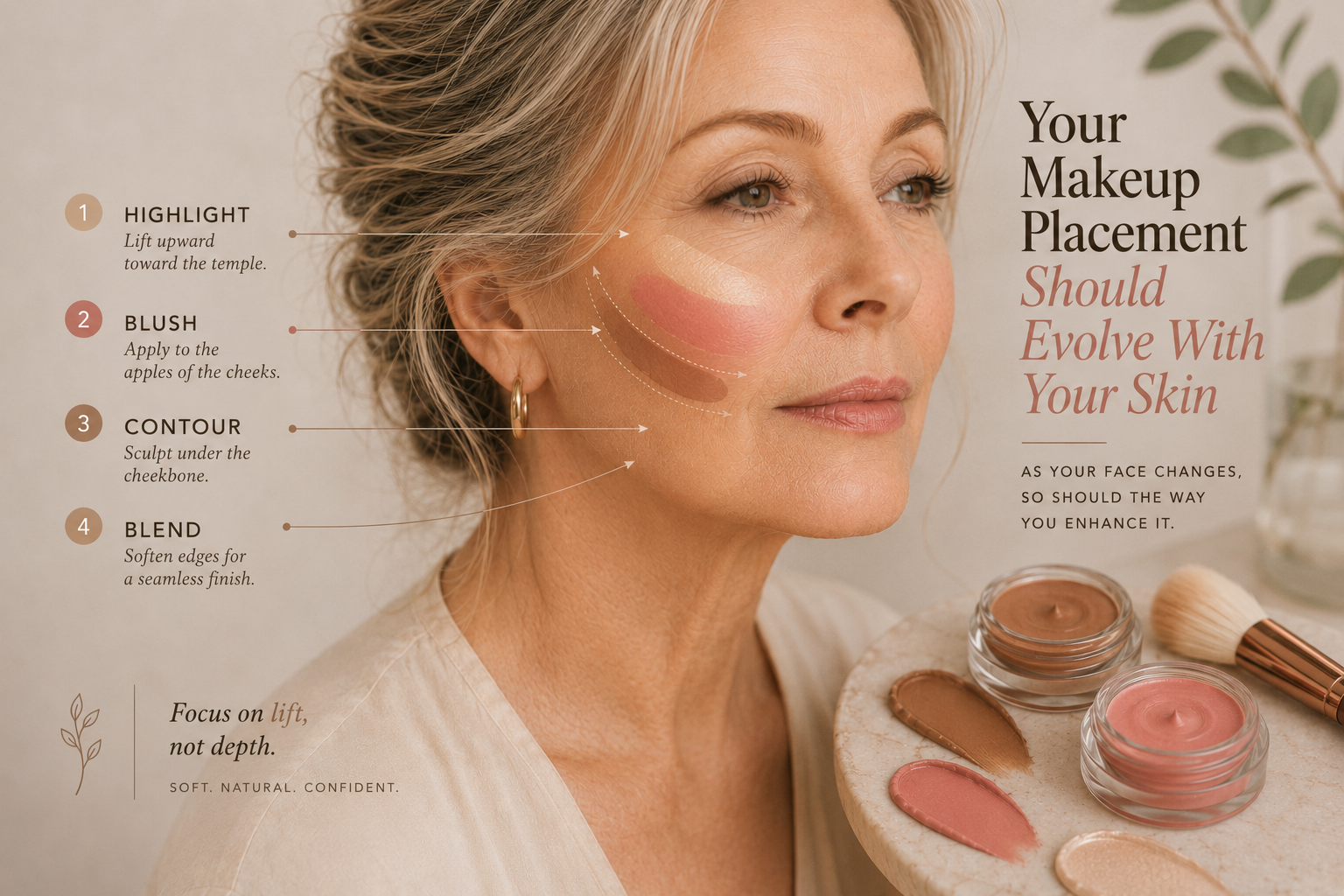
Heavy contouring tends to photograph better than it looks in real life.
Especially in daylight. Especially in winter. Especially while standing three inches from a magnifying hotel mirror wondering why hotel lighting feels emotionally confrontational.
Soft contouring works differently.
The purpose is not to sculpt an entirely different face. It is simply to restore dimension gently.
The most flattering contouring usually:
sits higher on the cheekbones
stays diffused
avoids muddy cool tones
blends upward
uses cream textures instead of dry powders
Cream bronzers and contour sticks tend to melt into mature skin more naturally than dense matte powders.
And honestly, glow matters more than sharpness now.
A softly luminous cheek with warmth and movement almost always looks more youthful than aggressively carved cheekbones.
Cream vs Powder Makeup
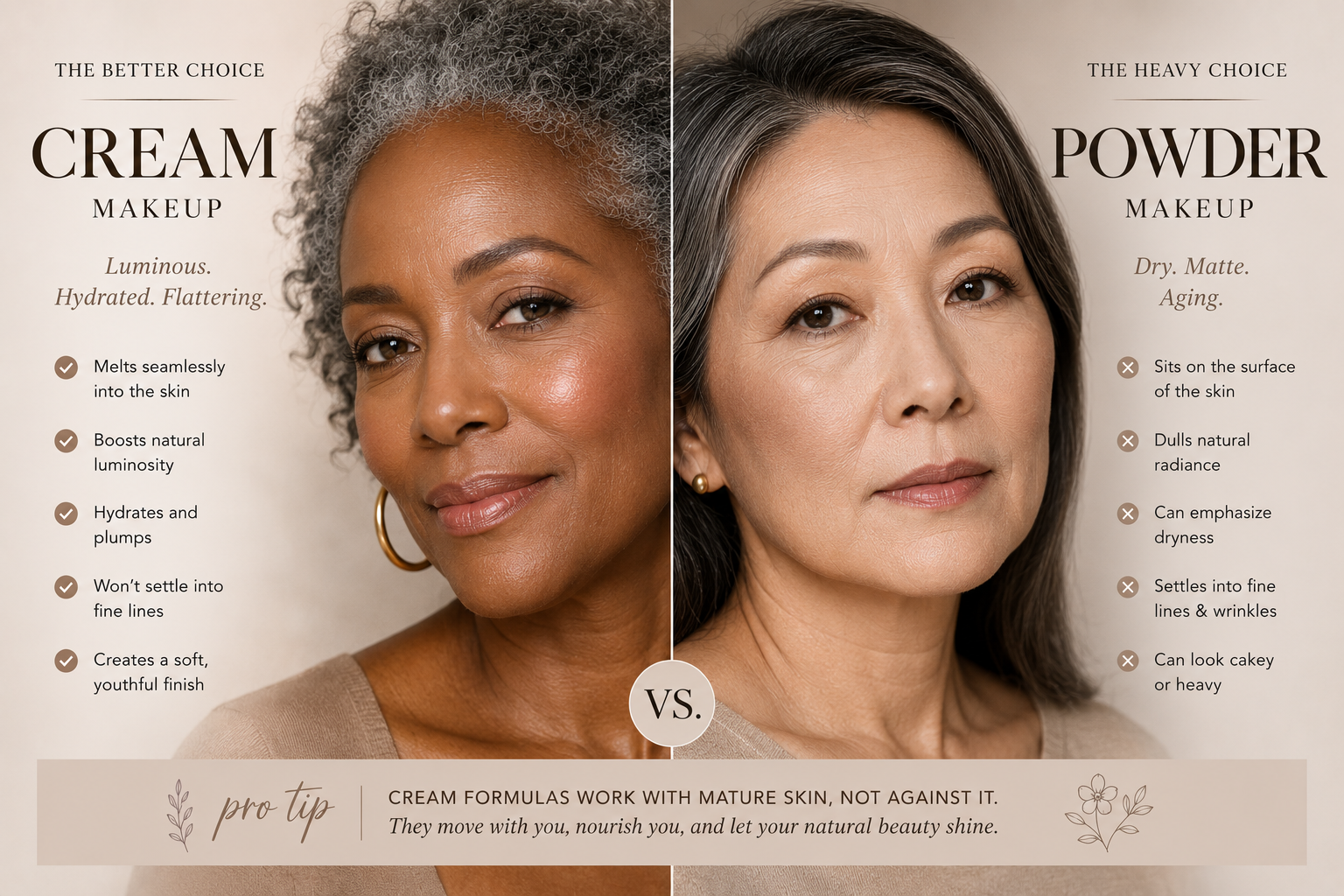
I still remember when the beauty goal was essentially to remove all evidence that skin was made of skin.
Everything matte. Everything powdered. Everything locked into place with the emotional intensity of industrial sealant.
And to be fair, some of us survived very humid summers that way. Barely.
Now I think mature beauty tends to look prettier when the face still has movement.
Not grease. Not shine. Just life.
That said, I don’t think powder is bad the way some modern beauty conversations suggest.
In humidity, powder can save a makeup look. Especially around the nose, chin, and under-eye area.
The difference is really placement and quantity.
Too much powder now can make the face look oddly tired by afternoon, even if everything appeared perfectly polished at 8:00 that morning.
Cream products usually move more naturally with mature skin.
Cream blush. Cream bronzer. Softer satin foundations. Hydrating concealers.
But even cream products behave differently depending on weather.
In very humid climates, overly emollient makeup can begin slowly migrating across the face in ways that feel personally disrespectful.
In dry winter air, powders can suddenly emphasize texture that seemed invisible at home.
Most of my makeup routines now change slightly depending on climate, lighting, season, and how my skin feels that particular week.
Which honestly feels much more realistic than trying to force the exact same routine year-round.
The face changes. The weather changes. Some mornings the makeup cooperates beautifully. Other mornings it behaves like it has unresolved resentment.
At this point, adaptability feels more useful than perfection.
Menopause Changes Skin More Than Most Women Expect
I don’t think women are prepared for how dramatically skin can change during menopause.
Not just visually. Physically. Emotionally. Practically.
Products that worked beautifully for years suddenly stop cooperating almost overnight.
Foundation becomes dry. Skin reacts to ingredients it tolerated perfectly before. Redness appears unexpectedly. Texture changes. Hydration disappears faster. The skin barrier becomes far more reactive.
And many women assume they’re somehow “doing beauty wrong” when in reality their skin has simply changed.
I’ve seen this repeatedly in the treatment room over the years.
Women arrive frustrated because the routines they trusted for decades suddenly make the skin feel tight, irritated, inflamed, or exhausted.
Often the instinct is to add more coverage. More powder. Stronger products. More exfoliation.
But mature skin — especially menopausal skin — usually responds far better to calm than aggression.
That realization changes everything.
The focus shifts toward:
barrier repair
hydration
inflammation support
gentler exfoliation
cream textures
nourishing skincare
less stripping cleansers
makeup that moves naturally with the skin instead of sitting heavily on top of it
I also think this is why many women suddenly feel like their makeup looks “wrong.”
The face itself hasn’t become wrong. The skin simply requires a different relationship now.
More flexibility. More softness. More patience.
And honestly, I wish more beauty conversations acknowledged this openly instead of treating menopause like a beauty failure women are expected to quietly correct.
Because many women are not imagining these changes.
The skin genuinely becomes more sensitive. More reactive. More delicate.
Even climate starts affecting it differently.
Dry air feels harsher. Heat creates more redness. Humidity changes texture. Long flights become noticeably dehydrating.
I’ve found mature skin often becomes much happier once routines become simpler, calmer, and more supportive instead of constantly corrective.
Oddly enough, some of the most beautiful skin I see now belongs to women who finally stopped trying to fight their face so aggressively.
Makeup Mistakes That Quietly Age the Face
Most aging makeup mistakes are not dramatic.
They’re cumulative.
Too much powder. Too much concealer. Overly matte skin. Heavy brows. Very dark lip liner. Harsh contour. Flat foundation. Unblended shadow. Very thick lashes.
And perhaps most commonly: Trying to recreate makeup techniques designed for twenty-year-old faces.
Mature beauty tends to look more elegant when makeup enhances movement rather than masks it.
Skin still needs dimension. Brows still need softness. Eyes still need light.
The face should still look capable of expression.
How to Look More Rested Without Heavy Makeup
I suspect this is what many women are actually searching for when they search for makeup advice.
Not really youth.
Recognition.
They want to look in the mirror and feel familiar to themselves again.
I hear versions of this constantly.
“My makeup suddenly looks wrong.” “I look tired all the time.” “Nothing sits right anymore.” “I don’t recognize myself in photographs lately.”
And honestly, I understand it.
Faces do change. Sometimes gradually. Sometimes all at once. Especially during menopause.
The skin becomes drier. The eyes become more tired. Features soften. Products stop behaving the way they once did. Humidity suddenly ruins an entire makeup look by lunch. Concealer settles differently. Foundation oxidizes. Powder becomes less forgiving.
There’s also something emotionally disorienting about realizing the beauty rules you learned twenty years ago no longer create the same effect.
I think many women quietly grieve this without talking about it.
But interestingly, the women who eventually look the most beautiful rarely become more polished.
Usually they become softer. More comfortable. Less performative.
The makeup routines that consistently make women look rested tend to be surprisingly restrained:
hydrated skin
less foundation
strategic brightness
warmth instead of heaviness
curled lashes
softer eyeliner
cream textures
healthy brows
color in the cheeks and lips
Not transformation. Just restoration.
Oddly enough, I think beauty becomes much more interesting once you stop trying to look untouched by life.
The face relaxes. And somehow the entire person does too.
More breathable. More human.
Like a woman who slept reasonably well, drank enough water, moisturized properly, and accepted that airport mirrors are simply not to be trusted.
The Chicest Makeup Colors for Mature Skin
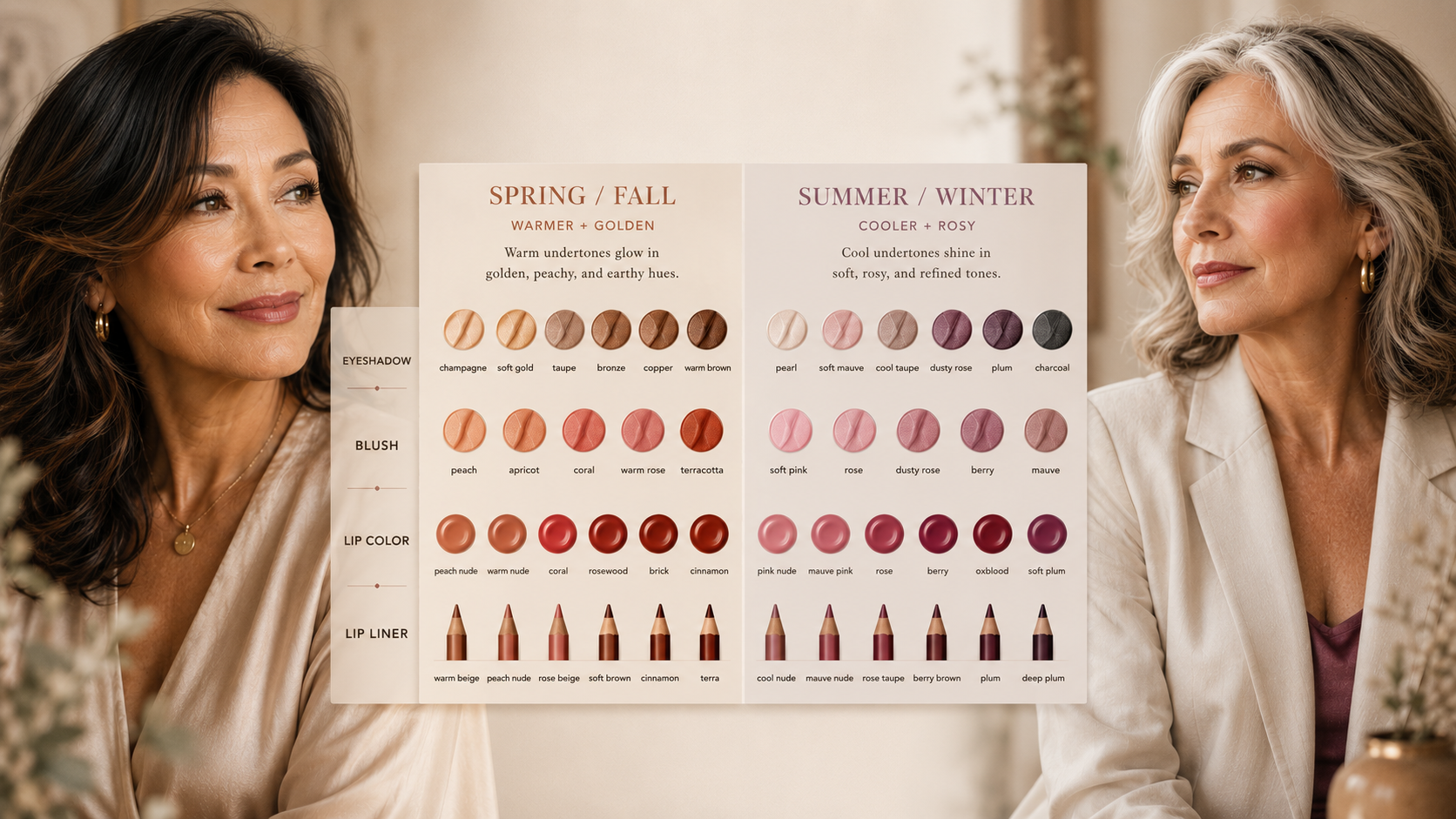
One of the more surprising things I’ve noticed after years working with women’s skin and makeup is how often the “wrong” makeup color is actually the thing making someone look tired.
Not older. Not unattractive. Just slightly disconnected from themselves.
Sometimes it’s a lipstick that’s too cool. Sometimes it’s a gray-toned contour that drains warmth from the face. Sometimes it’s eyeshadow that technically looks beautiful in the palette but somehow makes the eyes look exhausted once it’s actually on the skin.
And interestingly, this tends to become more noticeable with age.
As skin changes during menopause and beyond, contrast shifts. Hair color changes. Brightness changes. The face often becomes softer and more nuanced.
Colors that once felt dramatic and striking can suddenly start feeling severe.
Meanwhile, the right tones somehow make the entire face look more awake. More rested. More alive.
I don’t think seasonal color analysis needs to become rigid or obsessive to be helpful. But I do think understanding warmth, coolness, softness, and contrast can make makeup feel much easier.
Especially once you stop trying to force trends that were never meant for your coloring in the first place.
Spring Coloring
Warm, Clear & Light
Spring makeup tends to come alive with warmth and brightness.
These women often look beautiful in makeup that feels fresh rather than dramatic. Too much heaviness can overwhelm the natural lightness in the face.
The most flattering shades usually include:
Eyes
warm champagne
peachy gold
soft caramel
warm taupe
light bronze
apricot shimmer
olive gold
Blush
peach
warm coral
apricot
soft melon
warm rose
Lips
peachy nude
warm pink
coral rose
watermelon
glossy apricot
soft poppy
One thing I notice often with Spring coloring is that very cool mauves or overly gray neutrals can quietly drain warmth from the complexion.
Spring faces usually look healthiest with light and warmth around them.
Not necessarily more makeup. Just more vitality.
Summer Coloring
Cool, Soft & Muted
Summer coloring tends to be extraordinarily beautiful in softer cool tones.
This is often where women accidentally become too warm with makeup over time because beauty trends heavily favor bronzed skin.
But many Summers actually look far more rested in cooler muted tones.
Especially around the eyes.
Eyes
dusty taupe
soft mauve
cool cocoa
muted plum
rose brown
soft slate
mushroom tones
Blush
dusty rose
cool pink
muted berry
rose mauve
soft petal pink
Lips
rosy nude
mauve pink
soft berry
muted raspberry
rosewood
cool pink beige
I’ve noticed Summers often become incredibly elegant once they stop trying to force warmth into the face.
Heavy bronzer can sometimes fight the natural softness of Summer coloring.
Cooler tones tend to create harmony instead.
Especially in natural daylight.
Autumn Coloring
Warm, Rich & Earthy
Autumn coloring usually becomes more beautiful with richness.
Not harshness. Not brightness. Depth.
These are often the women who come alive in earthy tones, warmth, spice colors, olive, bronze, tobacco, terracotta, aubergine, and deep softened neutrals.
Eyes
bronze
olive
warm chocolate
copper
tobacco
deep moss
terracotta brown
antique gold
Blush
cinnamon rose
warm terracotta
spiced peach
burnt apricot
warm brick rose
Lips
warm berry
terracotta rose
cinnamon nude
brick red
warm wine
maple rose
caramel nude
Autumn makeup tends to look especially beautiful in candlelight, restaurants, rainy weather, autumn travel, and softer evening light.
There’s something deeply atmospheric about warm earthy tones on mature skin.
Especially once the skin itself becomes less tolerant of stark contrast.
Winter Coloring
Cool, Deep & High Contrast
Winter coloring often holds contrast beautifully even as the face softens with age.
But the key becomes refinement instead of severity.
I think many Winters become softer over time without actually becoming warm.
That distinction matters.
A Winter face can still wear depth beautifully — just usually with slightly more softness and dimension than before.
Eyes
charcoal
espresso
cool taupe
deep navy
pewter
cool plum
smoky cocoa
Blush
cool berry
raspberry rose
cool pink
soft wine
plum rose
Lips
blue-red
berry rose
raspberry
cool mauve
rich pink nude
blackberry stain
Winter coloring often looks extraordinary with:
defined lashes
softly luminous skin
richer lip tones
subtle contrast
cleaner makeup placement
But overly matte makeup can become harsh quickly.
Especially once texture and dryness begin changing the surface of the skin.
And honestly, I think this is where mature makeup becomes more interesting than younger makeup.
I used to think makeup was mostly about improvement.
Now I think it’s often about recognition.
Looking like yourself again.
Not necessarily younger. Not flawless. Just… familiar.
And honestly, I think many women quietly underestimate how emotional that can feel.
I’ve watched clients stare into mirrors after facials or makeup applications and suddenly go quiet for a moment.
Not because they looked dramatically different. Usually because they looked rested.
Sometimes that emotional shift is surprisingly small. Hydrated skin. Softer under-eyes. Less makeup than they expected. The right blush tone. A lipstick that brings warmth back into the face instead of draining it.
After years of working closely with women’s skin, I’ve become convinced most women are far more beautiful than they believe themselves to be.
But many have spent years studying themselves under bathroom lighting designed by people who apparently hold personal grudges against human faces.
Especially during menopause. Especially during stress. Especially during periods where the face suddenly changes faster than your sense of identity can keep up with.
I think that’s partly why makeup can become emotionally complicated in midlife.
You’re not only adjusting products. You’re adjusting to a face that behaves differently.
Some mornings makeup sits beautifully. Other mornings the exact same routine looks strangely heavy by noon.
Humidity changes everything. So does dry heat. So does airplane air. So does exhaustion. So does grief, honestly.
I still remember doing my makeup in a hotel mirror several years ago and realizing I was applying products completely differently than I had in my thirties.
Less concealer. More hydration. Softer eyeliner. Warmer blush. More cream textures. Less correction.
At first that realization unsettled me a little.
Then eventually it felt relieving.
I no longer wanted makeup that looked impressive under studio lighting. I wanted makeup that looked believable in daylight. At lunch. Walking through cities. Talking to people. Laughing. Being tired. Being alive.
And strangely enough, I think that shift made beauty feel calmer.
Not smaller. Not less beautiful. Just less performative.
I still haven’t completely figured out eyeliner in hotel lighting, though.
Some mornings are simply better than others.
A 5-Minute Makeup Routine That Quietly Changes Everything
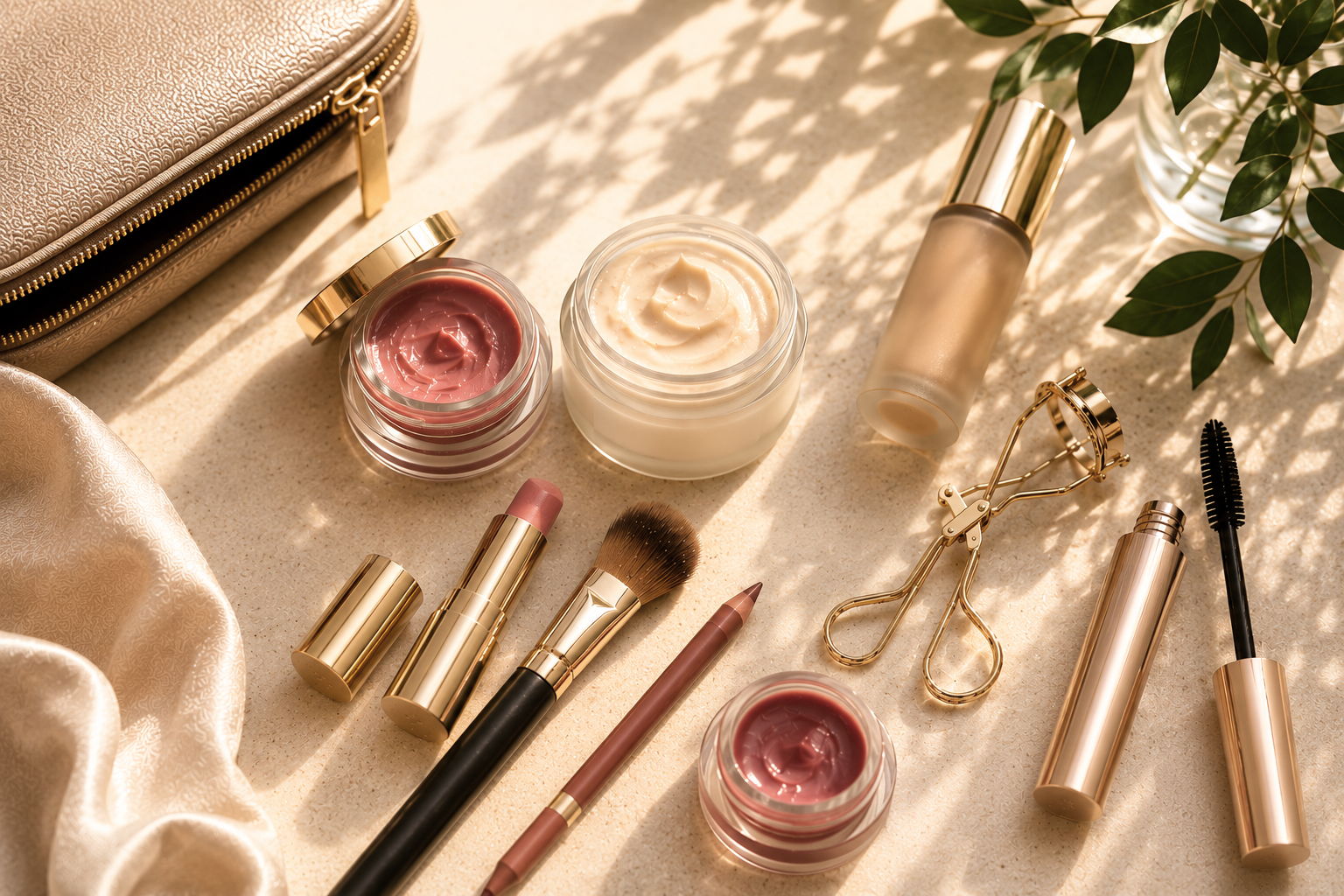
Some mornings truly are not meant for a seventeen-step makeup routine.
Especially before early flights. Or after sleeping badly. Or during cold winter mornings when the bathroom floor feels personally hostile.
My most consistently flattering quick routine is surprisingly simple:
hydrating skincare
lightweight skin tint
cream bronzer high on the cheekbones
cream blush slightly lifted upward
softly groomed brows
curled lashes + defining mascara
subtle satin shadow
tinted lip balm or soft lipstick
That’s usually enough.
Enough to look polished. Enough to look awake. Enough to feel like yourself again.
Which honestly becomes the entire goal.
What Years in a Treatment Room Quietly Teach You
One thing I never fully expected after working as an esthetician and makeup artist for over a decade was how emotional beauty actually is.
Not emotionally dramatic. Emotionally revealing.
Women sit down in treatment rooms and often begin apologizing almost immediately.
For their skin. For their eyes. For looking tired. For aging. For texture. For lines. For things most other people would never notice.
And after years of hearing women speak about their own faces this way, I think I’ve become much less interested in beauty that feels corrective.
The women who leave looking most beautiful are rarely the ones wearing the most makeup.
Usually they simply look more rested. Softer. More comfortable. Like themselves again.
I’ve seen women almost tearful after seeing hydrated skin properly for the first time in years.
I’ve watched women realize that softer blush placement lifted the face more beautifully than heavier contour ever did.
I’ve watched women stop pulling at the skin around their eyes once they realized they didn’t need to hide every sign of life from their face.
And honestly, I think mature beauty becomes much more interesting once perfection stops being the goal.
There’s a kind of ease that arrives eventually.
You stop trying to erase every shadow. You stop forcing makeup trends that don’t suit your features. You stop believing heavier coverage automatically creates a more polished face.
You begin noticing light instead. Texture. Warmth. Movement. Balance.
Oddly enough, I think I became less critical of my own face once I stopped trying to make it look untouched by life.
And perhaps that’s what refined beauty really becomes after a certain age.
Not transformation. Not performance. Not perfection.
Just a softer relationship with your own reflection.
Especially on the mornings when the humidity destroys your hair, the concealer creases by noon, the hotel lighting feels mildly hostile, and you still somehow manage to look quietly like yourself anyway.
That, honestly, feels far more beautiful to me now.
Disclosure: This article may contain affiliate links. If you make a purchase through these links, I may earn a commission at no additional cost to you.
