

Travel Safety Essentials: 10 Small Things I Pack for Europe

A Few Small Things That Make Travel Feel Easier
Start reading travel-safety advice and it doesn’t take long before your packing list gets a little ridiculous. There’s a special bag for your passport, another pouch to hide under your clothes, locks for the suitcase, locks for the hotel door, alarms, trackers, clips and cables. By the time you’re finished, you could start wondering whether your carry-on needs its own security detail.
I’m all for being prepared, but I also travel with a carry-on, so I’m selective about what comes with me. I want to wander through a market, sit at an outdoor café and figure out which train platform I’m supposed to be on without making myself nervous about every person standing nearby.
The question I come back to is pretty practical: What would be genuinely difficult to lose, and is there an easy way to make that less likely? My phone certainly qualifies. So do my passport, access to money and the luggage carrying everything I brought with me. I also want to close my hotel-room door at night and feel comfortable there.
It turns out I don’t need much. I pack a few small things that solve specific problems, and some of the best precautions don’t require packing anything at all.
1. Keep Your Phone Attached in Crowded Places
You step off a train in a city you’ve never visited with your carry-on in one hand and people moving around you. Somewhere outside the station is your hotel. You pull out your phone, open the map and start trying to match what’s on the screen with the signs in front of you. That’s exactly the kind of moment when I like having my phone attached to me.
A phone tether or wrist strap takes almost no room, and my phone would be one of the most disruptive things to lose during a trip. My boarding passes and train tickets may be on it, along with hotel reservations, maps, transportation apps, messages and photos. Replacing the device would be expensive, but standing in an unfamiliar city without everything I was relying on it to do would be the immediate problem.
Stations are where I notice the tether most, especially when I’m managing luggage and trying to work out where I’m going next. It’s useful in crowded markets and during airport boarding, too. Even getting into a taxi becomes a small juggling act when you’re holding a bag, checking the address and making sure you haven’t left anything on the curb.
I prefer a simple tether that works with the phone case I already own. If you mainly want something for taking pictures, a wrist strap may be enough. If your phone is constantly coming out for directions, a longer tether or slim crossbody version makes more sense.
I don’t expect a tether to make my phone theft-proof. It gives me some protection against the much more ordinary ways a phone disappears: dropping it, setting it down and walking away, or having it pulled from my hand while I’m distracted. Outdoor cafés are another place where I pay attention. It’s tempting to leave a phone on the table after checking a map or taking a picture, especially when you know you’ll probably pick it up again in five minutes. Mine goes back into my bag or stays attached to me.
2. Make Your Everyday Bag Harder to Open
Once my phone is put away, I want the bag holding it to require a little effort to open. I prefer a crossbody for sightseeing because it stays close to my body, moves easily toward the front in a crowd and doesn’t need to be put down every time I stop for coffee or lunch. I pay just as much attention to the zippers.
A zipper that slides open with one quick pull is wonderfully convenient when I’m standing at a shop counter looking for my wallet. Unfortunately, convenience works both ways. One of the simplest fixes is a small zipper clip or locking carabiner connecting two zipper pulls. I’m not trying to lock my handbag as though it contains the crown jewels. I just want opening it to require an extra movement that I know how to make and someone reaching toward my bag probably doesn’t.
When people are close together and my attention is elsewhere, I’ll move the bag in front of me and keep the main compartment clipped closed. I’d also choose a zippered bag over an open tote for a full day of sightseeing. Wallets and passports don’t go into exterior slip pockets simply because those pockets happen to be handy. If I can reach something without really thinking about it, someone standing behind me probably can too.
Dedicated anti-theft bags with locking zippers and other security features are an option, but I wouldn’t buy a new travel bag solely because it has “anti-theft” in the product name. A comfortable crossbody you’ll happily carry all day, with secure zippered compartments and perhaps a tiny zipper clip, may already do what you need.
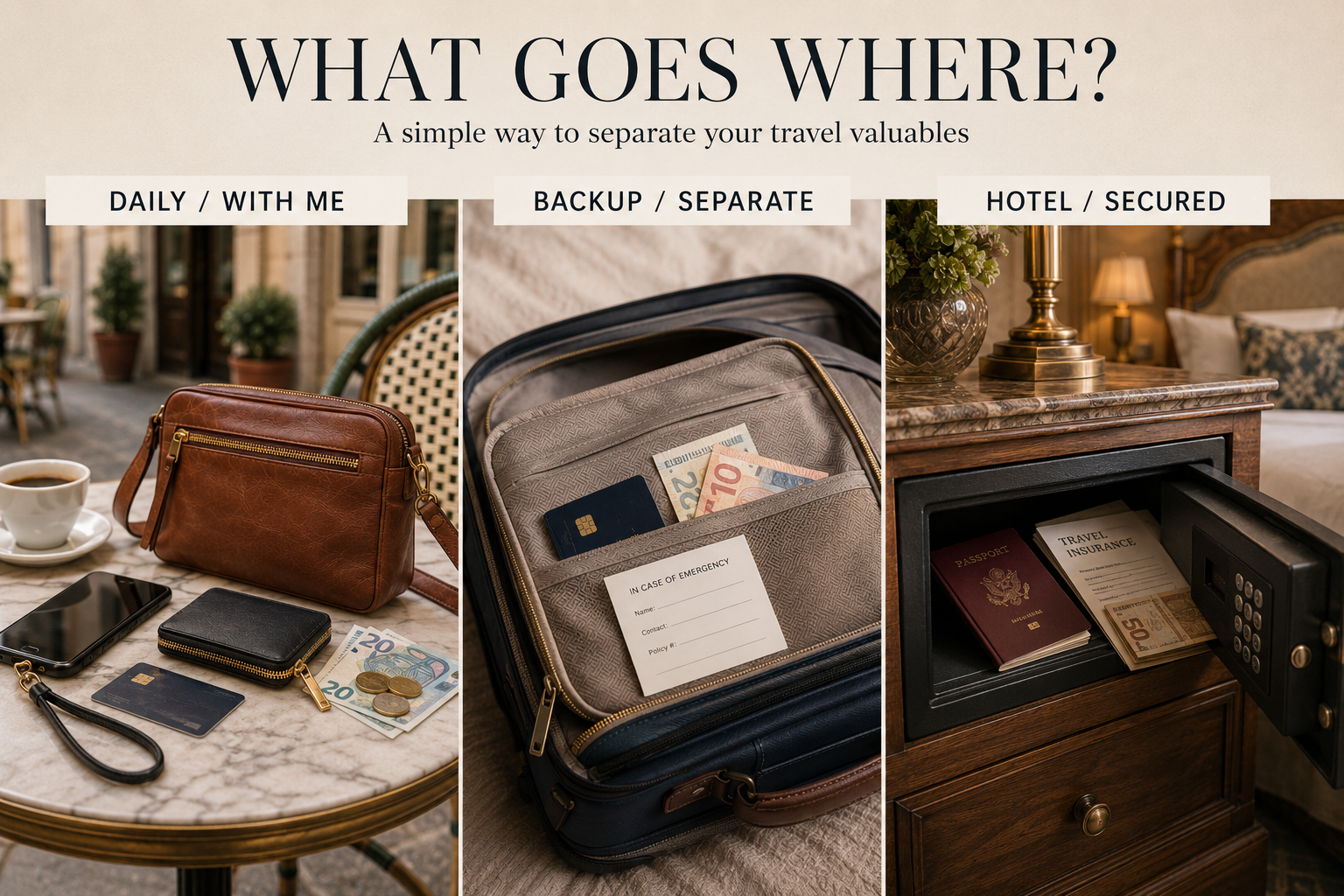
3. Never Keep Every Important Thing in One Place
Imagine realizing your wallet is gone and then mentally going through what was inside it: your primary credit card, the backup card you brought in case something happened to the first one, all of your cash and maybe even your passport. That is a very bad time to discover your backup plan was also in the wallet.
Before a trip, I decide what I actually need with me during the day. One credit card and a modest amount of cash cover most outings. Whether I carry my passport depends on where I am and whether I’m required to have it with me. When I don’t need it, I’d rather leave it secured at the hotel.
The backup card belongs somewhere else, along with reserve cash. If I’m traveling with my husband, we can split some of those backups between us rather than keeping everything in the same bag.
A slim travel wallet or passport organizer can be useful, but I care more about what goes inside it and where I keep it than a long list of security features. Putting every card, every dollar and both passports into one beautiful organizer rather defeats the purpose of having backups.
RFID protection gets a lot of attention in travel products, and I wouldn’t choose a wallet based on that feature alone. I care more about whether it stays securely closed, fits where I intend to carry it and makes it easy to take only what I need. Before leaving the hotel, I think about what needs to come with me that day and what is better left behind.
4. Know Where Your Luggage Is
Your suitcase may end up on a luggage rack at the other end of a train carriage, stored at the hotel after checkout while you enjoy a few more hours in the city, or checked for a flight even though you swore this was finally going to be the trip when you traveled carry-on only. I keep a tracker tucked inside my luggage for those moments.
An Apple AirTag, or a similar tracker compatible with your phone, won’t prevent a bag from being taken or guarantee that a missing suitcase will come back to you. I use one because when my luggage isn’t where I expect it to be, I’d rather have some idea where it is.
If my suitcase doesn’t show up at baggage claim, being able to see that it never left the connecting airport answers at least one very important question. On a train, my carry-on may be sitting several rows away or in a luggage area near the end of the carriage. I can enjoy the trip without feeling as though I need to keep checking on it.
I tuck the tracker somewhere inside the suitcase rather than attaching it prominently to the outside. A small holder keeps it in place instead of letting it work its way into some mysterious corner of the lining, where travel accessories apparently like to go when they no longer wish to be found. Once it’s there, I mostly forget about it.
5. Treat Backup Power as a Travel-Safety Essential
A phone battery at 8 percent feels very different when you’re sitting on your sofa than it does when you’re trying to get back to your hotel in Rome. At home, a dead phone is annoying. During a trip, it might be holding the walking directions to your hotel, the train ticket you need to board, the address you’re supposed to give a driver or the message telling you where to meet your tour guide.
I used to think of a portable charger as one of those handy travel gadgets. Now it stays in my day bag because I rely on my phone for too much to let the battery become an afternoon project. Travel is hard on a phone battery anyway. I’m taking more pictures, checking maps, looking up opening hours, pulling up reservations and using transportation apps. If we’ve been out since breakfast and aren’t heading back to the hotel before dinner, I don’t want to start rationing my battery at four in the afternoon.
For carry-on travel, I want a power bank with enough capacity to get my phone comfortably through a long day, but I don’t need the largest battery I can buy. Size matters because the charger sitting back in the hotel room is remarkably ineffective at charging the phone dying in my hand across town.
I keep a short cable with it and recharge the power bank at night along with my phone. It goes back into my day bag the next morning. A low battery becomes especially inconvenient when plans change. A canceled train, a different meeting point or an unexpected walk back to the hotel is exactly when I want full access to my phone rather than watching the battery percentage tick toward zero. I’d much rather spend those last hours of the day deciding where to have dinner.
6. Hotel Security: Add One More Layer Behind the Door
When I get into a hotel room, I put down my bags, look around, check out the bathroom and probably walk over to the window to see the view. At some point, I go back and check the door.
I want to know that it closes firmly and latches on its own. I use the deadbolt and security latch if there is one, and I take a minute to find the nearest stairwell or emergency exit. It’s part of settling into the room, along with figuring out which light switch controls which lamp, something that apparently requires an advanced degree in certain European hotels.
I’m careful with my room number as well. If the person at the front desk says it aloud, I don’t repeat it, and I don’t leave the key sleeve sitting on a café table with the hotel name and room number visible. If someone knocks unexpectedly and I haven’t requested anything, I can call the front desk and confirm who was sent up before opening the door.
If you’d feel more comfortable with another layer of security at night, a portable door lock or doorstop alarm is small enough to consider for a carry-on. A portable lock attaches to certain inward-opening hotel doors from inside the room, while a doorstop alarm sits behind the door and sounds if the door pushes against it.
Neither replaces the hotel’s locks. Any extra device I use also has to come off immediately because I wouldn’t put something on the door that could slow me down if I needed to leave the room quickly in a fire or another emergency.
Before bed, I keep my phone and room key somewhere I can reach them without searching through luggage in the dark. Backup cards, reserve cash and my passport, when I’m not required to carry it, stay secured rather than coming out sightseeing with me.
The room safe is one option, though hotel safes vary and no storage method is perfect. I find it more useful to decide where those things belong when I arrive instead of moving them around the room during my stay. A passport tucked into a different “safe place” every afternoon is surprisingly easy to hide from yourself. Once everything is where it belongs, I can lock the door and move on to more interesting questions, such as where breakfast is coming from.
7. Keep Critical Travel Information Available Without Internet Access
We’ve become so accustomed to having every detail of a trip on our phones that it’s easy to forget how little we know without them. A confirmation email that refuses to load is a minor annoyance until you’re standing somewhere unfamiliar and that email contains the address you need. Suddenly, having all your travel information “with you” starts to feel a little theoretical.
Before I leave home, I save the information I would need if I couldn’t get online. The name and address of each hotel are at the top of that list because I want to be able to show a driver where I’m staying even if my phone isn’t cooperating. I also keep essential reservation details, travel-insurance information and an emergency contact somewhere I can reach offline.
I like having a small paper backup as well. This doesn’t need to become a printed biography of the vacation. One page with the information that would be difficult to reconstruct is enough. I’m careful about what goes on it because there’s no reason to carry printed credit-card numbers, passwords or other sensitive information that would create a new problem if the paper disappeared.
Offline maps are worth downloading before a travel day when I know I’ll be arriving somewhere new. I’d rather do that on hotel Wi-Fi the night before than discover at the train station that my map needs a connection I don’t have.
For tickets and reservations I expect to use that day, I save an offline ticket when the app permits it. A screenshot works for information that doesn’t need to update in real time. I still keep the original confirmation, but getting to the hotel shouldn’t depend on persuading one stubborn email to open.
If you carry several printed confirmations, insurance papers or other travel documents, a compact document organizer may be useful. Otherwise, a protected pocket or simple folder in your carry-on does the job without adding another travel accessory. My test is straightforward: If my phone stopped working for the next hour, could I still get where I was going? If I can, I’ve backed up enough.
8. Carry a Small Everyday Wallet, Not Your Entire Financial Life
My everyday travel wallet is much less interesting than my wallet at home, and I consider that a good thing. I don’t need every credit card I own while I’m buying lunch in Florence. The loyalty cards from home and all the other things that somehow accumulate until a wallet barely closes can stay there. For the day, I need a payment card, some cash and whatever identification is appropriate.
Before leaving the hotel, I move only what I expect to use into a small card holder, money belt or neck wallet. The backup card and reserve cash stay separate, so if the little wallet disappears, I haven’t lost my only way to pay for the rest of the trip.
I also use Apple Wallet whenever contactless payment is available. Besides being convenient, it means I can pay without pulling out my physical wallet or handing over my card. Apple Pay doesn’t give the merchant the actual card number stored on my device, so there’s a security benefit beyond getting through the checkout line faster. I still carry a physical card because I don’t want my ability to pay for something to depend entirely on my phone.
When I do need the wallet, there isn’t much to sort through. I can find what I need and put it away without displaying a stack of cards in public or pulling out all the cash I brought for the trip to buy a coffee.
I value a zipper or secure closure more than lots of clever compartments. The wallet needs to fit comfortably inside the zippered part of my crossbody and be easy enough to use that I’ll put it back there instead of slipping it into an outer pocket because I’ll “need it again in a minute.” Famous last words.
For online purchases, check whether your credit-card issuer offers virtual card numbers. They let you use a different card number online instead of giving a merchant the number printed on your physical card. I wouldn’t complicate every purchase with one, but it’s a useful option when you’re making a reservation or buying something online while away.
At the end of the day, I know exactly what should be in that little wallet. A missing card is much easier to notice when I’m looking at a few things instead of the entire contents of my life at home.
9. Secure Luggage When It Has to Sit Away From You
European train travel has a way of making you reconsider how emotionally attached you are to your suitcase. On some trains, a carry-on fits overhead or between seats. On others, the practical place for a larger bag is a luggage rack near the end of the carriage. You put it there, find your seat and realize your suitcase is twenty feet away behind a row of people you’ve never met.
I’m not spending the journey watching it like a hawk, but I do pay attention when the train stops, especially if the luggage rack is near a door and people are getting on and off. My phone, wallet and passport stay with me rather than going into the suitcase.
A compact luggage lock keeps the suitcase zippers closed during a travel day. In some situations, a small cable lock also gives you the option of securing the bag to an appropriate luggage rack or joining two bags together. Whether that makes sense depends on the train and storage area. I would never attach luggage somewhere it blocks an aisle, interferes with access or gets in another passenger’s way.
A determined person can defeat a luggage lock, and a cable doesn’t make a suitcase impossible to move. It adds one more step for someone trying to grab or open the bag. The tracker tucked inside does something different: if the suitcase and I somehow part company, I have a way to check its location.
If I leave my suitcase with a hotel before check-in or after checkout, I make sure someone has actually accepted it for storage rather than leaving it somewhere that merely looks official enough. Valuables stay with me, and then I go enjoy the extra few hours in the city. The suitcase and I have spent enough quality time together already.

10. The Safety Habits That Take Up Zero Suitcase Space
Some of the travel-safety habits I rely on most have nothing to do with what I packed. I pay closer attention during transitions because boarding a train, getting out of a taxi, going through airport security or leaving a restaurant are the moments when my attention is split between where I’m going and whatever I’m holding. Before walking away, I look back. Phones have an amazing ability to remain on café tables. Shopping bags seem equally fond of train seats.
I’m also slower to reach for valuables when things get confusing. If someone approaches me while I’m buying a ticket, working out directions or managing luggage, I finish what I’m doing before shifting my attention. I don’t assume anything about the person who approached me. I simply prefer not to be fumbling with my phone, wallet or passport while trying to deal with something else.
Where I stop matters too. If I need to read a map outside a busy station, I’ll move out of the flow of people instead of standing in the middle of the sidewalk with my suitcase beside me and my attention buried in my phone.
I also listen to that little internal voice when something feels off. Maybe I’ve put my bag somewhere I can’t see it, left my phone sitting out longer than I intended or become so focused on figuring something out that I’ve stopped noticing what’s around me. I don’t need a dramatic reason to move the bag, put the phone away or change where I’m standing.
After a while, these habits become fairly ordinary, much like checking the hotel room before closing the door for the last time. I still check under the bed twice, though.
Safety Should Make the Trip Feel Lighter, Not Heavier
I don’t want to arrive in Europe prepared for every terrible thing that could possibly happen but I DO want to be prepared enough that an ordinary mishap is less likely to derail the trip.
I pack a few things because they solve problems I’d rather not deal with while I’m away. Beyond that, most of my travel-safety routine comes down to deciding where my important things belong, paying attention at the moments when I’m most distracted and having a backup when losing one thing would cause a much bigger problem. Once I’ve done that, I can stop thinking so much about travel safety.
The memories I want to bring home aren’t of how carefully I guarded my suitcase. They’re the café we found after taking the wrong street, the view from the train window, the little shop we almost walked past and the dinner that lasted much longer than we expected.
I want enough of a plan that I can forget about the plan and enjoy being there.
If you’re planning a European trip with a carry-on, you’ll find more of my packing strategies, travel favorites and practical planning resources throughout the B’Inspired Carry-On Travel collection. And if you’re still trying to figure out how to fit everything you actually want to bring, my Elegant Europe Carry-On Packing Guide is a good place to start.
Shop the Guide
These are the small travel-safety items I’d consider packing for a European trip. I’ve kept the list focused on things that are easy to use, easy to pack and solve a specific problem while you’re away.
Phone Lanyard, Tether or Wrist Strap
A simple way to keep your phone attached when you’re using it for directions, photos or tickets in crowded places.
Zipper Clips or Locking Carabiners
Small clips add an extra step to opening the main compartment of a crossbody or travel bag without requiring a dedicated anti-theft bag.
Apple AirTag + Secure Holder
Tuck one inside your carry-on or checked luggage so you have a way to check the bag’s location when it isn’t beside you.
Compact Power Bank
Choose one small enough to stay in your day bag so you can recharge your phone while sightseeing instead of heading back to the hotel with a dying battery.
Portable Hotel Door Lock or Doorstop Alarm
An optional extra layer for travelers who feel more comfortable adding their own security device to a hotel-room door.
Small Zip Travel Wallet, Neck Wallet or Money Belt
A compact wallet makes it easier to carry only the card, cash and identification you need for the day while keeping backups somewhere else.
Compact Luggage Lock or Cable Lock
Useful for keeping suitcase zippers closed and, where appropriate, adding another step to moving or opening luggage stored away from your seat.
Slim Travel Document Organizer
If you carry paper copies of reservations, insurance information or other important documents, a slim organizer keeps them together without taking over your carry-on.
Some links in this guide may be affiliate links, which means I may earn a small commission if you make a purchase through them, at no additional cost to you. I only share products I believe are useful and appropriate for the kind of travel discussed here.
